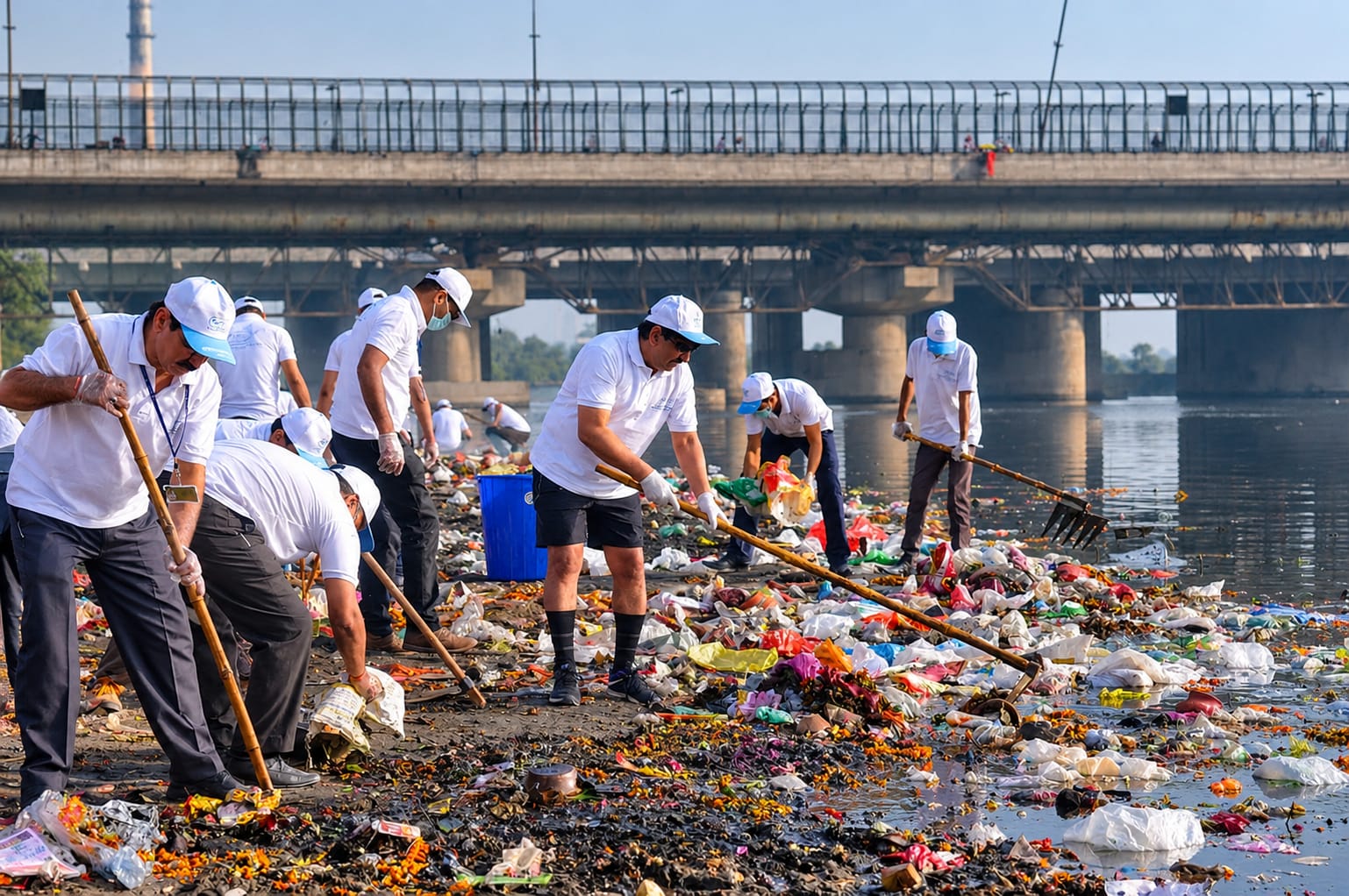
The Yamuna, one of India’s most important river systems, has become a stark example of this contradiction. Despite decades of cleaning programmes, substantial public expenditure and repeated judicial interventions, the river continues to receive untreated wastewater from cities, drains and industrial establishments.
Now, the Supreme Court of India has proposed a mechanism that could fundamentally change how responsibility for river pollution is determined. States, Union Territories and even individual districts could face financial penalties if the quality of the river deteriorates within their respective jurisdictions.
In an order dated November 4, 2026, in New Okhla Industrial Development Authority v. State of Uttar Pradesh and Others, a Bench comprising Justice Manoj Misra and Justice Manmohan directed that authorities responsible for worsening the Yamuna‘s water quality must be held accountable. The order places the Central Pollution Control Board (CPCB) at the centre of a proposed monitoring and assessment mechanism, directing it to formulate a method for calculating environmental compensation.
The direction marks an important development in the ongoing judicial scrutiny of the Yamuna’s condition. More importantly, it challenges the practice of treating river pollution as an isolated administrative problem rather than a shared responsibility across an entire river basin.
When India ‘s administrative boundaries become excuses
The Court’s intervention follows its examination of a comprehensive Yamuna Action Plan prepared by a committee headed by the Union Home Secretary. The plan was presented before the Bench on October 7, following earlier proceedings and deliberations involving the authorities responsible for the river’s restoration.
The proposed action plan includes the construction of 125 new sewage treatment plants (STPs), 12 Common Effluent Treatment Plants (CETPs), 10 municipal solid waste processing plants and 23 biogas plants. It also proposes upgrading 20 existing sewage treatment plants to improve their treatment capacity and compliance with prescribed discharge standards.
The plan identifies domestic sewage as the single largest source of pollution entering the Yamuna. However, the Bench questioned whether expanding infrastructure alone would be sufficient to address the problem.
One of the Court’s concerns related to the 520 drains discharging wastewater into the river. It observed that the Yamuna‘s deteriorating condition reflected broader failures in the civic administration of towns, cities and villages along its banks. Despite substantial expenditure on river-cleaning programmes, pollution levels had continued to rise.
The Court also identified discrepancies in the action plan concerning encroachments on water bodies and wetlands in Delhi’s designated Zone ‘O’. While the plan suggested that these areas were free from encroachments, an annexure prepared by the Delhi government marked all 35 water bodies and wetlands in the zone as encroached upon.
The Bench further pointed out inconsistencies in the assessment of sewage treatment plants. Although the plan suggested that 28 of Delhi’s 37 existing STPs met certain prescribed standards, the CPCB’s assessment indicated that none met all the required parameters, with only five meeting the bacteriological limit.
These discrepancies raised questions not merely about the availability of infrastructure but also about its actual performance and the accuracy of official reporting.
How will the penalties work?
The most consequential aspect of the November 4 order concerns the proposed financial accountability mechanism.
The Supreme Court has directed the CPCB to provide water-quality data at points where the Yamuna and major drains entering it cross the boundaries of different states, Union Territories and districts. The assessment will cover parameters such as Biochemical Oxygen Demand (BOD), Chemical Oxygen Demand (COD), Faecal Coliform and Total Suspended Solids (TSS).
These measurements help establish the extent of organic pollution, sewage contamination and suspended pollutants in water.
Under the proposed mechanism, if water quality deteriorates on any of these parameters while passing through or exiting a particular state, Union Territory or district, the concerned administration will be held accountable and penalised.
The financial compensation will be deposited with the Registry of the Supreme Court. However, the amount will depend on a formula that the CPCB has been directed to submit.
The order also provides that states and Union Territories may recover the penalties from polluters and officials found negligent in performing their duties, following an appropriate inquiry.
This distinction is important. The proposed mechanism is not simply about imposing fines on governments. It seeks to establish responsibility through measurable changes in water quality and subsequently identify the polluters or officials whose actions or negligence contributed to the deterioration.
The Court has also suggested that water samples collected simultaneously at different monitoring points could be independently analysed by institutions such as the Indian Institutes of Technology to ensure that the findings are scientifically verified.
Monitoring beyond paperwork
Alongside the proposed penalties, the Supreme Court has issued several directions intended to strengthen the monitoring of existing pollution-control infrastructure.
Every sewage treatment plant, common effluent treatment plant and government-commissioned biogas plant must install tamper-proof smart energy meters within one month.
STPs and CETPs must additionally install inlet and outlet meters equipped with continuous sensors to record wastewater discharge and parameters including pH, BOD, COD, TSS and ammoniacal nitrogen. Faecal Coliform levels must be tested weekly through accredited laboratories.
The data generated through these systems must be shared with the CPCB through digital integration, allowing centralised monitoring.
The Court has further directed the CPCB to arrange unannounced inspections of every STP with a capacity of five million litres per day or more, as well as CETPs, at least once every quarter. These inspections will be conducted through IITs, NITs or accredited third-party laboratories.
Their findings must be published within 30 days, and environmental compensation must be recovered from operators for every day of non-compliance.
Another important direction concerns incidents such as fish deaths, the appearance of white foam, algal blooms and sudden increases in pollution levels. The CPCB has been asked to investigate such incidents and submit detailed reports identifying their causes and recommending remedial measures.
The Court has also directed urban local bodies to register septage tankers and equip them with GPS tracking systems to monitor the collection and disposal of waste.
To improve administrative coordination, Chief Secretaries of the Yamuna basin states and Union Territories, along with the concerned Central Ministries, have been directed to nominate senior nodal officers of at least Special Secretary rank within two weeks.
The officers responsible for individual treatment plants and major drains must be identified on a public portal and submit monthly compliance affidavits before the Court.
The matter has been listed for its next hearing on January 13, 2027.
The human cost of a polluted river
Beyond the technical parameters, monitoring systems and proposed financial penalties lies a crisis that directly affects communities dependent on rivers.
For millions of people, rivers are sources of drinking water, irrigation, fishing, transportation and everyday economic activity. Their deterioration affects farmers who depend on river systems for cultivation, fishing communities whose livelihoods depend on aquatic ecosystems, and households exposed to contaminated water sources.
The consequences are not distributed equally. Communities with limited access to alternative water supplies and sanitation infrastructure often bear a greater burden of environmental degradation.
The Yamuna’s pollution is particularly visible in Delhi, where untreated sewage and industrial discharge have contributed to the river’s deteriorating condition. The appearance of thick white foam, particularly around the Kalindi Kunj stretch, has repeatedly drawn public attention to the extent of contamination.
Such incidents are not merely visual manifestations of pollution. They also raise questions about the quality of water entering an already stressed urban river system.
The issue exposes a larger contradiction in India’s environmental governance. While river rejuvenation programmes have expanded across the country, their effectiveness depends on functioning local sewage systems, industrial compliance, municipal waste management and regular monitoring.
A treatment plant that exists on paper but fails to operate effectively cannot protect a river. Similarly, constructing new infrastructure without addressing the drains carrying untreated waste into the river risks repeating the same cycle.
From responsibility to accountability
The Supreme Court’s November 4 intervention attempts to move the discussion from general commitments towards measurable administrative responsibility. Its emphasis on treating the Yamuna as a continuous ecological system recognises that pollution generated in one jurisdiction can affect communities and ecosystems downstream.
The Bench has also acknowledged that it is not a city-planning authority or an expert technical body. The responsibility for preparing and implementing an effective restoration plan remains with the administrators. The Court’s stated approach is to give civic authorities the flexibility to discharge their responsibilities while holding them accountable if they fail to achieve results.
However, the success of this mechanism will depend on how accurately water quality is monitored, how transparently the data is published and whether authorities can identify the sources of pollution rather than merely transfer financial liability between administrations.
The Yamuna is not India’s only river facing these challenges. The Ganga, Musi, Sabarmati and several other river systems have also experienced persistent pollution pressures, making the question of intergovernmental coordination and environmental accountability relevant far beyond the immediate proceedings.
The Supreme Court’s directions may establish an important framework for holding authorities responsible for the deterioration of a shared river. But penalties alone cannot restore an ecosystem. That requires functioning sewage infrastructure, stricter industrial regulation, protection of floodplains, effective municipal administration and sustained public oversight.
For years, the central question surrounding India’s polluted rivers has been how much money must be spent to clean them. The Court’s latest intervention introduces another, equally important question: who should pay when a river becomes dirtier under their watch?
A river may flow across states, districts and cities, but its destruction is rarely confined to the jurisdiction where the pollution originates. If accountability is to mean anything, it must follow the river too.