The recent debate around Nehru’s understanding of Indian nationalism has brought back into focus Perry Anderson’s provocative examination of the Congress leadership, Partition and the ideological foundations of the Indian Republic.
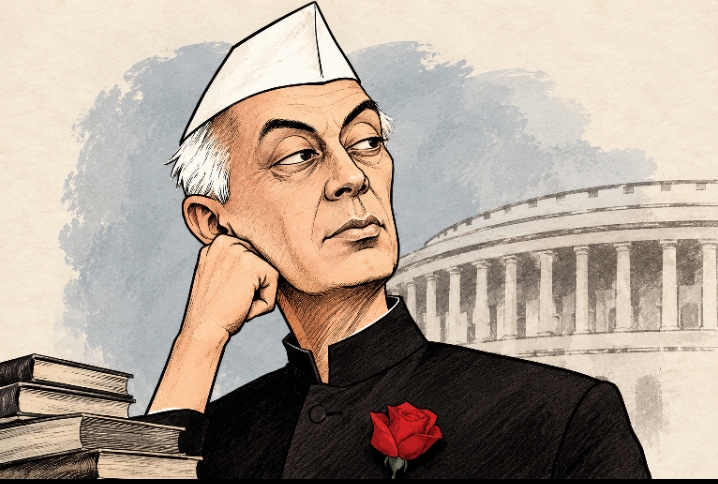
Jawaharlal Nehru has occupied a privileged position in India’s political and intellectual imagination. To generations of Indians, he has represented the promise of a secular, democratic and modern republic. His commitment to parliamentary democracy, scientific institutions, industrialisation and non-alignment helped establish the foundations of independent India’s political identity. Even his critics have often acknowledged the historical significance of his leadership.
Yet, the legacy of Nehru has never been beyond criticism. The questions surrounding his understanding of Indian nationalism, his relationship with the Muslim League, the politics of Partition and the centralisation of the Indian state have periodically challenged the celebratory narrative surrounding the country’s first Prime Minister.
A recent interview with Sharjeel Imam has brought some of these questions back into public discussion. In an extended conversation with The Quint, Imam challenged what he described as the secular-nationalist understanding of Indian history, arguing that Nehru’s The Discovery of India was an exercise in constructing the myth of an ancient and historically unified Indian nation.
Interestingly, Imam explicitly invoked the work of British Marxist historian Perry Anderson, particularly his book The Indian Ideology, suggesting that readers revisit its critique of Gandhi, Nehru and the Congress leadership.
This is an important reference. Anderson’s intervention, published in 2012, was among the more provocative attempts to question the established intellectual consensus surrounding the making of modern India. His argument was not simply that Nehru made political mistakes or that Congress failed to anticipate the consequences of Partition. He sought to interrogate the very historical narrative through which the Indian Republic had come to understand its own origins.
Anderson was, in several respects, considerably more unsparing than conventional critics of Nehru. His criticism extended beyond individual decisions to the political assumptions, institutional arrangements and historical representations that shaped the postcolonial Indian state.
Anderson’s book is organised around three broad questions: the role of Gandhi in the national movement, the political circumstances leading to Partition, and the character of the Indian Republic after independence. Nehru figures prominently in all three. The 2021 expanded edition also includes Anderson’s responses to his critics and an assessment of India under Narendra Modi.
His starting point is a rejection of the idea that India has existed as a unified nation for thousands of years. Anderson argues that the modern Indian nation-state was a historical and political construction, and that its claims to ancient civilisational unity have often obscured the conflicts and negotiations through which the subcontinent’s political arrangements evolved.
This is where his reading of Nehru becomes particularly interesting.
Nehru’s Historical Imagination and the Idea of India
In The Discovery of India, written during his imprisonment in the 1940s, Nehru presented India as a civilisation whose underlying unity had survived successive invasions, political upheavals and cultural transformations. The book was an attempt to recover a sense of national belonging at a time when the freedom movement was confronting the possibility of Partition. Its intellectual ambition was considerable: to construct a common historical imagination for a country divided by religion, caste, language and region.
Anderson, however, was sceptical of this historical project. He questioned whether the search for an ancient Indian unity had resulted in a selective reading of history, one that tended to subordinate competing political identities to a larger national narrative.
For Anderson, this was not an innocent intellectual exercise. The construction of a unified national identity had political consequences. It made it easier for Congress to claim that it represented the entire population, while treating demands for constitutional safeguards and political power-sharing as obstacles to national unity.
The question was particularly consequential for Muslims.
Congress, the Muslim League and the Politics of Partition
Anderson’s most controversial argument concerns the responsibility for Partition. Against the dominant nationalist narrative, which places much of the blame on British imperial policy and the Muslim League’s separatism, he assigns primary responsibility to Congress. He argues that Congress’s refusal to accept an arrangement that would have accommodated substantial provincial autonomy and Muslim political representation contributed decisively to the collapse of negotiations.
The Cabinet Mission Plan of 1946 occupies an important place in this argument. The proposal envisaged a united India with a relatively weak central government and substantial autonomy for provincial groupings. It offered a possible constitutional arrangement through which the Congress and Muslim League might have remained within a common political framework.
Anderson argues that Congress’s resistance to the constraints this arrangement would have placed on the central government, particularly after Nehru’s statements in July 1946, helped undermine the possibility of an agreement.
This interpretation is important because it challenges the retrospective presentation of Partition as an almost inevitable consequence of Muslim separatism. It asks whether a different constitutional settlement was possible and whether Congress’s commitment to a strong centralised state contributed to the eventual division of the country.
The argument is also significant in light of Maulana Abul Kalam Azad’s India Wins Freedom. Azad, who remained committed to a united India, was deeply critical of the Congress leadership’s handling of the final negotiations. He particularly blamed Nehru’s statements on the Cabinet Mission Plan for damaging the prospects of an agreement.
Sharjeel Imam draws on this historical tradition in his recent intervention. His argument is that the political demands of Muslims in colonial India cannot be adequately understood through the conventional narrative of nationalism and separatism. He places considerable emphasis on the history of negotiations, constitutional safeguards and the demand for decentralised political arrangements.
There is, however, a distinction worth maintaining. Anderson’s argument is a historical indictment of the Congress leadership and the political choices that shaped Partition. Imam takes this further into a contemporary argument about Muslim political agency, community rights and the legitimacy of the postcolonial constitutional arrangement. They overlap on certain historical questions, but their political projects are not identical.
Nehru and the Contradictions of the Indian Republic
Anderson’s criticism of Nehru does not end with Partition.
In the section dealing with the Republic, he examines the contradictions between Nehru’s democratic reputation and the actual exercise of state power. His discussion of Kashmir is particularly severe. He questions the Indian state’s claim to democratic legitimacy in the territory, examining the history of political intervention, the erosion of representative institutions and the coercive measures used to maintain control.
For Anderson, Kashmir exposed the limits of the secular-nationalist argument that India’s territorial unity and democratic character were mutually reinforcing. The treatment of Kashmir raised uncomfortable questions about whether the state’s commitment to democracy extended to people whose political aspirations challenged its preferred understanding of national integration.
He also examines the dismissal of the elected Communist government in Kerala in 1959. The episode demonstrated that the Congress leadership’s commitment to parliamentary democracy could become conditional when electoral outcomes threatened its political interests. The intervention was particularly damaging to Nehru’s reputation as a liberal democrat because it exposed the gap between democratic principles and the exercise of executive authority.
These are serious charges, and they deserve to be examined on their historical merits. Nehru’s supporters would rightly point out that the challenges confronting the newly independent country were extraordinary. Partition had displaced millions, princely states had to be integrated, and the Republic was attempting to establish democratic institutions in a deeply unequal society. The circumstances cannot be separated from the decisions made by its first leadership.
But historical circumstances cannot become a permanent defence against historical scrutiny.
Colonial Continuities and the Question of Caste
Anderson’s broader argument is that the Indian Republic inherited important continuities from colonial rule. Its administrative machinery, centralising tendencies and coercive institutions were not entirely transformed by independence. The transfer of political power from the British to the Congress leadership did not automatically produce a rupture with the structures through which colonial authority had been exercised.
This is an important intervention in the debate on Nehru because it challenges the tendency to treat independence as a clean historical break. It asks whether the political and administrative foundations of the new Republic were more continuous with colonial governance than the official narrative would suggest.
Another dimension of Anderson’s argument concerns caste. He questions the assumption that the survival of electoral democracy necessarily represents the overcoming of social hierarchy. Indian democracy, in his reading, has coexisted with entrenched caste inequalities and the political dominance of upper-caste elites. The formal equality promised by the Constitution has not necessarily translated into an equal distribution of political and social power.
This is particularly relevant to the question of representation. Who speaks for India? Who gets to define the national interest? And whose demands are treated as legitimate expressions of political identity?
These questions connect Anderson’s critique of Congress nationalism with his examination of the postcolonial state.
The Limits of Anderson’s Critique
There is, of course, a case to be made against Anderson himself. His work has attracted substantial criticism from Indian historians and political thinkers. Some have questioned his familiarity with the complexities of Indian society, while others have argued that his polemical style leads him to understate the achievements of the freedom movement and the difficult circumstances under which the Republic was established.
His account of Partition has also been contested. Assigning primary responsibility to Congress risks underestimating the agency of the Muslim League, the British government’s role and the communal violence that had transformed the political environment by 1946. The failure of the Cabinet Mission negotiations cannot be explained through the actions of one political leadership alone.
Anderson’s tendency to make sweeping judgments about Gandhi and Nehru has also invited criticism. Political history involves more than identifying the shortcomings of prominent leaders. It requires examining competing interests, institutional constraints and the choices available at particular historical moments.
Nevertheless, these criticisms do not diminish the importance of the questions he raises.
Reopening the Debate on Nehru and Nationalism
Indeed, what makes The Indian Ideology particularly relevant today is that the debate over Nehru is no longer confined to the familiar confrontation between the Congress and the Hindu right. A more fundamental interrogation of the nationalist consensus has emerged, including from sections of the Muslim intellectual and political landscape.
Sharjeel Imam’s recent intervention is one manifestation of this development. His criticism of Nehru’s historical imagination, his invocation of Iqbal and Azad, and his emphasis on constitutional negotiations have reopened questions that the mainstream nationalist discourse has often treated as settled.
There is a danger, however, in allowing the current political climate to turn historical reassessment into an exercise in replacing one set of unquestionable heroes with another. Neither Nehru nor Jinnah, Gandhi nor Iqbal, should be exempt from critical examination. Their political ideas, decisions and historical consequences must be studied in their full complexity.
Nor should criticism of Nehru become an indirect justification of the majoritarian politics that has sought to dismantle the secular and constitutional protections of the Republic. The failures of Congress secularism, where they existed, cannot be used to establish the legitimacy of Hindutva nationalism. Equally, defending constitutional secularism should not require an uncritical defence of the Congress’s historical record.
This distinction is essential.
Nehru’s contributions to India’s democratic institutions, scientific development, higher education and international standing remain historically significant. His commitment to a secular constitutional order distinguished his political project from the religious nationalism that would later become increasingly influential. But recognising these contributions should not prevent an examination of the exclusions and contradictions within his understanding of nationalism.
Perhaps the most important contribution of Anderson’s work is that it shifts the discussion away from the moral reputation of individual leaders towards the political foundations of the Indian Republic.
Was the idea of a unified Indian nation historically inevitable? Did Congress adequately accommodate the political aspirations of Muslims and other marginalised communities? Could the Cabinet Mission Plan have offered an alternative constitutional future? And did the postcolonial Republic transform the structures of colonial power as decisively as its founding narrative suggests?
These are not questions that can be answered through political nostalgia or ideological hostility.
Sharjeel Imam’s reference to Perry Anderson offers an opportunity to revisit a book that challenged the intellectual comfort of India’s established political discourse more than a decade ago. Anderson’s arguments are open to disagreement, and some of his conclusions warrant closer historical examination. But the questions he raised have not lost their relevance.
A mature democracy should be able to examine its founding figures without treating criticism as an act of disloyalty. Nehru’s legacy deserves neither hagiography nor convenient dismissal. It deserves the kind of historical scrutiny that applies to every consequential political leader.
The Idea of India, if it is to remain a meaningful democratic proposition, must be capable of surviving that scrutiny.