Imagine opening WhatsApp and finding a video that appears to show a politician making a controversial statement. Someone in your family has forwarded it, people in a local group are discussing it, and others have already begun sharing their opinions. Although the video looks convincing, nobody knows where it originally came from or whether the politician actually made that statement. By the time anyone verifies the footage, it has already shaped the political conversation by directing attention toward a particular person, creating an impression, and encouraging people to interpret an event in a certain way. This is the growing challenge of digital politics, where fabricated content does not simply circulate as false information but also influences how people understand political events, judge politicians, and form opinions about public issues.
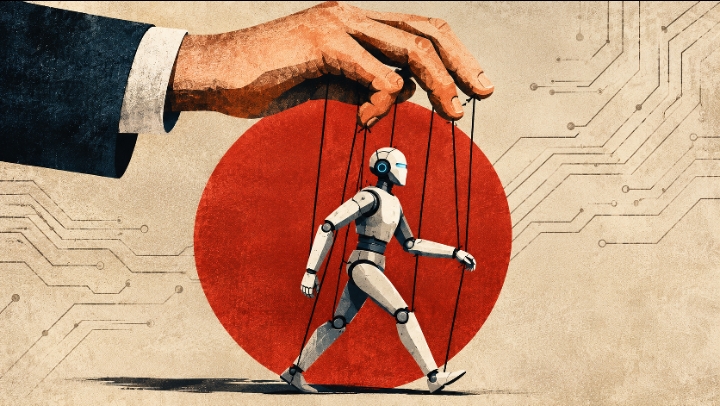
Artificial intelligence (AI) and political narratives are closely connected, although they serve different purposes. While AI provides the technology to create convincing images, videos, and voices, narratives give that content its political meaning and shape how people interpret it. For instance, AI can generate a video of a politician making a speech that never happened, but the narrative determines whether viewers interpret it as evidence of dishonesty, national pride, political strength, or a threat to the country. The same technology is also used to portray political opponents as enemies or present a particular crisis as a struggle for national survival. In this way, AI makes it easier and faster to produce such content, while social media platforms help spread it to much larger audiences. What matters politically, therefore, is not simply what AI creates, but how that content is used to promote particular interpretations of public events.
India’s 2024 general election showed how AI was used to reinforce political narratives. AI-generated deepfake videos falsely showed Bollywood actors Aamir Khan and Ranveer Singh criticizing Prime Minister Narendra Modi over his campaign promises and economic performance before apparently endorsing the Congress party. Both videos ended with the Congress election symbol and the slogan, “Vote for Justice, Vote for Congress.” Reuters confirmed that the videos had been manipulated and reported that they had received more than 500,000 views across social media, although it could not establish who had created them. A Congress spokesperson, Sujata Paul, also shared the video featuring Ranveer Singh on X despite knowing that the platform had labeled it as manipulated media. She told Reuters that she initially believed the person in the video was a look-alike, and the post was later removed. These videos show how AI gave an existing political argument the appearance of celebrity endorsement, making an invented endorsement look genuine. However, their circulation alone does not establish that they changed voters’ political preferences.
AI was also used for a different purpose during the same election. According to Reuters’ reporting on the campaign, the campaign team of Congress candidate Vijay Vasanth created a two-minute AI-generated audio-video featuring his deceased father, former politician H. Vasanthakumar, appealing to voters to support his son. Unlike the fabricated celebrity endorsements, this was an attempt to invoke a political legacy during an election campaign. This distinction matters because AI-generated political content is not automatically misinformation; its purpose and presentation matter, as does whether audiences know that the content was AI-generated. The broader concern, therefore, is not the technology alone, but how it is used and whether people have enough information to distinguish authentic material from fabricated content.
Political Authority and Public Trust
The central issue, however, is how political narratives shape public trust and political authority. Holding public office does not automatically earn a politician the public’s trust, because much also depends on how people view their leadership and authority. When a politician is repeatedly portrayed as decisive, indispensable, and uniquely capable of protecting the nation, people gradually begin to associate political authority with that individual’s personal qualities rather than simply with the office they hold.
Similarly, when the same political ideas are repeated through speeches, television debates, social media posts, and digital campaigns, people gradually begin to accept them as common sense, while competing views struggle to gain public attention. Political narratives, therefore, do not merely describe reality; they also shape how people understand political events, judge public figures, and evaluate the choices before them.
From Misinformation to Public Opinion
BOOM’s 2024 annual report provides useful insight into AI-generated misinformation. According to the report, 108 of the 1,291 fact-checks BOOM published that year involved AI-generated misinformation, including 39 cases involving fabricated images, 41 involving voice clones, and 28 involving deepfake videos and audio recordings. The 2024 Lok Sabha election was the leading subject of misinformation across BOOM’s overall fact-checking sample, while election-related misinformation accounted for 12 of its AI-related fact-checks. These figures reflect BOOM’s fact-checking work rather than the total amount of AI-generated misinformation circulating in India.
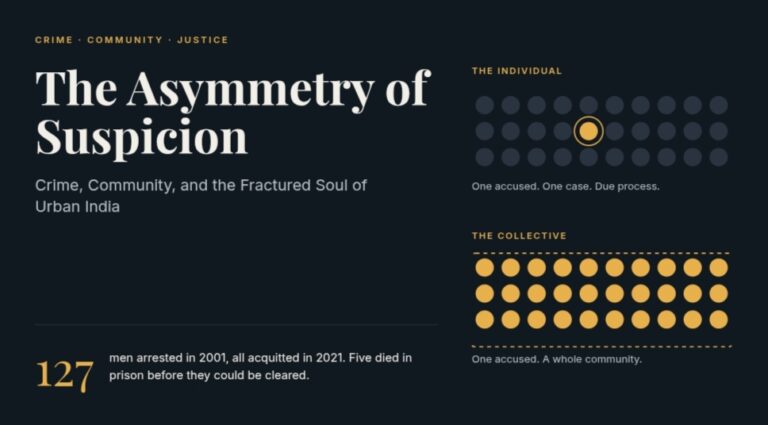
The report also draws attention to the wider social consequences of misinformation. Of BOOM’s 1,291 fact-checks in 2024, 172 involved false or misleading claims targeting the Muslim community. Although this figure covers misinformation in general rather than AI-generated content alone, it highlights how fabricated and misleading claims also affect communities and shape how they are perceived in public discussions.
Recognizing the risks of synthetic political content, the Election Commission of India issued an advisory on October 9, 2025, during the Bihar Assembly election and eight Assembly by-elections, advising political parties against misusing AI tools to create deepfakes that distort information or spread misinformation. It also called for clear labeling of AI-generated and synthetic content used in election campaigns.
Research by Rhys Crilley and Robert A. Saunders, published in Place Branding and Public Diplomacy under the title “The Resonant Slop Machine: Public Diplomacy and Strategic Narratives in the Age of Artificial Intelligence”, examines how AI-generated content and meme culture amplify political narratives. Using Donald Trump’s AI-generated “King Trump” fighter jet video, circulated during the 2025 No Kings protests, the researchers explain how even absurd and provocative content attracts attention and reinforces political messaging. Their analysis highlights how AI-driven political communication challenges the authority of reliable information while making emotionally charged political narratives more visible.
An India-focused study by Enakshi Roy, Kaifia A. Laskar, and Mohammad Reyaz, titled “Retroactive Gatekeepers: Fact-Checkers, Electoral Disinformation, and Audience Engagement in India”, published in Emerging Media in November 2025, examines how fact-checking organizations responded to electoral misinformation during the 2024 general election. Drawing on interviews with fact-checkers from six organizations and observations inside one newsroom, the researchers explain how fact-checkers often intervene after misinformation has already circulated widely. The study also examines how language barriers, platform algorithms, and differences in digital access affect the verification of political content and efforts to reach audiences. Its findings highlight the difficulties of addressing misinformation in a country where political messages circulate across multiple languages and digital platforms.
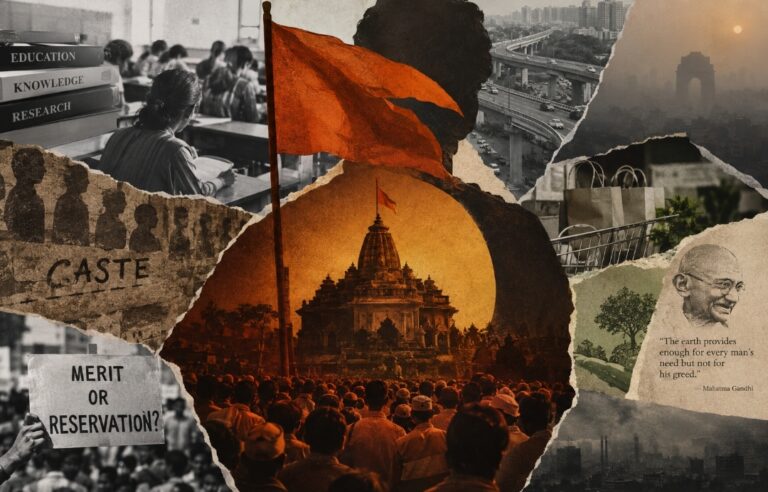
In India, the concern goes beyond individual deepfakes or fabricated political statements, as it also concerns how people form political beliefs in a digital environment where the same ideas are repeated through WhatsApp forwards, Facebook posts, X posts, Instagram Reels, YouTube Shorts, television debates, and content shared by political influencers and campaign networks. Narratives about national leadership, religious identity, caste representation, national security, reservation, unemployment, and economic performance compete to shape public opinion, while AI makes it easier to create fabricated images and voices that appear to support particular political arguments. As people encounter the same claims across different platforms, those claims become part of the broader context in which they understand public events and judge political parties.
For a student discussing politics with classmates, a worker following election updates on a phone, or a voter receiving political videos through family groups, the problem is not simply whether a particular clip is fake. It is also whether the information surrounding that clip helps them understand what actually happened or encourages them to accept a particular political interpretation without examining the facts. When fabricated content enters everyday conversations, people must distinguish between genuine events, political claims, and material created to mislead them.
However, individual viewers are not solely responsible for addressing misleading content. Political parties, social media platforms, and institutions responsible for electoral integrity also share this responsibility.
This does not mean that repeated exposure automatically changes voters’ political preferences or that every political narrative is based on misinformation. The deeper concern is that people increasingly encounter political issues through emotionally charged messages, making it harder to distinguish documented events from political claims and fabricated content. When a politician’s image becomes more important than an examination of government policies, opponents are presented as threats to the nation, and emotional reactions take precedence over factual scrutiny, public debate and political accountability suffer. The problem, therefore, is not simply the circulation of false information, but the growing power of political narratives to shape how people interpret information in the first place.
EVMs count votes, but they do not capture the political narratives that shape voters’ choices before they enter the polling booth. Which political narrative has a voter come to accept? Whom have they been encouraged to fear? Whose authority do they recognize, and which political claims do they accept without question? Understanding Indian electoral politics now requires looking beyond political institutions and campaign strategies to examine how digital platforms shape public opinion and how people view political authority. The next major political battle will not be fought only over votes; it will also be about who shapes political narratives, which version of events people accept, and whether they have access to reliable information and the ability to distinguish between what actually happened and what they are being encouraged to believe.