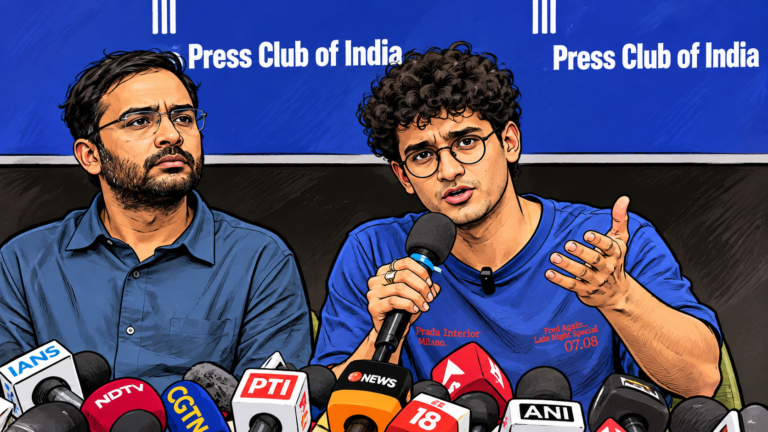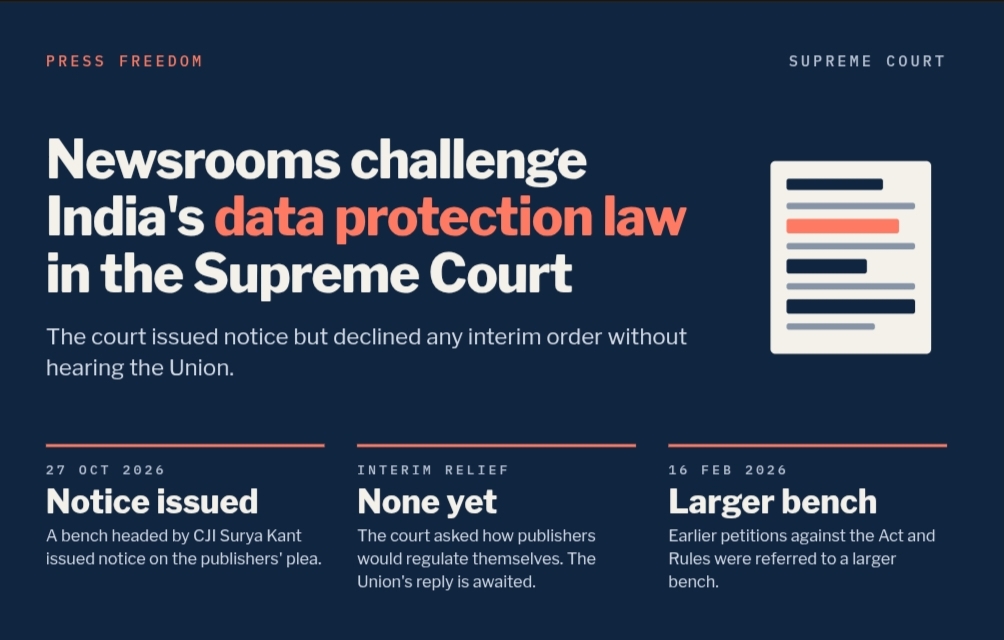
The Supreme Court on Tuesday issued notice on a petition by the Digital News Publishers Association (DNPA), which argues that India’s data protection law and its rules violate press freedom. The court gave no interim relief and said it would not pass an order without hearing the government.
The petition challenges provisions of the Digital Personal Data Protection (DPDP) Act, 2023, and the DPDP Rules, 2025. It was heard by a bench headed by Chief Justice of India Surya Kant. Senior Advocate Madhavi Divan appeared for the association.
What the publishers argued
Divan asked the court to stay the challenged provisions. She told the bench that newsrooms would have to shut down if they were required to seek the permission of the people they report on before reporting on them. She also submitted that digital news publishers are already regulated.
The Chief Justice responded that the court would never pass an ex parte order. He asked the publishers to explain how they would regulate themselves. The Union’s reply to the petition is awaited.
What the law requires
The DPDP Act regulates the processing of digital personal data and generally requires a lawful basis, usually consent. The publishers contend that applying this framework to news gathering cuts into the freedom of the press protected by Article 19(1)(a) of the Constitution. The court has not ruled on either side’s position.
An earlier challenge is already before the court
The publishers are not the first to approach the court. On 16 February, a bench of the Chief Justice and Justices Joymalya Bagchi and Vipul M. Pancholi issued notice on earlier petitions, including those of RTI activist Venkatesh Nayak, journalist Nitin Sethi and the Reporters’ Collective. It declined to stay the Act, saying it would not put in place through an interim order a regime enacted by Parliament, and referred the matter to a larger bench.
Those petitions target Section 44(3) of the Act, which amends Section 8(1)(j) of the Right to Information Act. They also challenge Section 36 and Rule 23, which allow the Central Government to call for information from data fiduciaries, and question the structure and independence of the Data Protection Board. It is not yet known whether the publishers’ petition will be heard together with that batch.
Why it matters
The petition brings media organisations into the challenge for the first time. Their daily work involves personal information about public and private persons. The Chief Justice’s question on self-regulation suggests that any interim protection would depend on the accountability framework publishers can show.
What remains unanswered
The Union government has not yet filed its response. The case number and the other members of the bench were not reported. Whether the publishers’ plea will be tagged with the earlier batch before a larger bench, and what self-regulation framework the court will accept, are still to be decided.