Even as Delhi has been a hotbed for India’s politics for the past three months, political parties begin blowing horn over 2027Assembly elections. With every indication that Uttar Pradesh, the most populous most populus and electorally potent state, with 80 Lok Saha seats, will go to pools early in 2027, both the Opposition and the BJP is likely to test their grounds on a realigned electoral roll and political narrative.
Eroding from its 71 in 2014 and 62 in 2019, to only 33 seats in 2024,BJPfaced itsgravest setback in UP 2024 General Elections, resulting in PM Modi’s first term reliant on NDA’s support. 2027 state elections will also be the first time that states go into election in the post-CJP parading which has visibly put the BJP narrative and organisational machinery on the backfoot.
The graduate and teachers’ constituency seats in UP’s Legislative Council dealt a blow to the Bharatiya Janata Party. The BJP losing both the Teachers’ and Graduates’ seat from PM Modi’s own Lok Sabha seatin Varanasi, while retaining the Gorakhpur-Faizabad Teachers’ constituency by a slim margin of 300 votes. While MLC elections typically favour the ruling party, SP won 5 out of the 11 seats contested, with BJP winning 6.
SP Chief Akhilesh Yadav called it the “double-defeat of double-engine government.”
Aside from the anti-incumbency that sets in when a CM contests third election and UP’s prior electoral history of rotating parties every election, till Yogi and BJP bucked the trend in 2022, UP Legislative Assembly elections pose challenges to both the Opposition and BJP in the state.
The Fragmented O-position
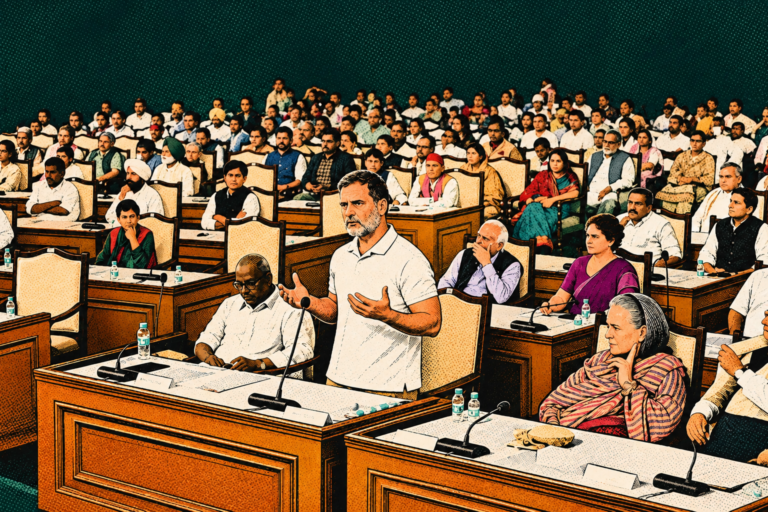
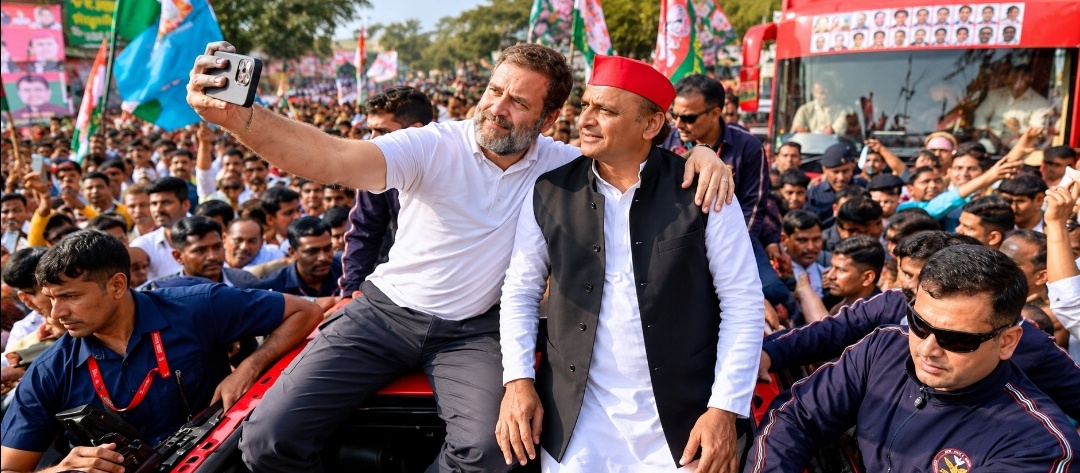
Akhilesh’sapparent decision not to contest the elections himself would instead free him to campaign in all 403 seats drew the UP BJP to christen him as “Ranchhod Akhilesh;”the underlying thrust of the announcement claimed his intent to field 403, signalling no seat sharing agreement or pre-pool alliance with RaGa’s INC. This is in stark contrast to the “Vote Chori” (“vote theft”) ampaign launched by the INDIA Bloc less than a week ago; where both RaGa and Akhilesh were seen together, with INC and SP cadre making the lion’s share of the “Delhi Chalo” crowd.
While SP may have been willing to share seats with INC in 2024,when it needed to consolidate its PDA vote bank; INC’s vote share has steadily declined from 7in 2017 to as little as 2 percent in 2022 UP Legislative Assembly elections; even as it kept stronger in General Elections, garnering 8 in 2014, 6 in 2019 and 10 percent in 2024. The disjuncture is natural as the INC has failed to substantially dent into state politics of UP, limited to being the junior partner to BJP’s primary opposition. Akhilesh has been at the forefront of opposition to CM Yogi Adityanath in UP, and has always been positioned as the CM candidate of opposition alliances in UP, even during the “UP ke chore” alliance in 2017 with the INC.
As the BJP has been effectively able to consolidate about 40 percent of the electorate, adding anti-BJP voters to the SP’s fold is crucial to overcoming the Sangh’s organizational activism, narrative hold and electoral machinery of the BJP. Even if the vote share of the INC is low and anti-BJP voters may be pushed to vote for the SP as a more credible choice in UP, SP’s individual best till date has been 34 percent in 2024 in the post-Modi era. To overcome the hurdle, not only does the SP need to break into the BSP’s Bahujan coalition but also consolidate all anti-BJP votes into a single fold.
Prof. Satish K. Jha, a political scientist at the University of Delhi, told Karvaan India that the Opposition’s electoral prospects depend on shifting caste-based voting patterns. He observed,“The Opposition Party’s prospects depend on how much Congress succeeds in denting the BJP’s upper-caste Brahmin vote and on Dalit votes breaking away from Mayawati and shifting to the SP.”
Prof. Jha added caution in same breath. “All these factors will make a difference only if Akhilesh retains his PDF votes, as in the 2024 parliamentary election.”
Akhilesh may also be treating his intent to filed candidates on all seats to bargain for higher number of SP candidates as against INC. However, a delayed pre-pool alliance is less likely to trickle down partnership to the respective party cadres, reflecting in cadre morale before elections. Moreover, the recent mobilization by INC in UP has also shown how Rahul Gandhi’s stature has risen amongst voters, especially the youth. Even in its most minimum impact, separate candidates can dull SP’s chances, especially in the more closely contested seats in Awadh and Purvanchal. It remains to be seen if the risk is work taking for Akilesh.
The BSP has drawn a nil in 2014 and 2024, only managing 10 seats of the 38 it contested, when in alliance with SP in 2019. With an ageing Mayawati, lack of clear second line of leadership beyond dynastic succession, the Bahujan coalition collapsed with a decline in its essential activism. The vacuum it left in Dalit activist politics has been recentred around Chandrashekar Azad’s Bhim Army, which emerged as a grassroots alternative to the BSP. SP’s pitch to fight alone may overlook the substantial base that Azad has built amongst Dalits and BSP’s continued resonance within the Bahujan coalition.
The Dis-position’s Fragmented Coalition
Amit Shah’s recentpromise to the implementation UCC in UP if the BJP return to power is as a means for Hindu voter consolidation across caste lines.Political commentators on UP, particularly,Sudha Pai have observed the BJP’s mobilization of its traditional upper-caste voter base via Hindutva, while combining non-Brahminical Hindutva with political marginalization of non-Yadav OBCs and non-Jatav Dalits under the SP and BSP respectively, building a cross-caste coalition.
This coalition reached its zenith in the 2019 Lok Sabha elections where the BJP almost pooled in a 50 percent vote share. Uniform Civil Code is an attempt to dislodge electoral discourse from caste-based representation towards religious homogeneity. Focus on kamandalpolitics over the mandal divisions also allows the BJP to employ its 80-20 narrative, singling out the SP for its appeasement of Alpsankhyak voters, a significant chick of its Pichhda, Dalit, Alpsankhyak (PDA) coalition.
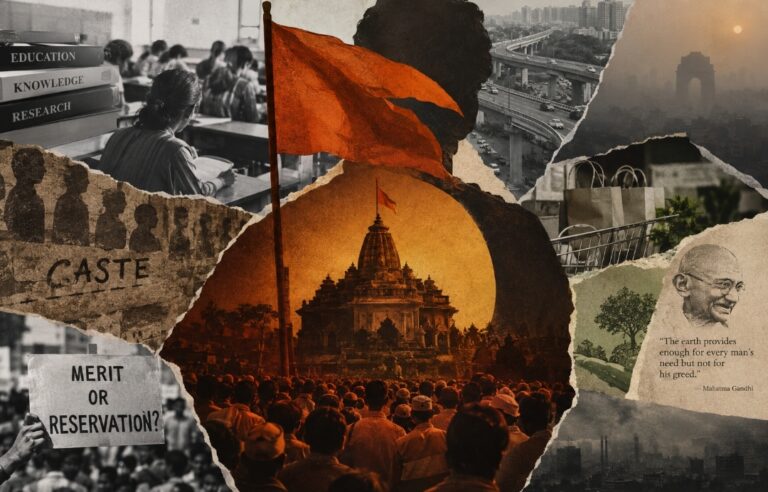
UCC would also be meant to blunt tensions within its Hindu coalition vis-à-vis competing caste demands. Anti-caste protests in Delhi in August 2026 raised demands against the SC/ST (Prevention of Atrocities) Act and the UGC’s 2026 equity regulations. As upper-caste agitation evolved from policy-based agitation to challenged institutional mechanisms including affirmative action for vulnerable sections of society designed to address historical disadvantages.
The urgency to address this brought in UP Deputy CM Brajesh Pathak and former BJP President J.P. Nadda to have subsequent meetings with anti-caste/Savarna protestors to pacify discontent over BJP’s increasingly caste-heterogenous policy agenda. While upper-caste constituents of the BJP coalition have expressed anxieties over the redistributive policies, while non-dominant SCs and OBCs could only be added to the Hindu coalition for BJP’s gravest hurdle in narrative reconciliation of these two juxtaposed positions and walking the tight rope between competing material demands of different caste groups.
Upper-caste discontent could severely hurt BJP’s electoral prospects in UP 2027. Accommodating anti-reservation sentiments into Party manifesto would undermine the caste coalition that underpinned BJP’s electoral substantiation in UP, beyond its “Brahmin-Baniya” voter base, with the Nishad ultimatum, alongside Mukesh Sahni’s mobilisation around “Arakshannahitoh vote nahi” This makes reservation politics a structural challenge to its Mandal-Kamandal strategy, rather than merely an isolated protest.Unresolved Nishad reservation exposes the limitations of BJP’s balancing act. Sanjay Nishad’s (no voter without reservation) would further weaken the BJP in Purvanchal if not addressed adequately. While BJP’sKamandal narrative may seek to embed religious unity, material competition over reservation, state resources and symbolic representation may not be stunted completely.
Polarization & Populism
Lastly, ensions within BJP’s ranks over succession of PM Narendra Modi has also marred the BJP in UP, with speculation about the rivalry between UP CM Yogi Adityanath and HM Anit Shah creating internal stress. This, partially, may have been contained by HM Shah and the UP BJP Chief urging party workers to put aside grievances, focus on unity, and mobilise at the grassroots for electoral success.
As the Opposition builds its vanguard on “vote chori, chandachori,” (“vote theft, temple donation theft”) with voter roll discrepancies in UP like at Pilibhitand allegations of electoral exclusion of PDA voters furthering the case. HM Amit Shah has pushed back with against the Oppositions attempt to entangle the BJP for electoral malpractice with counter-protests like the “loktantrabachao, arajaktahatao” (“save democracy, remove anarchy”). While CM Yogi Adityanath has approached reignited narratives of Pakistani and Bangladeshi nationals being expunged/‘purified’ off India’s electoral rolls, attempting to recast the crisis of legitimacy that the election Commission of India faces, into a matter of national security.
Securitization of the political issues when on backfoot is not atypical to BJP’s playbook. By attempting to recast deleted voters from victims to infiltrators allows the BJP to consolidate Hindu voters over alleged threat to land, resource and political space of the Hindu and anarchy by opposition parties and anti-BJP protests.The BJP’s aggressive deployment of the insider-outsider trope attempts to overcome criticism of SIR, subordinate the material contradictions of Mandal to the ideological consolidation of Kamandal through polarisation, dealing with BJP’s prime problems in the state at a go.
By projecting himself as a decisive administrator, with a recent The News18 survey of 30,925 respondents reinforces this appeal, with 66.2% preferring him as CM and 77.1% expressing satisfaction with his government’s performance.
CM Yogi and the BJP has also built on its Labhartimodel of neo-welfarism, pulling social welfare from the Opposition camp in favour of continuing with its double engine host of door-to-door welfare schemes; creating a strong sense of dependence on government subsidies for daily life. CM Yogi has simultaneously harvested a ‘strong man’ persona on law and order, and for infrastructure growth during his tenure. “Bulldozer Baba,” as he is more popularly monikered, has been the adopted Hindutva-driven governance model across BJP CMs.
Sharat Pradhan, a veteran journalist who has covered UP for nearly five decades, offers an explanation of how CM Yogi and BJPdiscredit the opposition on its selected agenda of law and order, by “…continues[ing] to target the Akhilesh Yadav-led Samajwadi Party as one that has always allowed a free hand to criminals and outlaws.” While “Chief Minister Yogi Adityanath has been thriving on his Rs 2000-crore publicity campaign largely aimed at creating an impression that he has transformed the outlawed state’s law and order.”However, “…his [CM Yogi’s] assertion is the fact try hat even after being in power for nearly ten years he harps on scaring the electorate by what lay in store if Samajwadi Party were to get voted back to power.”
The real task of the Oppositon would be to highlight and convince voters that economic stress including farmers’ distress, inflation, unemployment, etc., which have persisted on, even as the BJP has gone onto win landslide victories in states after states, matter more than religious fervour. However, weak organizational apparatus of opposition parties has limited their success to entangle the BJP on bread-and-butter issues that drive mobilization. Beyond the caste calculus that operates for UP election, it is prudent for opposition parties to drive economic issues.
Offering a broader assessment,Mr. Pradhan, notes that “The ruling BJP is leaving no stone unturned to not only beat its nine-year-long anti-incumbency but is also somehow out to impress upon the electorate about the potential ills of the key adversary Samajwadi Party that is moving heaven and earth to stage a return after a two-term defeat.”