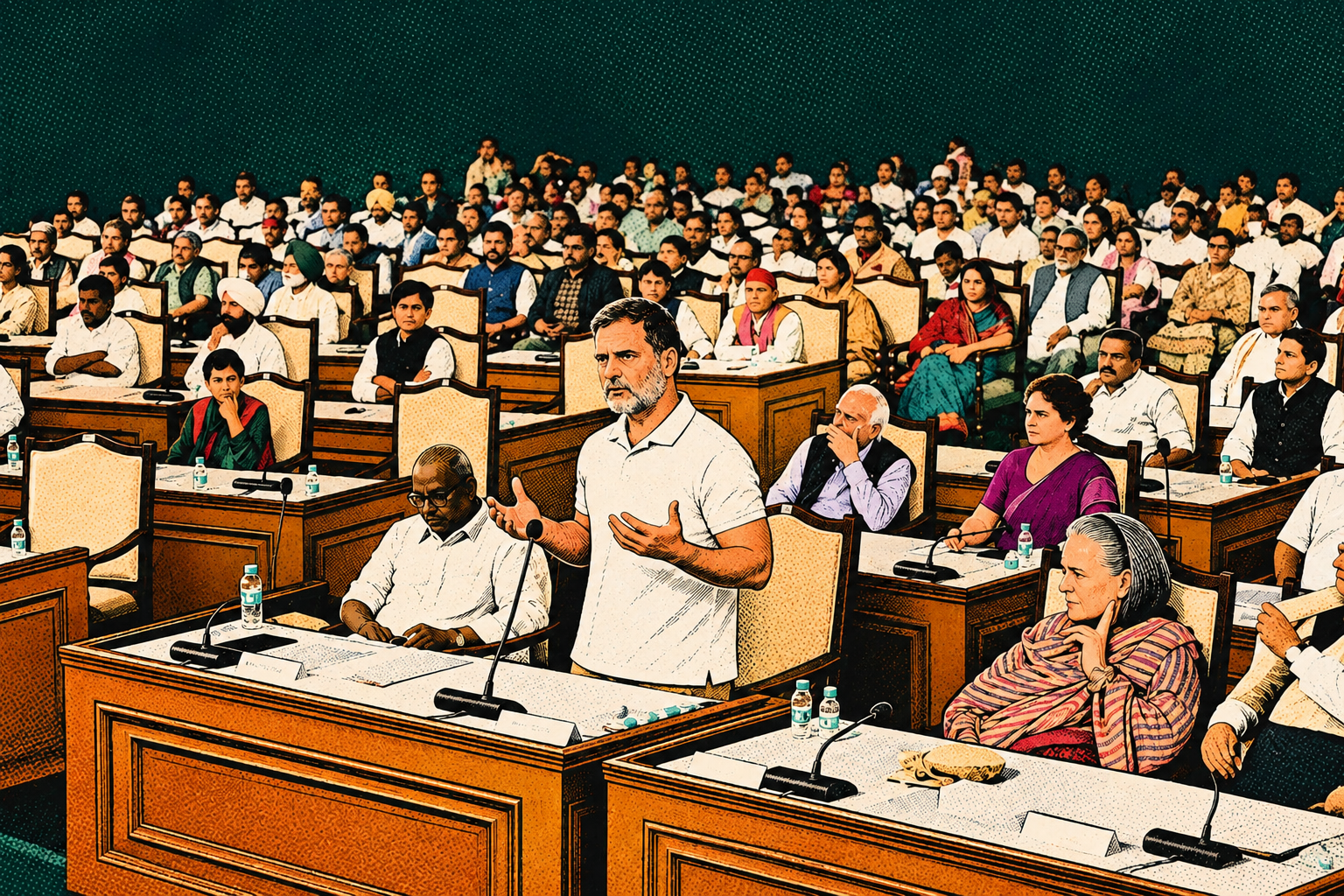
A parliament house-like set presided over by a former Lok Sabha Speaker Meira Kumar, 37 speakers, MPs from 18 opposition parties, civil society activists and deleted voters passed a resolution carrying six charges of “interntional deletion” of 13 crore voters against CEC Gyanesh Kumar. INDIA Bloc’s “public impeachment” of CEC Gyanesh Kumar over “vote chori” on 31 October. The very next day, a massive turnout by supporters of INDIA Bloc parties covering Ram Leela Maidan, carrying banners showcasing the names of all deleted voters under the Special Intensive Review. A show of strength in the thousands strong Delhi Chalo rally at Ram Leela Maidan on 1 November.
As Delhi broke dawn from a politically charged weekend, Jawaharlal Nehru Marg and Minto Road bore graffities on “Vote chor, gaddi chor” (Vote theft, stolen public office), “Rollback SIR;” along with spray painted messages of “Illegal PM,” “Modi must go” and “Ban RSS,” enmeshing the Opposition’s central message delivered to the supporters of the political opposition.
An Institutional Oppositon And Constitutional Resistance
The Ambedkarian Cornicle critiqued the symbolic CEC impeachment proceeding as a “choreographed dissent.” This political self-parody, TAC argued, is where the performance of resistance substitutes enacting the very resistance it seeks to deliver, thereby stifling urgency for political action.
The criticism in itself is begotten out of a normative standard of dissent, and grossly mistakes a lack of confidence in dispensation in control of the India Parliament owing to systematic denied of voice to INDIA Bloc MPs in the Parliament of India through suspensions, adjournments, voice votes bereft of deliberation; and lack of faith in institutions of parliamentary democracy.
The INDIA Bloc, unlike CJP 1.0 is neither a generational movement, nor a spontaneous social movement which is able to create a networked sub-culture and political capital. Resistance by INDIA Bloc must, by definition, reinforce institutional opposition, whether dissent is voiced in the Parliament well or the capital streets.
Theatrical as it may be, the public impeachment reasserted the distinction between the inability of the Opposition to successfully challenge BJP’s agenda, register dissent or impute accountability upon CEC Gyanesh Kumar in Parliament dominated by the NDA; and the willingness of the Opposition to engage through parliamentary mechanism on the same. Effectively blunting BJP’s reiterated fearmongering over “dimagi naxals” (here, intellectual extremists/radicals) for foreign funded attempt to spread anarchy. Whereas the Parliament itself posed an asymmetric limit of the Opposition’s ability to address its agenda; the public impeachment, at its least, allowed the Opposition to blunt charges of anarchy, but also made its commitment to constitutional resistance a political spectacle.
Additionally, through political spectacles the Opposition has also found a means by which to bring attention to itself and its agenda. As the partisanship of India’s establishment media marginalizes dissenting discourses, the Opposition was able to centre media attention to its central issue of “vote chori.”
Ram Leela 2026 Isn’t Ram Leela 1975
While optimism can run high amongst opposition political circles and comparison between the Ram Leela rally during JP Movement 1975 and INDIA Bloc’s Ram Leela Rally has been endemic. The two may seem to bring similar momentum, but they inhabit vastly different political realities.
The JP Movement had only succeeded in defeating India Gandhi following a two-year blot on civil liberties under the National Emergency of 1975-77, and a merger of most major opposition political parties, atop economic stress, including food shortage, mass unemployment, hyperinflation, etc. Even as gross inequality widens and the chasm between the rich and poor increases, the BJP has often bucked macro-economic stress with PM Modi’s brand of religious nationalism, welfare populism and civilizational romanticism in the recent past.
What bears more reasonable criticism is the INDIA Bloc is infamous for lack of consistent mutualism. While INDIA Bloc parties allied against Modi-led BJP for 2024 General Elections, it soon functionally disintegrated post-elections. While INDIA Bloc opposition parties are quick to unite for rallies, divisions quickly arise during elections, with regional parties. As most regional parties are splinters of the INC, led by former INC regional leaders, and dominate amongst erstwhile Congress electorate, regional satraps have been hesitant to accept the leadership of the INC in the INDIA formulation.
While many noticed the exceptional shift was noticeable amongst regional leaders in this regard, as Mamata Banerjee called on “My leader Sonia ji” as a proof of the INC forming the nucleus of the INDIA Bloc. The issue of “vote chori” has been able to unite opposition political parties only as regional leaders have also been compelled by recent threat of splits, including the trifurcated split of the All-India Trinamool Congress in West Bengal, Sarad Pawar’s Nationalist Congress Party in Maharashtra and the twice spit of the Uddhav Thackrey’s Shiv Sena.
A simultaneous rise of INC in India’s opposition space with electoral decline of regional parties weaken electorally, does not indicate any headway into BJP voters or those of its peer opposition. Even as voters look towards or coalesce around the INC, so long as it marks itself out as the principle and most capable opposition to wrest the BJP, the INC’s weak organizational machinery and network of local leaders to its more regionally rooted allies requisites that the INDIA Bloc not only come together to rallies but also translate their combined voter share during elections. BJP’s predetermined advantage of having Sangh Parivar affiliates carry routine activism and its mobilize voters and booth-level machineries for mobilizing voters cannot be challenged otherwise.
Moreover, the INDIA Bloc cannot be a seasonal formation. It requires a structured organization, a shared vocabulary, pool resources, and build consistent and coherent narratives to reach out to voters.
From Single Issue To An Umbrella Opposition
Rohan Pandey at Youth Ki Awaaz asks a crucial question on “vote chori,” “How many people outside its own support base actually believe this is happening?” While “vote chori” can drive out civil society activist, political ideologue, delegated voters and their affected kins, sustained political opposition would require the INDIA Bloc to catch all upcoming which does not find any takes within the ruling BJP’s agenda.
Elections are seldom won on singular issues. Removal of CEC Gyanesh Kumar cannot be the common minimum program of the Opposition but also needs to materially and substantively provide an alternate form of leadership, governance and policy platform. Neither can resistance be merely premised on anti-incumbency or growing public ire. It must mobilize itself towards constructive and alternative outcomes.
The ability of the INDIA Bloc to enmesh a right with bread-and-butter issues is yet to be seen, especially as it retreats from curtail working class issues like the resistance to E20/ethanol.
Sanjay K Jha’s report at The Wire drives how the Ram Leela Maidan rally brough in sympathizers from all across the country with demands stretching from agricultural distress to tribal governance, from social cohesion to economic insecurity. A youth responder to Jha registers his priorities in a list, “Rozgar kha gaye, exam-paper kha gaye […] vote kha gaye” (ate away employment, ate away exam papers […], ate away our vote).
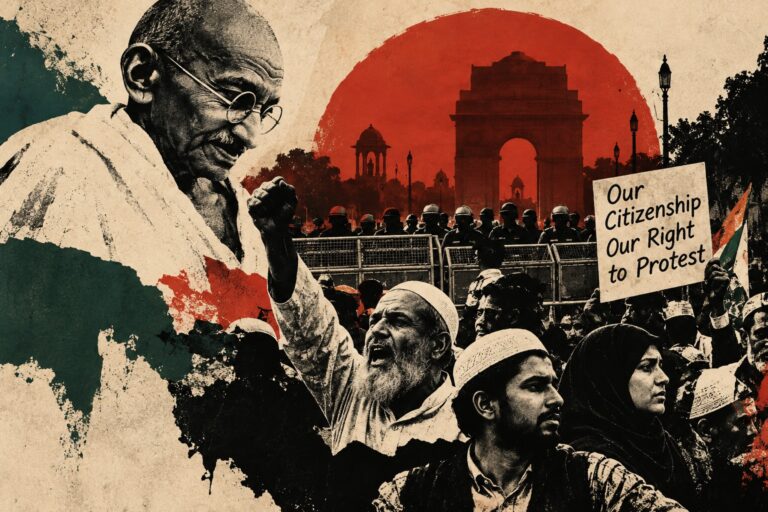
Even as India’s Gen Z and youth attends opposition cries against the dispensation, their participation reflects frustration over the gap between political promises and delivery. Although “vote chori” is a non-negotiable plank for any form of opposition that wishes to compete electorally, as it touches the very essentials of multi-party democracy and free and fair elections itself. Voters are often more responsive to immediate and material issues. Bread and butter issues, like employment, taxes, inflation, cost of living, etc. prevail over the voting right that I or you will only exercise once in 5 years, or the abstractions of civil liberties, democracy or right to protest being under threat.
The INDIA Bloc’s real challenge, therefore, is to transform this emerging convergence of grievances into a coherent political and economic alternative.
The Ram Leela rally demonstrated that dissatisfaction with the ruling dispensation extends beyond electoral integrity, but it also exposed the diversity of expectations that the opposition must accommodate. Farmers seeking affordable inputs, unemployed youth demanding secure livelihoods, workers concerned about rising costs and marginalised communities seeking social dignity may share their discontent, but they do not necessarily share an electoral agenda. This is where the opposition must move beyond reactive mobilisation towards a ‘credible’ common minimum programme.
It must demonstrate how restoring institutional accountability will translate into better governance, economic security and social justice. Without this substantive connection, “vote chori” risks being limited to a slogan rather than becoming a durable political coalition capable of challenging the BJP electorally.
The Opposition can hold public impeachments, but it is the voter who must convict “vote chori.”