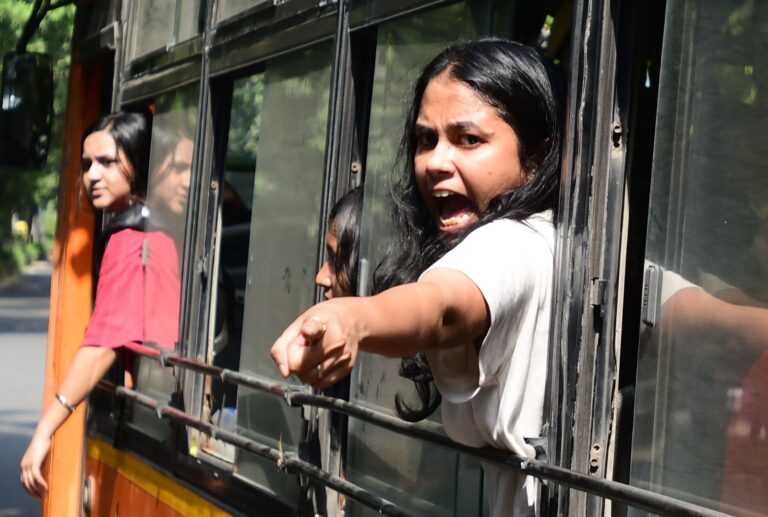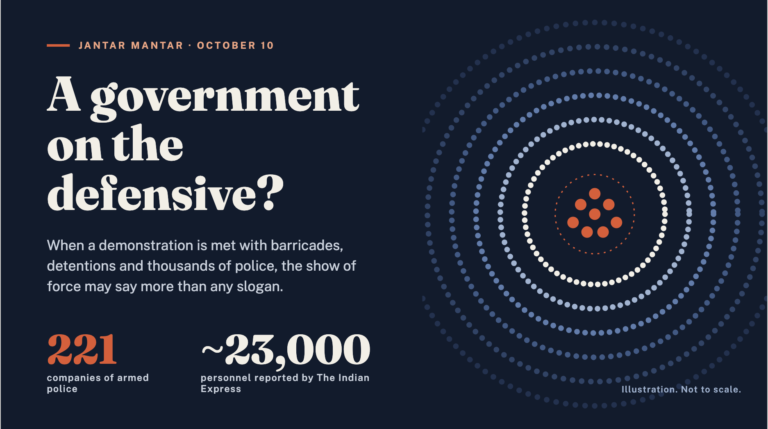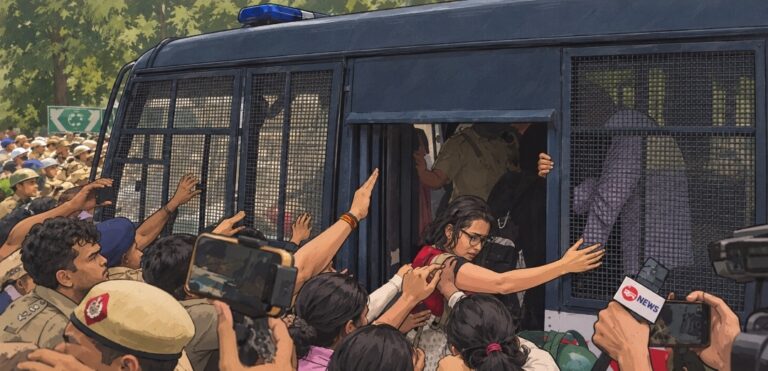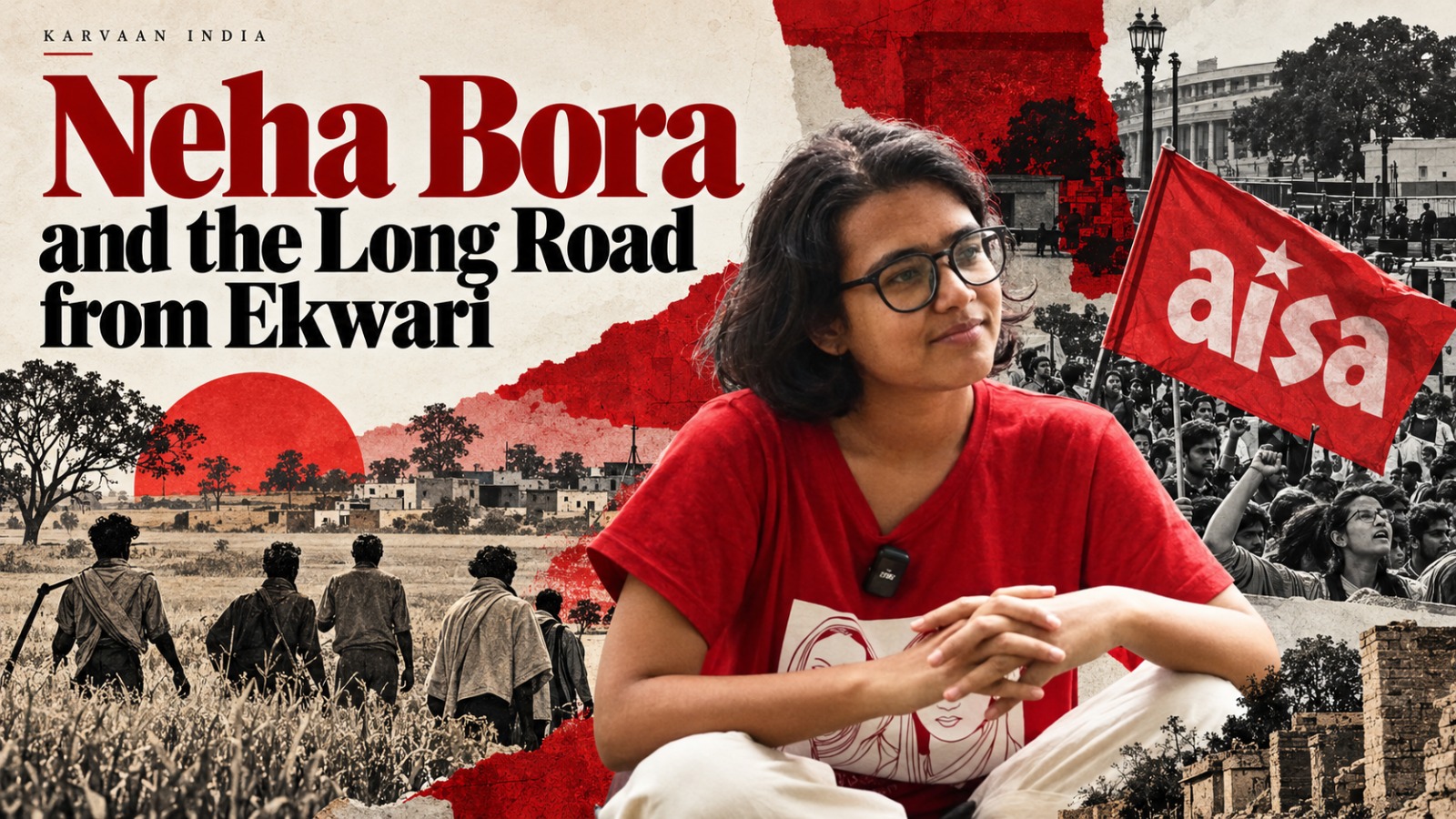
Everyone knows Neha Bora, but what do you know about her association with AISA and CPIML? Most people met her name in the first week of October 2026, when Delhi Police took her from Jantar Mantar in a white car and women protesters climbed onto the vehicle to stop it from moving. She is 29, pursues a PhD, and was released from a police station in Narela some hours later. AISA has said that she emerged without a bag or a phone. The image of the car has travelled furthest. The organisation behind her has a longer story, which begins thirty-five kilometres beyond Arrah, in the village of Ekwari.
Neha Bora’s roots in Ekwari
In the heart of Bhojpur district lies Ekwari, a quiet village where the afternoon sun casts a golden sheen over fields tended by farmers and labourers. Peace has settled there today, though it was once the epicentre of the Naxalite movement in Bihar. Divisions of opinion based on caste and class still run through the village, and almost everyone has a story about the uprising. Elders recount the clashes in detail. Younger villagers, who never witnessed them, speak with an intensity that suggests the tales have been woven into collective memory and into identity itself.
Master Jagdish Mahto and Rameshwar Ahir ignited a mass uprising there. Dalits, backward classes and the landless poor rose against upper-caste feudal lords who had ruled the village for generations. Many of those lords were notorious for abuse, including the sexual exploitation of lower-caste women. Both sides resorted to violence in pursuit of justice or power.
In 1967 landlords beat Mahto brutally while he tried to prevent the rigging of an election for his friend Ram Naresh Ram. Bela Bhatia, a human rights activist and scholar, has argued that the beating ignited resistance and sent Mahto towards the Naxalites in Bengal. He then returned to Ekwari to organise the villagers. She has pointed to a constellation of urgent issues that had long plagued the community. Samman and izzat, dignity and respect, were paramount for the lower castes and the poor. Wages often came in Khesari, a crop that could cause serious health problems. Women suffered social, economic and sexual abuse within that feudal order, and the Naxalite movement offered the marginalised a vehicle to assert their rights.
Memory in Ekwari: two accounts of one uprising
Memory in Ekwari has not settled into a single account. Ranjeet Kumar, a Bhumihar in his late seventies, remembers days of bloodshed when people seemed ready to kill one another. He calls the movement a hoax, a ploy for power, and says that figures like Mahto brainwashed lower-caste people into rising against their betters. Ram Naresh, a 38-year-old Dalit man, was born after those days, and his name has been changed for this account. He says that the struggle allows his generation to live with samman and to speak, protest and demand rights without fear. He adds that the intensity of the struggle has waned while its legacy has endured in every movement undertaken today.
Anita Devi, seventy, recalls a time when landlords abducted young girls and sometimes invaded homes to violate the dignity of women. Women from her community can now go to school, visit markets and roam freely, which she could never have imagined while growing up. She says that pervasive violence and oppression pushed the lower castes to unite and form armed groups for their defence.
Cycles of violence in Bhojpur
Cycles of violence and counter-violence followed. Naxalites clashed with the private armies of landlords, and hundreds died. Organisations such as the PUCL, the PUDR and Human Rights Watch documented police encounters and extrajudicial killings that further inflamed the conflict. The 1990s brought the Ranveer Sena, an upper-caste militia notorious for massacres of backward castes. Eight people died in Nadhi when the CPI(ML) attacked landlords, and nine more lost their lives in a retaliatory strike on Scheduled Castes. Bathanitola witnessed the worst attack in 1996, with twenty-two Dalits murdered by landlords. Ten Scheduled Caste villagers perished in Ekwari at the hands of upper-caste individuals, and another ten in Nagri.
The assassination of Sheopoojan Singh, an assistant to the landlords, on 23 February 1971 became a turning point. Around fifteen landlords were assassinated between 1971 and 1973, among them Thana Singh of Jagdishpur. On 6 May 1973 a clash in Chauri between paramilitary forces and Dalit labourers took the life of Lal Mohar Dusadh, and Ganeshi Dusadh succumbed to his injuries on the way to hospital. Balkeshwar Dusadh and Dinanath Teli died later, with nineteen others wounded. Police often sided with the landlords throughout this period, suppressing dissent among lower castes and landless labourers. The journalist Arun Sinha has recorded that the death of Rameswar Ahir prompted a crackdown, and on 3 April 1974 four landless labourers were executed after surrendering. Hiranand Dusadh was arrested and shot on 9 April. By May 1974 two more men had been shot in Dullamchak on suspicion of being Naxalites.
Danwar-Bihta in 1989 showed how closely this violence was tied to the ballot. Rajput landlords had long captured polling booths and coerced Dalits into voting for chosen candidates. When the Dalits of the village resolved to vote independently, landlords led by the influential Jwala Singh massacred twenty-three of them.
How CPI(ML) Liberation changed course
Out of that mobilisation rose a party that eventually reconsidered its own methods. A rectification campaign in 1978 sought to reform operational strategies, and an internal reassessment soon sparked wider changes. Leaders debated the need for mass activities at a special conference in July 1979. The Indian People’s Front and the Bihar Pradesh Kisan Sabha followed, marking a departure from earlier reliance on armed struggle. Santosh Sahar, a party activist who edits the Hindi magazine Samkaleen Lok Yudh, recalls a massive crackdown during the Emergency and the imprisonment of many leaders. Tactics changed afterwards with the opening of mass fronts. By the mid-1990s, he says, Liberation had become an overground party engaged in open contest with feudal forces.
AISA and the road from campus to party
AISA, the All India Students’ Association, is the student organisation affiliated with CPI(ML) Liberation. Legal organisations of workers, peasants, students, youth and women became the method of the party after its reorientation. AISA brings that method to campuses. The road from campus to party has been travelled before. Dhananjay won the presidency of the Jawaharlal Nehru University Students’ Union in 2023 on an AISA-backed panel and contested the 2025 Bihar Assembly election from Bhorey as a Liberation candidate.
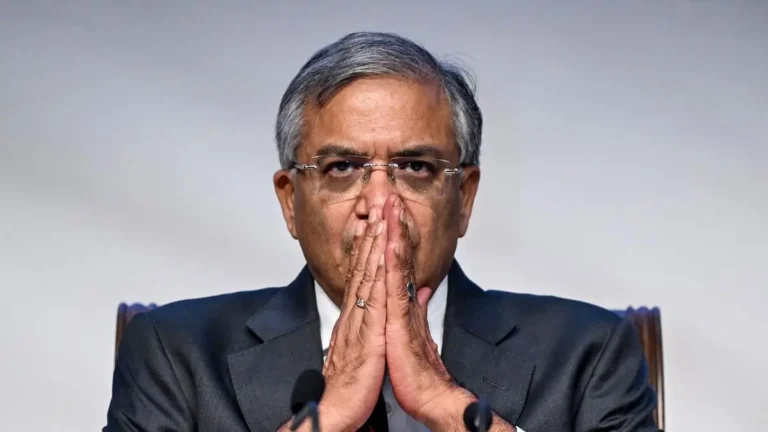
Neha signs her articles with a single name, in the old JNU Left habit. During the summer AISA worked under the banner of the CJP, a satirical outfit founded by a former AAP worker, over which it had no control. One commentator has found her more pragmatic than the rhetoric suggests. The organisation she leads has been among those running protests in New Delhi this autumn, and she has emerged as the face of the agitation. The demonstration at Jantar Mantar on 4 October targeted Chief Election Commissioner Gyanesh Kumar. When police took her away, CPI(ML) Liberation demanded to know where she was held and spoke of grave apprehension for her safety. Together with two AISA colleagues she had also joined Sonam Wangchuk’s hunger strike.
The electoral record
Fame of that kind meets a stern test in the electoral record. Rameshwar Prasad won the Bhojpur Lok Sabha seat in 1989 under the banner of the Indian People’s Front, which marked a high point for the party. For three decades afterwards defeat followed defeat against candidates from the Janata Dal, the RJD and the BJP. In 2014 Raju Yadav polled 98,805 votes, or 11.06 per cent, while R.K. Singh won with 391,074. Raju Yadav improved to 419,195 votes, or 38.79 per cent, in 2019 and still lost to the incumbent.
Afaque Haider, a researcher of Bihar politics, has traced that decline to the Mandal policy of 1990, which reserved 27 per cent of government jobs for Other Backward Classes. Intermediate castes such as Yadavs, Kurmis and Koeris grew politically assertive and drew away from class-based movements. Lalu Prasad Yadav and the RJD gave those aspirations the language of social justice, which found stronger resonance with voters than a politics of class struggle. The reforms associated with T.N. Seshan, in his reading, fostered a growing belief in democracy and pushed many leaders towards more formidable electoral options. Caste became the linchpin of electoral mobilisation in the 1990s. The party struggled to adapt, and fragmentation over ideological lines weakened its cohesion.
Admired in the fields, voted for elsewhere
Villagers in Bhojpur have often admired Liberation and voted elsewhere. Prakash Yadav, 43, works in a shop in Patna, credits the party with making backward communities secure, and votes for the RJD because it holds more influence in government. Suryanath Manjhi, a farm labourer in Chauri, acknowledges that Dalits have a voice in the region because of the party. He votes for the BJP because he sees it as the only party working for a unified Hindu cause. Raju, 24, from Sandesh, credits the movement with bringing dignity to the poor and says that young people like him need progress as well as slogans of equality and dignity. Ordinary people there have long linked the party with andolan, with protest and movement, and have hesitated to see it as a viable electoral option.
The 2024 breakthrough in Arrah
The long-awaited breakthrough came in 2024. A coalition with the RJD and Congress returned the Arrah seat to Liberation after the defeat of two-time BJP MP R.K. Singh. Sudama Prasad, an OBC regarded as approachable, polled 529,382 votes, or 48.28 per cent, and won by a margin of 59,808. Manoj Manzil, a former MLA from Agiaon, called the result a reply to those who believed the influence of the party was fading. He blamed earlier defeats on the Ranvir Sena and on what he called the false promises of Nitish Kumar about land reforms for the EBC community.
A party leader, speaking on condition of anonymity, has conceded that elections cannot be won on class issues alone and that parliamentary politics demands coalitions. Caste, he said, is intertwined with class, and the party has begun reaching out to specific groups such as the Mallah and Chandravanshi communities. Workers have also gone door to door asking constituents for small donations, which leaders believe raises funds and gives voters a sense of ownership.
Will Neha Bora’s following become votes?
One commentator has argued that the women who climbed onto the car came out for Neha, with the party’s programme playing little part. The same writer has asked whether a leader who forces a government to blink can also persuade a voter to switch. Bhojpur has asked a similar question for decades. People from backward castes in the fields around Ekwari still turn away from the camera and hide their faces, wary of reprisal. A generation of students who learned politics in AISA will have to carry a rebellion that began over dignity in those fields into constituencies where voters have often admired Liberation and chosen other parties. Sudhir Mishra’s film Hazaron Khwahishen Aisi has a character who says Delhi and Bhojpur lie a thousand kilometres from each other and stand millennia apart in time. Whether the following Neha commands will turn into votes remains open.