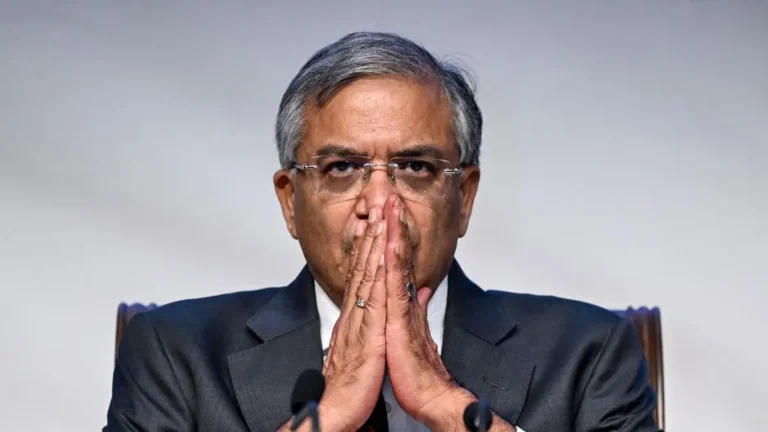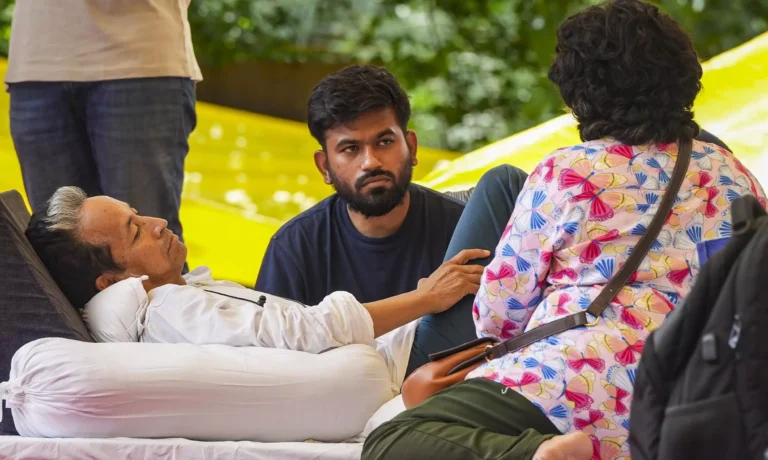
On October 17, 2026, a team from the Jammu and Kashmir Police arrested 59-year-old Kashmiri Pandit activist Rakesh Handoo, also known as Bunty, from his residence in Greater Faridabad, Haryana. Registered under FIR No. 151/2026 at the Baramulla Police Station, the charges included cyberterrorism under Section 66F of the Information Technology Act and provisions of anti-terror legislation. Handoo, a long-time advocate who contested the 2008 Assembly election against former Chief Minister Farooq Abdullah, was accused of generating and amplifying fake terror threat letters targeting Kashmiri Pandit government employees and non-local migrant workers under the guise of a militant group calling itself the “United Liberation Council”. In response to July and August threats and targeted assaults on migrant laborers, security forces initiated a largescale crackdown resulting in more than 3,000 arrests. According to police, the suspects are considered Over Ground Workers (OGWs), which is the terminology used for individuals covertly aiding terrorist activities.
The arrest sent shockwaves through the region, but the public narrative following the revelation was telling. Community leaders and political figures immediately stepped forward to demand a fair trial, urging the public not to jump to conclusions, emphasizing his decades of public work, and framing the event as a tragic individual aberration or an internal dispute. Had a Kashmiri Muslim activist been involved, this would have already accumulated hundreds of thousands of retweets, and a biased media apparatus would have deployed countless journalists to question the core tenets of Islam. Instead, there were no televised calls for collective punishment, no public vilification of his broader identity group, and no collective blame cast upon his community.
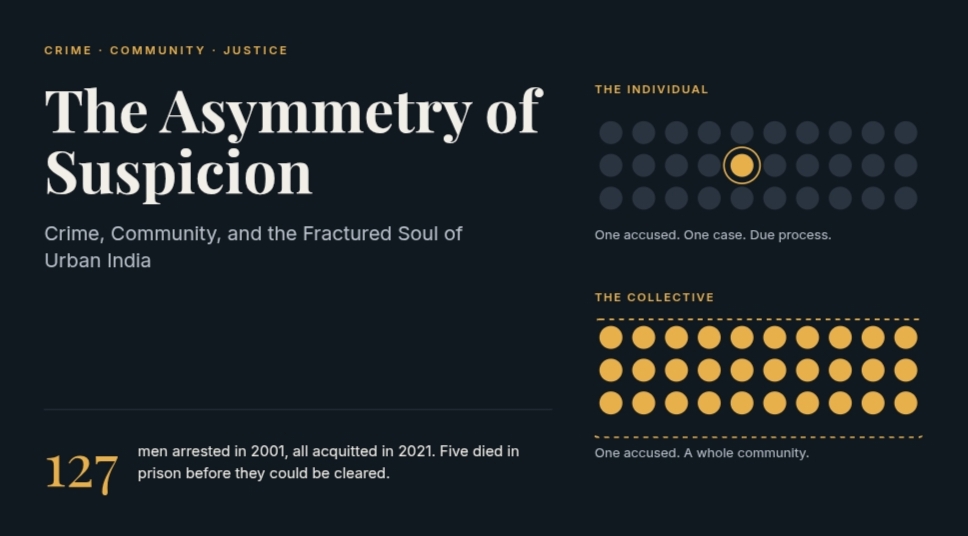
This restrained response stands in stark contrast to the institutional and social treatment experienced by India’s Muslim minority when faced with allegations of terror or subversion. Over the past decade, a profound asymmetry has taken root across the country’s legal, political, and media landscapes. For a long time, the whole Muslim community has been kept on the threshold of an apology, their religion is perpetually questioned, while Hindutva and its ideology are never brought under the scanner of guilt. In this skewed reality, the censor pardons the crows to vex the doves. When a member of the majority community is accused of terror, hate speech, or false flag subversion, the act is treated as an isolated crime by an individual who remains entitled to the presumption of innocence. When a Muslim is accusedor merely suspectedthe guilt is immediately assigned to an entire population, and the minority pays an unbearable price for crimes it never committed.
Across urban India, the psychological landscape of Muslim life has been fundamentally shaped by these cyclical sociopolitical ruptures. The state, media, and social institutions operate under a framework where individual wrongdoing by a minority suspect is transformed into a collective indictment, while systemic injustices against innocent individuals are dismissed without accountability.
The Illusion of Individual Privilege versus Collective Guilt
The handling of cases involving non Muslim perpetrators highlights how the legal system and public media grant the privilege of individuality to the majority community. In January 2024, the Uttar Pradesh Special Task Force arrested two Hindu men, Taharsingh and Om Prakash Mishra from Gonda, for orchestrating bomb threats against Uttar Pradesh Chief Minister Yogi Adityanath and the Ayodhya Ram Temple. To divert suspicion, the accused created email accounts under Muslim names. In October 2022, police in Madhya Pradesh arrested two men, Dharmendra and Devesh, for circulating inflammatory threat letters signed under fake Muslim aliases to provoke communal unrest. In early 2025, a teenager in Prayagraj created a fake social media account under his Muslim classmate’s identity to post a bomb threat against the Mahakumbh festival to settle a personal grudge.
A similar pattern emerges in counter intelligence and security operations. Senior Defence Research and Development Organisation scientist Pradeep Kurulkar was arrested in Pune in May 2023 for passing sensitive missile research data to hostile foreign intelligence operatives after falling for an online covert trap. Indian Navy personnel and defense staff, including Pradeep Mukherjee in 2026 and Satendra Siwal in 2024, were arrested by anti terror agencies for leaking classified military movements to foreign intelligence. Furthermore, historical bomb blast cases, such as the 2008 Malegaon explosion, in which figures like Pragya Singh Thakur and Lt. Col. Prasad Shrikant Purohit were charged under anti terror laws, demonstrate the existence of organized right wing violence.
Yet, in none of these cases did mainstream media interrogate the Hindutva ideology, choosing instead to question the entire community, nor were entire neighborhoods subjected to punitive state action. The perpetrators were treated strictly as individuals subject to due process.
For Indian Muslims, however, the boundary between the individual and the collective has been erased. The identity of a suspect instantly becomes an indictment of an entire faith, driving a cycle of media trialsand state overreach long before any court hears the evidence.
The Stolen Decades: Life under Arbitrary Detention
While majority suspects are protected by procedural safeguards, thousands of Muslim youths have been swept up by stringent anti terror laws such as the Unlawful Activities (Prevention) Act, the Terrorist and Disruptive Activities (Prevention) Act, and the Prevention of Terrorism Act. Under these frameworks, obtaining bail is extraordinarily difficult, allowing individuals to be detained for years or even decades before their cases are resolved.
The human toll of these long term detentions is evident in numerous legal acquittals delivered by Indian courts after decades of incarceration. In December 2001, Surat police raided an educational seminar and arrested 127 Muslim men, charging them under POTA for belonging to a banned organization. In March 2021, nineteen years later, a trial court acquitted all 127 men, ruling that the prosecution had failed to produce any evidence connecting them to terror activities. Five of the accused died in prison before they could be cleared.
In Maharashtra, eleven Muslim men arrested in 1994 following the Babri Masjid demolition were charged under TADA with plotting war against the state. In February 2019, a special court acquitted them after twenty five years of detention, citing severe procedural violations and a total absence of evidence.
Nisaruddin Ahmad spent twentythree years in prison following his arrest in 1994 before being fully acquitted by the Supreme Court of India in 2016. Gulzar Ahmad Wani, a Ph.D. scholar arrested in 2001, was acquitted by the courts in 2017 after sixteen years in jail, with the judiciary reprimanding the police for a fabricated investigation.
Mohammad Amir Khan was abducted by police in Delhi in 1998 as an 18yearold and implicated in 19 separate bomb blast cases. It took fourteen years of incarceration for him to be systematically acquitted of every charge, an experience he later detailed in his memoir documenting his wrongful imprisonment.
Following the 2002 attack on the Akshardham Temple in Gujarat, six Muslim men were arrested and convicted by lower courts, with three sentenced to death. In 2014, the Supreme Court acquitted all six men after they had spent eleven years in prison, issuing a sharp rebuke to investigating agencies for framing innocent citizens while the real culprits escaped justice.
The Human Destruction of Innocent Lives
Behind the legal terminology of acquittal lies catastrophic personal destruction. When an innocent young man is arrested on fabricated charges, his youth is taken away inside a prison cell. He enters detention with ambitions and plans, he emerges decades later with failing health, grey hair, and a life completely disrupted.
The structural impact on families is severe. Parents exhaust their life savings, sell homes, and liquidate assets to pay for endless legal battles. Fathers frequently pass away during the prolonged trials without seeing their sons cleared. Wives of the incarcerated are left in a state of social isolation, living like widows while their husbands remain alive in distant cells, bearing the burden of raising families while facing societal hostility and financial ruin.
Children suffer the deepest consequences. Growing up without a parent, they miss the shoulder of a father from where they could have seen the world. They navigate education, economic hardship, and social exclusion without support, carrying the burden of public vilification during their formative years, deprived of the guidance and stability a family is meant to provide.
When the courts finally issue an acquittal after ten, fifteen, or twenty five years, the state provides no restitution. While no amount of reparations can truly compensate for a lifetime wrongfully taken, the bare minimum remains entirely absent: there is no official apology, no financial compensation for lost time, and no systemic review to reform the process.Cruelly, those responsible for wrongful arrests operate with absolute impunity. Investigating officers, prosecutors, and officials involved in fabricating evidence rarely face suspension, legal penalties, or disciplinary action. The system continues uninterrupted, leaving exonerated individuals to reconstruct their lives without assistance.
The Psychological Landscape of Urban Muslim Life
The cumulative effect of this double standard has altered the daily existence of Muslim citizens in urban centers across India. The threat of arbitrary arrest, combined with media driven vilification, has reshaped how minority communities interact with public institutions and urban spaces.
Urban Muslims regularly navigate an environment requiring hyper vigilance. Everyday activities, seeking housing in metropolitan areas, securing employment, expressing political viewpoints, or wearing traditional attireare weighed against potential social backlash or state scrutiny. Residential segregation has increasingly become a mechanism for selfpreservation rather than a mere demographic pattern, as individuals seek safety within community enclaves.
This environment is sustained by a media ecosystem that frequently sensationalizes terror investigations involving minority suspects. Prime time broadcasts often present unverified claims as established facts long before trial proceedings begin. This public framing creates lasting prejudice, ensuring that even after full judicial acquittal, individuals continue to face suspicion and social ostracization.
A Republic Divided Against Its Own Principles
A nation cannot maintain a twotiered system of justice without undermining its constitutional foundation. When a society permits one community to be judged strictly by individual actions while subjecting another to collective suspicion and systemic vulnerability, the principle of equal citizenship under the law is compromised.
The arrest of Rakesh Handooalongside numerous cases involving falseflag threat letters, espionage, and hate campaignsdemonstrates that criminal conduct and security threats are not tied to any single religious identity. They are individual acts that require impartial enforcement of the law.
Restoring integrity to the justice system requires structural accountability. Anti terror statutes must not be deployed without strict evidentiary oversight, officers who fabricate charges must face legal consequences, and individuals subjected to prolonged wrongful incarceration must receive formal compensation and rehabilitation. Until equal standards of justice, due process, and accountability apply to every citizen regardless of background, the promise of a fair and unified democratic republic remains unfulfilled.