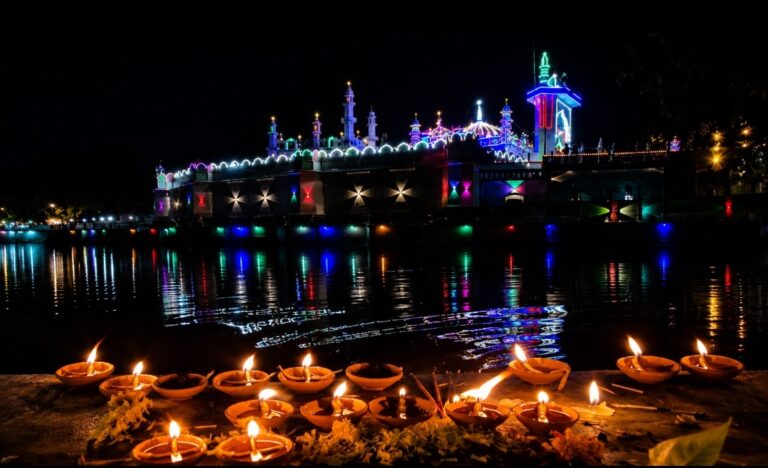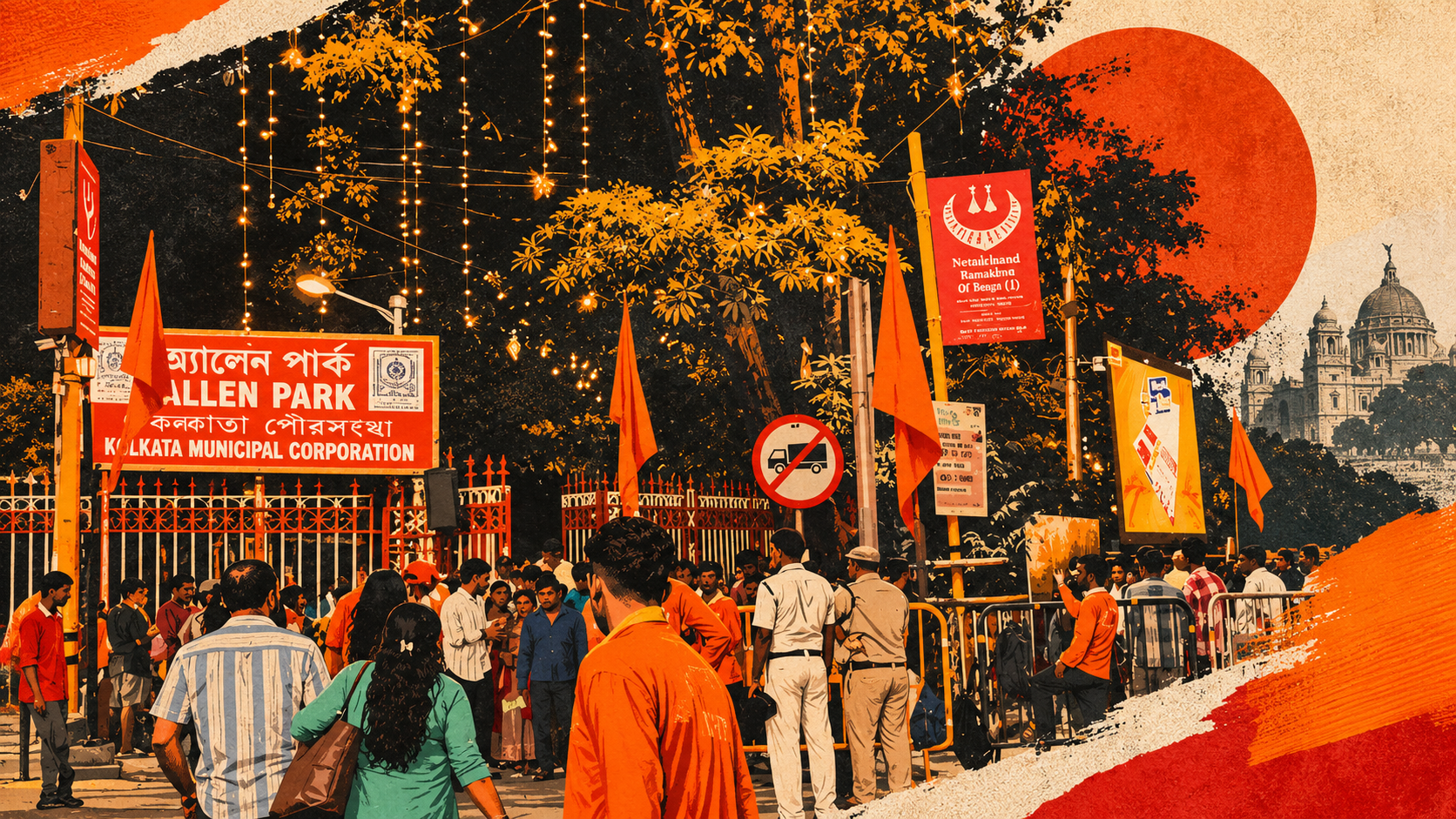
Maha Saptami: A themed pandal, a canopy of miniature lights and illuminated panels. Durga Pujo, an integral part of the lifestyle of any Bengali, draws Calcuttans into the annual pandal-hopping spree. Only this time, an unexpected ‘new’ pandal was on everyone’s checklist: Allen Park on Park Street. Synonymous with the Kolkata Christmas Carnival, the “Tandav”-themed Allen Park Pujo was organised by the BJP functionary-led Kolkata Sanatani Sangha, which attributed the initiative to the efforts of the CM Suvendu Adhikari-led “Sanatani government” in West Bengal.
Flanked by saffron flags, the Pujo at Allen Park was called a “hijack” of other religions’ sites by The Observer. While critical commentators adopted an ‘I told you so’ analysis of the shift from Sarad Utsav (autumn festival) to Durga Pujo (worship of Goddess Durga), within the oversimplified binary of Hindutva versus secularism vis-à-vis the change in state government, such explanations overlook the political and electoral undercurrents that West Bengal presents.
Since May 2026, West Bengal’s opposition space has been squeezed, leaving little room to challenge the BJP’s electoral hegemony. The scene was not as grim when the election results were declared on 5 May. With the subsequent three-way internal split in the AITC, the Bengal BJP has been left without any competent or coherent opposition to its policy agenda in the Legislative Assembly, allowing the BJP to give Sangh affiliates a free hand to pursue the Hindutva project through an invigorated assertion in socio-cultural spaces, events and discourses.
This retrenchment of Bengal’s socio-political landscape offers a glimpse into how the BJP intends to reinforce its ideological regime by institutionalising its electoral hegemony, and vice versa.
Bengal’s polity, in the first six months of BJP rule, showcases two undercurrents determining how politics is being reconfigured in the state.
First, the BJP’s attempts to recast the terms through which Bengal’s public culture is articulated as part of its ideological project, with subsequent shifts in Bengal’s socio-political milieu multiplying electoral advantages for the BJP in West Bengal.
Second, internal contradictions within the BJP’s homogenising tendency have impelled it to co-opt Bengal’s party-society, resulting in the continuation of the state’s political structures despite a change in the party in power.
Securitised Education in Doctrinal Knowledge Systems
Take the instance of the internal dispute between the ABVP and Left students’ unions, which quickly spiralled into partisan tensions, leading to an ABVP siege of JU. This was followed by clashes between the Akhil Bharatiya Grahak Panchayat and SARFI students over interrupted political engagement, resulting in the encampment of the campus, violence and repeated standoffs.
Echoing PM Narendra Modi’s call to root out “dimagi Naxals” (here, intellectual terrorists), CM Suvendu Adhikari alleged that Left students’ unions involved in the JU agitation, and those who extended solidarity to SARFI students, were “tukde tukde gangs” and “jihadis” who refused to honour the national flag and Vande Mataram. CM Adhikari subsequently held a Vande Mataram rally and a Gerua Samman Yatra in Jadavpur to “instil the spirit of nationalism”.
Labelling student dissenters as “anti-national” and “anti-social” follows the standard template of systematically subduing liberal education spaces, where student politics is securitised as an ecosystem that promotes criticism, dissent and political opposition, which are portrayed as threats to national security rather than expressions of democratic rights.
The BJP has entangled student politics, liberal education and opposition spaces into a singular opponent in the state. Institutional disagreements have been turned into questions of national identity, effectively shifting the substance of student grievances towards a test of ideological legitimacy.
As internal campus conflicts are conflated with questions over the ideological ownership of campuses, physical encampment and repeated standoffs have transformed educational institutions into visible sites of political contestation, where the question of who gets to occupy, organise and exercise dissent within an academic institution remains contentious.
Prof. Soumyadeep Chowdhury, an emerging researcher on Indian politics and Assistant Professor of Political Science at Adamas University, Kolkata, argues, while speaking to Karvaan India, that education will always be at the forefront of any ideological project. The BJP’s sustained efforts to establish a permanent narrative have been geared towards reshaping both the substance and structure of education in West Bengal, reproducing its preferred system of knowledge.
Liberal academia has become a particularly suitable target, especially in the post-CJP paradigm, which has demonstrated an invariable solidarity among students and the academic fraternity.
From the Akhil Bharatiya Vidyarthi Parishad’s (ABVP) assertion across campuses where Left students’ unions have been dominant, to the proactive incursions of Sangh affiliates, including the Vishwa Hindu Parishad and Bajrang Dal, into Bengal’s socio-religious practices, and Adhikari’s push for 1,000 RSS-affiliated schools within the next year, alongside the appointment of party leaders as college governing council presidents, a pattern has emerged.
Conformism through confrontation and ideological assertion in line with the Bharatiya Janata Party’s (BJP) version of Hindutva cultural majoritarianism has emerged in West Bengal.
The BJP has not only engaged in ideological indoctrination through education but has also labelled student dissent a security threat rather than an expression of students’ right to dissent. In doing so, it has sought to determine which forms of dissent are legitimate and who is entitled to dissent lawfully.
Bengali in BJP’s Bharat
Next, the BJP has reconstructed the Bengali nation itself.
While initial commentaries indicated a dichotomy between Bengal’s cosmopolitan milieu and pluralist society and the BJP’s Hindu majoritarianism, West Bengal had been the seat of the Hindu Renaissance during India’s nationalist movement, using essentially Hindu iconography to build the case for independence from colonialism.
From “Vande Mataram” in Bankim Chandra Chattopadhyay’s Ananda Math (1882), to political Hinduism or Hindutva being coined by Chandranath Basu in Hindutva: Hindur Prakṛta Itihas (1892), to Swami Vivekananda’s Hindu spiritual universalism or Neo-Vedanta and the revolutionary nationalists in the Anushilan Samiti who drew inspiration from the Bhagavad Gita, Hindu thought has been an integral part of Bengal’s political history.
Both Ankush Pal, in Himal South Asian, and Chowdhury Irad Ahmed Siddiky, in his working paper, dispel the notion of Bengali exceptionalism, i.e., the argument that Bengal’s inherent cultural distinction from the rest of the Hindi Belt, rooted in linguistic regionalism and intellectual pride, made it inherently resistant to the BJP’s Hindu nationalism. Hindu nationalism was not alien to Bengali identity in the first place.
Dr. Moutusi Paul Choudhury, a researcher on Indian polity and Assistant Professor at St. Xavier’s College (Autonomous), Kolkata, recognised a “[…] process of mutual assimilation, [that] the Bengali intelligentsia is currently reeling under the pressure of saffronization.”
Ahead of Kali Pujo, Boro Maa Temple in Naihati changed its iconic tagline from “Dhormo Jar Jar, Boroma Sobar” (To each their own religion, but Boro Maa belongs to all) to “Boromaye Bhakti, Sanataner Shakti” (Devotion to Boro Maa, strength of Sanatan). The temple committee and Naihati’s BJP MLA, Sumitra Chattopadhyay, maintained that the shift reflected devotees’ requests and public sentiments rather than political change.
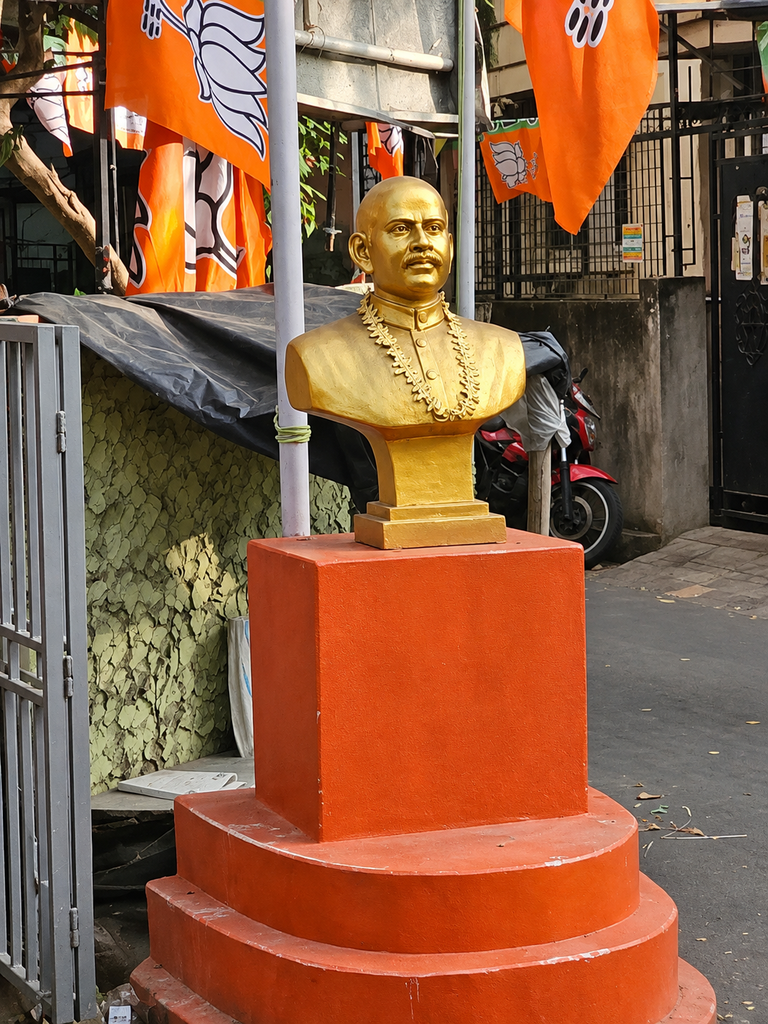
A recent Shyama Prasad Mukherjee bust in Haltu, Kolkata.
The Bengal BJP has repeatedly asserted its Bengali origins by drawing on the history of Shyama Prasad Mukherjee’s Jan Sangh, its ideological and organisational predecessor.
The BJP has co-opted Bengal’s own Hindu heritage to reconcile itself with the Bengali Bhadralok’s conception of Bengal. From West Bengal Day on June 20 to proposed memorials, public holidays and renamed public spaces and roads after Syama Prasad Mookerjee, the BJP has foregrounded Hindu victimhood while marginalising the complex histories of displacement and communal violence.
Prof. Soumyadeep Chowdhury notes, “[…] BJP’s rise in Bengal is deeply ideological and historical […] from renaming roads […] Hindu freedom fighters [… and] with proposed changes in the syllabus.” He asserts that building a strong Bengali identity intertwined with the BJP is at the forefront of establishing its ideological base and overcoming anti-incumbency for electoral consolidation.
By reorganising Bengal’s civilisational identity and political existence around his Bengali Hindu Homeland Movement of 1947, the BJP has elevated Syama Prasad Mookerjee into a central figure in West Bengal’s political history. This, as Arghya Prasun Roychowdhury points out in The Indian Express, amounts to a “selective reconstruction” intended to normalise majoritarian nationalism through state-sponsored historical memory and public culture.
By appropriating historical figures, religious symbols and public commemorations, the BJP is actively dismantling Trinamool’s Bengali sub-nationalism to integrate the idea of the Bengali nation into the folds of Hindu nationalism.
Majoritarian Mobilisation and Peripheral Minorities
During the 2026 West Bengal election, the BJP’s electoral mobilisation scapegoated “infiltrators” and “Bangladeshis” who had allegedly entered West Bengal’s electoral rolls, turning majority insecurities into electoral capital. This narrative invoked fears that refugees were encroaching on physical and political spaces, jobs and land, cornering welfare resources provided by the state, perpetrating the criminal-corruption nexus of the Mamata-led Trinamool government and placing undue pressure on infrastructure.
Despite the absence of concrete figures on how many illegal migrants were removed through the SIR, and with 91 per cent of all adjudicated cases before the SIR tribunal being restored, BJP Bengal President Samik Bhattacharya demanded an SIR 2.0, claiming that the voter roll revision remained incomplete because the SIR had operated under the duress of the Trinamool state machinery.
This has left room for fanning societal divisions for electoral capital, while the BJP’s “purifying” electoral lists have repeatedly shown a tendency to remove undesirable voters.
The process of purification continues with the striking off of 75 Muslim communities from the West Bengal OBC list, which has been reverted to 66 communities and a 7 per cent reservation ceiling. The Adhikari government has sought the re-verification of approximately 1.6 crore caste certificates issued since 2011, including 48 lakh OBC certificates. The disproportionate impact on Muslim communities has fuelled fears of further deletions of Muslims holding OBC certificates following re-verification. Even as procedural regularisation or judicial compliance is invoked, the burden of collective uncertainty is borne by communities that have historically depended on affirmative action to overcome structural exclusion.
Simultaneous directives have made singing Vande Mataram compulsory during morning assemblies across public schools, including state-recognised madrasas. District Magistrates were also ordered to conduct comprehensive surveys of madrasas, covering institutional management, teachers, students, infrastructure, academic activities and funding sources. In September 2026, closure orders were issued to 252 madrasas, while approximately a hundred others received show-cause notices.
While actions contrary to Muslim interests have been more restrained and driven by administrative interventions, the situation for Christians, a community comprising less than 1 per cent of the electorate, has been different. Muslims constitute about 27 per cent of the electorate in Bengal. For Christians, over 60 reported incidents across 13 districts over five months have been recorded. These point to a distinct yet evident pattern of targeted intimidation, disruption of worship and mob violence against prayer gatherings, accusations of forced conversion and attempts to perform purification rituals such as ghar-wapasi (“returning home”). Of these incidents, 52 involved raids on prayer meetings, homes and churches, while eight involved physical assaults, mob violence or vandalism, with the alleged participation of Sangh outfits such as the Hindu Jagaran Manch, Vishwa Hindu Parishad, Bajrang Dal and Hindu Suraksha Samiti.
Even as church bodies introduce written applications and affidavits for converts following attacks on prayer meetings in West Bengal, and Bengali Christians held a mega prayer and protest rally in Kolkata on 5 November 2026, the BJP rejected allegations of institutional complicity, outlining a zero-tolerance policy towards wrongdoing.
The BJP’s attempts to polarise the electorate along religious lines are also an inevitable part of its strategy of Hindu voter consolidation, which highlights Hindu vulnerability to non-Hindu practices. This division is reinforced through a combination of administrative interventions, cultural assertions, dietary regulation and the selective policing of religious practices.
Dehumanising Governance
The BJP reproduces a dogmatic Hindutva model of governance that de-centres citizens from the process of governance to preserve the Hindu majoritarian aesthetics of Bengal’s development story.
The bulldozer has come to be recognised as the BJP’s iconic symbol of governance, having acquired a vocabulary of retributive coercion and assertive authority.
Within days of declaring victory, alleged BJP workers used bulldozers to demolish a Trinamool party office and a shop near Hogg Market. The Adhikari government undertook major drives for the immediate eviction of hawkers in Kolkata, from the Sealdah, Howrah, Jadavpur and Dum Dum railway station areas, alongside commercial stretches in New Market, Esplanade, Bhowanipore and Boi Para, citing encroachment. Lacking social security nets to offset livelihood insecurities, the informal sector, including grocers, vendors and kirana shops, has become indispensable to affordable everyday consumption for the city’s working class.
Even as the Calcutta High Court placed stay orders on immediate evictions, the anticipation of displacement itself becomes a mechanism of control, compelling disadvantaged communities to negotiate their existence rather than demand constitutional entitlements. The Hindutva model of governance not only determines what Bengal’s development story will look like but also who gets a part in it and who does not.
The puritan project has also extended beyond public spaces to impose restrictions on personal dietary practices. Dietary policing by Sangh affiliates such as the Hindu Jagran Manch, alongside the Adhikari government’s directive for stricter enforcement of the West Bengal Animal Slaughter Control Act, 1950, has effectively criminalised the sale of cattle for meat. The Act limits the slaughter of cattle to animals jointly certified by a civic body and a public veterinary surgeon as being above 14 years of age and unfit for work or breeding, or permanently incapacitated.
This has not only affected the daily dietary practices of religious minorities but also impacted Hindu cattle herders, particularly Ghosh communities, who, lacking adequate age documentation, have been compelled to retain unproductive cattle. Shortages, steep inflation and public apprehension about being associated with beef consumption have adversely affected the state’s cattle and food industries. The class contradictions within Hindu consolidation prioritise collective religious interests over the material needs of less privileged Hindu communities.
In June, West Bengal’s mid-day meals were set to replace eggs with vegetarian alternatives, following a proposal to outsource meals to ISKCON for KMC-run schools. While the mid-day meal scheme has been an instrument for student retention, it also provides essential dietary nutrition to children from the poorest segments of society.
Such attempts to polarise the electorate along religious lines are also an inevitable part of the BJP’s strategy of Hindu voter consolidation, which highlights Hindu vulnerability to non-Hindu practices. This division is reinforced through a combination of administrative interventions, cultural assertions, dietary regulation and the selective policing of religious practices.
While the Hindutva model of governance seeks political legitimacy through the assertion of a homogeneous development model for the Hindu nation, Aakar Patel argues in The Leaflet that Hindutva does not necessarily represent a coherent economic philosophy but instead depends on the visible management of religious minorities for ideological consistency.
Performances of cultural homogenisation and purification remain central to this assertion. Through the selective application of law, the normalisation of a coercive state and regulatory interventions that limit personal choices, the ideological dispensation communicates its authority to play politics with the personal through both spectacle and fear. The bulldozer exemplifies this governing logic, communicating the aesthetics reproduced across states as part of the Hindutva model of governance.
Majoritarianism and development are intertwined to create a distinct Bengali identity that essentialises the BJP’s Hindu majoritarianism through Hindu populism, romanticism and assertive Hindu pride, while simultaneously peripheralising religious minorities and delegitimising political opposition.
Internal Contradictions of BJP’s Bengal
Despite the pervasiveness of its ideological regime, counter-hegemonic tensions arise from the very quarters that the BJP hopes to consolidate.
The BJP regularly struggles to reconcile its push for greater uniformity within Sanatani practices with the Hindu Shakta traditions prevalent in Bengal, which diverge from the Vaishnav traditions of the BJP bastion in the Hindi heartland.
Both Durga Pujo and Kali Pujo presented opportunities for political legitimacy beyond what had emerged as Mamata-led Trinamool’s criticism of the BJP as a “bohiragoto” (outsider) party through its “Ma-Mati-Manush” (mother, motherland, people) slogan. This was echoed across BJP-backed Pujo committees, Sangh stalls circulating BJP-aligned publications and even the alignment of pandal themes in favour of the ruling dispensation. Lavish LED billboards and grand pandals served the same political necessity: to overcome its most significant criticism as an “outsider” party in Bengal.
The political profile of the Pujos in Bengal has been undeniable. For a long time, they have been associated with the corridors of power, prestige and posturing in West Bengal’s politics. Politics was, and remains, an inevitable and inherent part of Kolkata’s Durga Pujo, serving as a means of legitimising ruling dispensations, carrying forward partisan messaging, reasserting authority, entrenching patronage and shaping a politics of space and memory.
Pujos have also provided the BJP with an opportunity to associate itself more integrally with Bengali Hindu traditions.
Yet the same Allen Park Durga Pujo, which claimed to represent a demand for a Sanatani Bengal, forsook the Bengali tradition of Khuti Pujo in favour of a Bhoomi Pujan. Mere weeks before Durga Pujo, Bageshwar Baba, a venerated Hindu monk from the Hindi heartland, had urged Bengalis to give up fish and meat during Durga Pujo and labelled those who consumed non-vegetarian food during the festival as “pakhandi” (heretics).
The backlash may have prompted BJP West Bengal President Samik Bhattacharya to minimise Bageshwar Baba’s comments as a matter of “personal/individual opinion”, while CM Adhikari ate fish bhog at Kalighat to sidestep the controversy amid public outcry.
Moreover, the Adhikari government’s governance credentials have generated dissatisfaction even among its own voters.
The BJP’s industrialisation agenda included the West Bengal Investment Promotion Policy, 2026, a proposed ₹5,000-crore investment promotion framework for manufacturing, industrial clusters and FDI, a semiconductor facility in Durgapur–Panagarh, defence manufacturing hubs in Bankura and Birbhum, ₹200 crore for Siliguri logistics development, and a proposed Global Capability Centre Policy to attract MNCs in AI, data centres and technology services.
However, it will take some time for these economic incentives to generate employment and facilitate Bengal’s economic development. The BJP’s poll promise had also assumed the continuation of Mamata’s welfare ecosystem, effectively outbidding her for women voters by promising Lokhir Bhandar beneficiaries INR 3,000 per month instead of INR 1,500. West Bengal’s debt-driven neo-welfare economy faces significant fiscal constraints. The BJP’s 2026–27 Budget attempts to balance expenditure with the deficit.
This excluded nearly a third of former beneficiaries from Annapurna Bhandar. Stricter eligibility criteria, Aadhaar-bank linking, income verification and fresh applications contributed to further payment delays, triggering protests across Bankura, Malda, Hooghly, North 24 Parganas and other districts, including road and railway blockades and demonstrations outside BDO offices.
These internal inconsistencies, coupled with the limitations of the already saturated welfare ecosystem under the Mamata-led Trinamool government and the slow pace of development, which is nowhere close to providing immediate relief from Bengal’s de-industrialised economic stress, have impelled the BJP to adapt and adopt the same institutions of the party-society that it once criticised, in order to maintain control in the state and consolidate electoral gains.
The New Party-State
Anand Vardhan’s Newslaundry article raises the question of whether the BJP can sustain its regime without the old political order. West Bengal has experienced a party-society, i.e., a nexus between the ruling party and local clubs, trade associations, labour unions, actors’ guilds, Pujo committees, bazaar committees and others, since the Left came to power in 1977. The Trinamool inherited the party-society created by the Left and used it to sustain its electoral machinery.
Bengal’s political culture is characterised by party offices in every neighbourhood being treated as one-stop centres for everyday problems, arbitration, permissions and interactions with the government. The plethora of para-legal institutions operates through a mix of patronage, threats and coercion. Party offices have functioned as ex-officio courts, handling matters ranging from local tenders to property disputes, from acting as mouthpieces of the Trinamool through Duare Sarkar to Aadhaar form-filling, from delivering Lokkhir Bhandar benefits to mobilising voters on polling day. This need for self-preservation and the chain of patronage remain strong in West Bengal’s party-society, which relies on an established model of dense cadre networks, street mobilisation and party control over civil society. This is a testament to the tenacity of the party-society in assimilating itself into the political regime, even as its previous inhibitors are rooted out.
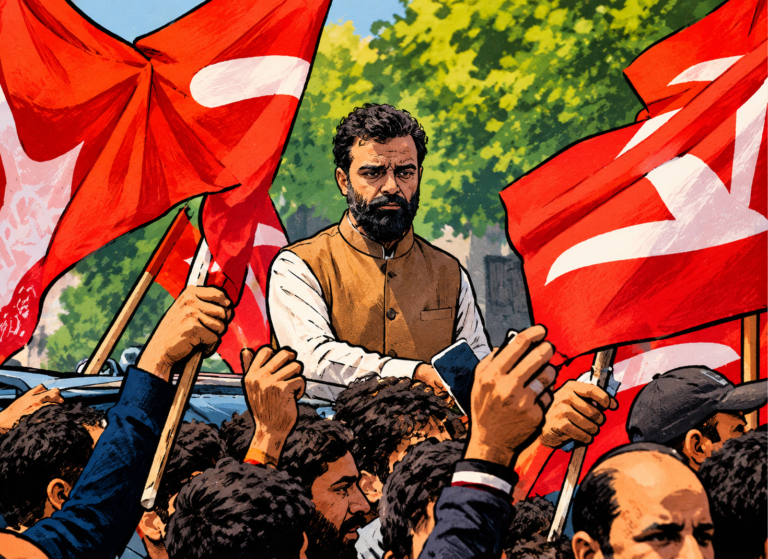
It came as no surprise when, on 5 May, the Jora Phool flags of the AITC were replaced by the Komola Phool of the BJP. Auto-rickshaws, buses, labour union stands and buildings where erstwhile TMC strongmen resided were all painted in the colours of the victor.
An initial assessment of the BJP in Bengal would have led many political scientists to believe that the party, which had fought against and successfully defeated the electoral might of Trinamool’s party-society, would resist any attempt to take over the same vices against which the 2026 mandate had consolidated. This was particularly expected because the BJP had won on the back of relentless and organised campaigning sustained by associations within the Sangh Parivar.
Six months down the line, the same institutions now stand absorbed into the BJP’s own fold.
If the Trinamool depended on the party-society for its continued electoral success, the party-society, too, depended on Mamata’s protection from the law when its members channelled party funds and lined their own pockets through hawala, ‘protection money’, extortion, illegal land acquisition, construction materials, dubious local tenders and other such activities, while serving as musclemen for the local Trinamool party boss.
Instead of choosing to remain in conflict with the party-society, the BJP has systematically taken it over.
Dr. Ambar Kumar Ghosh, a Non-Resident Fellow with the European Partnership for Democracy, Brussels, offers a similar explanation while speaking to Karvaan India. “…[The BJP]…had no other way but to embrace the model to consolidate itself electorally…” He adds that the BJP, as a political party, is an “…alien to Bengal’s traditional political lineage…” and must therefore make use of the same relationships to operate the rank-and-file, cadre-patronage-based arrangements prevalent in Bengal.
It came as no surprise when, on 5 May, the Jora Phool flags of the AITC were replaced by the Komola Phool of the BJP. Auto-rickshaws, buses, labour union stands and buildings where erstwhile TMC strongmen resided were all painted in the colours of the victor.
The speed with which the BJP abandoned its poll promise to develop an alternative model that separated party, state and society, or brought about democratic transformation, and instead integrated the same apparatus into its fold is indicative of its electoral concerns.
With “street fighter” Mamata seemingly confined to armchair criticism from her Kalighat Trinamool office following the fragmentation of the AITC, the Left-INC alliance remains the only political alternative with the organisational readiness to resist and exercise opposition politics.
Despite the CPI(M), CPI and CPI(ML) collectively obtaining a little more than 4.5 per cent of the vote share in 2026, the Left’s vociferous criticism of the Adhikari government in recent months has revived its cadre-based ideological strategies of activism. Whether the assumption of “Age Ram, Tar Por Bam” (First Ram/BJP, Then Bam/Left) comes true or not, the Left is poised to take over the opposition space in West Bengal. Left-ABVP violence may have been almost inevitable, given the entrenched history of political violence in the state.
Left students’ unions have recently provided organisational structure and support to the CJP during the Jantar Mantar protests, while also organising solidarity marches in Kolkata for student protests across the country, including one of the largest rallies in recent memory. Their past role as a vanguard in the 2024 Abhaya Movement and the 2014 Hok Kolorob Movement is well remembered, with their agitations in Bengal on bread-and-butter issues such as unemployment, inflation and women’s safety marking a return to public attention.
With CM Adhikari repeatedly emphasising the BJP’s objective of preventing a resurgence of the Bam front, the ready co-option of the party-society may have been driven by an awareness of this threat. With Mamata and the Trinamool losing their influence even within the state’s opposition space, the Left may have emerged as the most likely caretaker of the party-society, gaining an insurmountable and pervasive organisational reach that could challenge the BJP’s hegemony.
However, there is a distinction in the manner in which the party-society will relate to the ruling dispensation.
Dwaipayan Bhattacharyya, writing in The India Forum, rechristens this arrangement as a command society because the BJP-RSS seeks to replace the negotiation-based governance that the political society in Bengal has long represented, albeit mediated through political parties and party-society institutions, with rigid hierarchical control.
Through the coercive demolition of hawkers’ stalls and poor settlements, the dismantling of the negotiated access to livelihoods enjoyed by the poor, the weakening of political society and local intermediaries, and the absorption of opposition legislators through investigative-agency pressure, the BJP replaces Mamata’s franchisee politics, negotiated through patronage, with ideological discipline.
This can be seen across the incorporated party-society institutions, which reproduce the ideological projects highlighted above while consolidating specific electoral constituencies.
The Bharatiya Mazdoor Sangh, an RSS-affiliated trade union organisation, has emerged as an important vehicle for expanding the Sangh’s influence among workers. After May 2026, hundreds of trade union leaders associated with the AITC’s INTTUC approached the BMS, seeking affiliation or organisational mergers. The BMS now operates approximately 600 units in Bengal, effectively expanding into labour networks previously associated with rival political parties.
The ABVP, the RSS-affiliated student wing, has expanded its organisational presence from 96 colleges to more than 400 institutions. Its politics of visibility through confrontation and a strong-arm modus operandi, which relies on instantaneous panic, confusion and coercion, has been on visible display during confrontations with Left students’ unions at JU and Presidency University, as well as with the Trinamool Chhatra Parishad.
Numerous Durga Pujo committees and para (neighbourhood) clubs remain active in the community irrespective of election cycles. In 2019, the BJP introduced the Bharatiya Janata Sharad Samman competition and approached Puja committees across Kolkata, offering sponsorship opportunities and prominent political inaugurations. The initiative also sought to counter the TMC’s projection of itself as the defender of Bengali culture. Post-election, club trusts and Durga Pujo committee leaderships have been changed to accommodate local BJP leaders and distance themselves from Trinamool leaders.
Chorbagan Sarbojonin Durgotsab Samity accommodated Debdeep Adhikari, a minor and the nephew of CM Adhikari, as its chief patron. BJP MLA Papiya Adhikary is building a new entertainment-industry confederation, EIMPCC, seeking to challenge the existing AITC-run FCTWEI’s authority, thereby cultivating a popular culture favourable to the BJP.
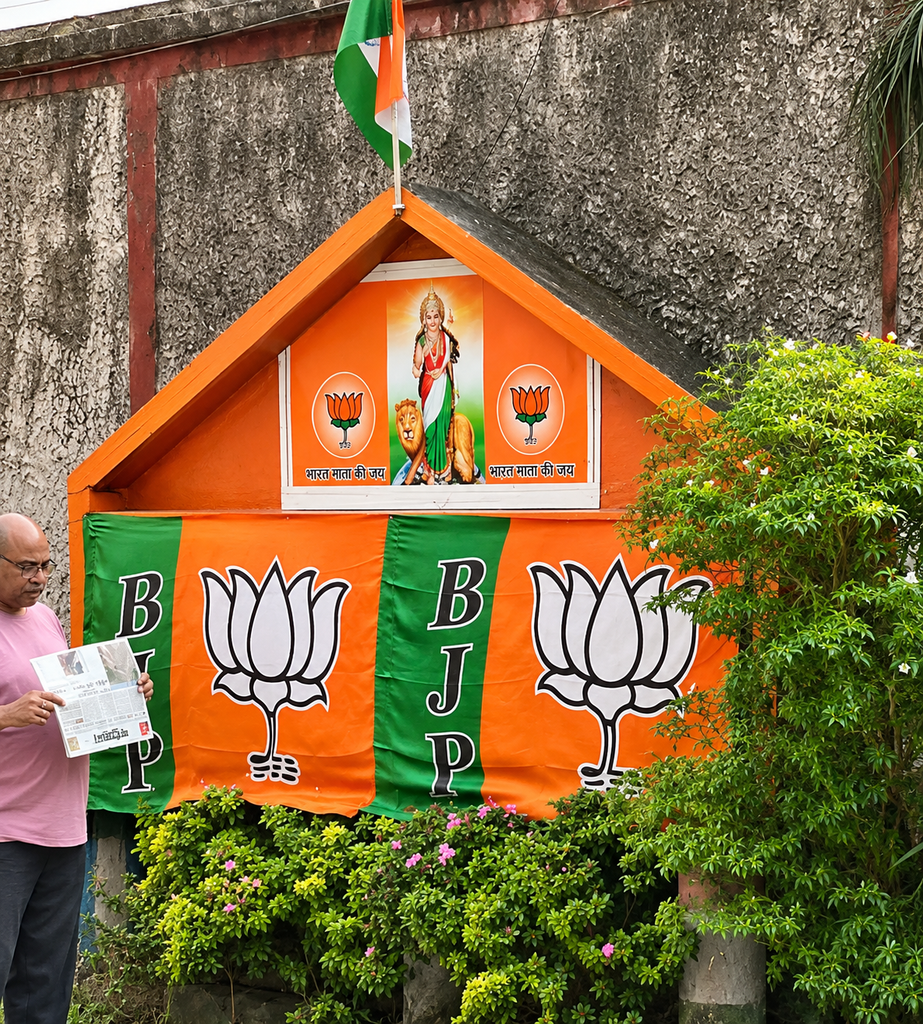
A patrika path kendra/roadside newspaper-reading kiosk in Haltu, Kolkata
The patrika path kendra, or roadside newspaper-reading kiosks, which many Calcuttans have grown up seeing along the sides of roads, typically beside flagpoles for unions and party offices, were originally constructed during the Left rule. They are only one of the sites of contestation. As unions merge into the BMS and erstwhile Trinamool party affiliates are absorbed into the BJP fold, public sites become spaces for partisan confrontation. From repainting road median barriers in colours that shift from Mamata’s palette of blue and white to yellow and white, to changing club hoardings from blue to saffron, the partisan affiliation of the party-society stands out.
The ‘Sacred’ Party-Society?
In a recent response dismissing complaints about late-night firecracker violations during Kali Pujo and Deepawali, CM Adhikari labelled critics as naysayers opposing the “Sanatani awakening” in Bengal. He further added that he would endeavour to prevent the “atheist Communists” and the “Jamaat-influenced Trinamool Congress” from raising their heads.
The shift in nomenclature from cultural pluralism to religious nationalism is instructive in framing political opposition in West Bengal, not merely in terms of policy divergence but by blurring essential distinctions between a political opponent and a cultural adversary to Bengal’s ‘newfound’ civilisational conscience under the BJP.
There is a far more problematic danger at play here, extending beyond a sitting CM blaming political opponents’ environmental concerns over firecrackers, prompted by, to put it mildly, unhealthy AQI levels, on a lack of faith in Hindu traditions.
While the party-society may have been extensively used for political purposes since 1977, there was never a time when it acquired a label of sanctity. In other words, it was never above criticism, whether during the Left Front or Trinamool rule. Yet, as it becomes more deeply entangled with the BJP, its adoption of ‘saffron’ hues may offer much more than a simple shield from the law.
By entangling itself with the sacred colour of Hindu civilisational nationalism, the party-society risks making any opposition to it, at least in discursive terms, appear to be an act of profanity. That is, if opposition to the BJP has been called heresy, could opposition to institutions of the party-society also be construed in the same way?
The question itself may seem a tad too far-fetched. But in August, CM Adhikari and the BJP went on to accuse Anandabazar Patrika of hurting Hindu religious sentiments through its headline “Protik bhenge gerua gundami” (or “Saffron goonism breaks symbols”), which accompanied its coverage of the ABVP’s siege of JU. Alleged BJP workers subsequently went ahead and painted Anandabazar Patrika’s white-coloured office saffron.
With law and order, which has a chequered record, coming under heavy criticism, and UP-style ‘bulldozer justice’ and encounters defining his regime, the implications are significant. To a layperson who fears upsetting the nationalist BJP and believes that it represents the collective interests of Bharat and its Hindu civilisation, the saffron colour, actions drawing on the Hindutva vocabulary and the carrying of saffron flags may become inextricably associated, in both discourse and imagery, with the ruling BJP camp. Opposition to it could then automatically be interpreted as anti-Hindu. The resulting self-censorship over criticism of corruption itself may prove corrosive.
The contradiction between the BJP’s slogan of “Bhoy out, Bhorsha in” (fear out, trust in) during the May 2026 elections has become apparent amid allegations of TMC-style tolabaji. These range from extortion from small businesses and demands for INR 5 lakh in cut money from a real-estate promoter to land grabbing. BJP functionaries have also faced allegations of cheating party workers by promising LPG dealerships and petrol pump distributorship permits.
Dr. Moutusi Paul Chaudhury, in her comments to Karvaan India, remarks: “What we are witnessing in West Bengal is not the expurgation of party-society, but its alignment with the saffron agenda. Governing the state requires inhabiting those very local networks – while Bengal’s own cultural vocabulary inevitably regionalizes the party’s national rhetoric.”
The BJP’s holier-than-thou politics against the previous Trinamool regime has dissipated, and it is increasingly seen as an inheritor of the same politics of might associated with Mamata. Deep Halder writes in The Print about how the BJP has failed to deliver sushasan (good governance) and instead reproduced elements of TMC-era lawlessness. These include khap-style justice, “egg therapy”, strip parades, i.e., public humiliation and vigilante punishment of erstwhile Trinamool strongmen, as well as the bulldozing of CPI(M) bookstalls during Durga Pujo.
The BJP’s sectarian politics thrives on creating a nationalist ‘us’ and an anti-nationalist ‘other’. Trinamool’s corruption, tolabaji, cut money and local strongmen provided the BJP with a ready villain in the muscle and money power that the AITC and Mamata represented. As many rebel AITC leaders are inducted into the NDA or are rechristened the “bhalo Trinamool” (Good Trinamool), with ambiguous alignments with the BJP in Bengal, the BJP’s style of politics requires a new enemy to unite its voters.
It has attempted to do this through a combination of fearmongering against religious minorities, securitising liberal dissent and politicising civilisational-cultural identity, while simultaneously co-opting the very party-society it had promised to uproot.
However, Bengalis voted for an alternative model of governance. The stalled development, industrial decay, unemployment, concerns over women’s safety and the crime-money-politics nexus represented by the Trinamool were rejected by voters in favour of the BJP’s double-engine government.
The insincere U-turn from combating the party-society to now inhabiting and preserving it may ultimately be answered only by the electorate.
Allen David Simon is a researcher and columnist working at the intersection of political culture and governance in the Global South, with a focus on human security in South Asia.