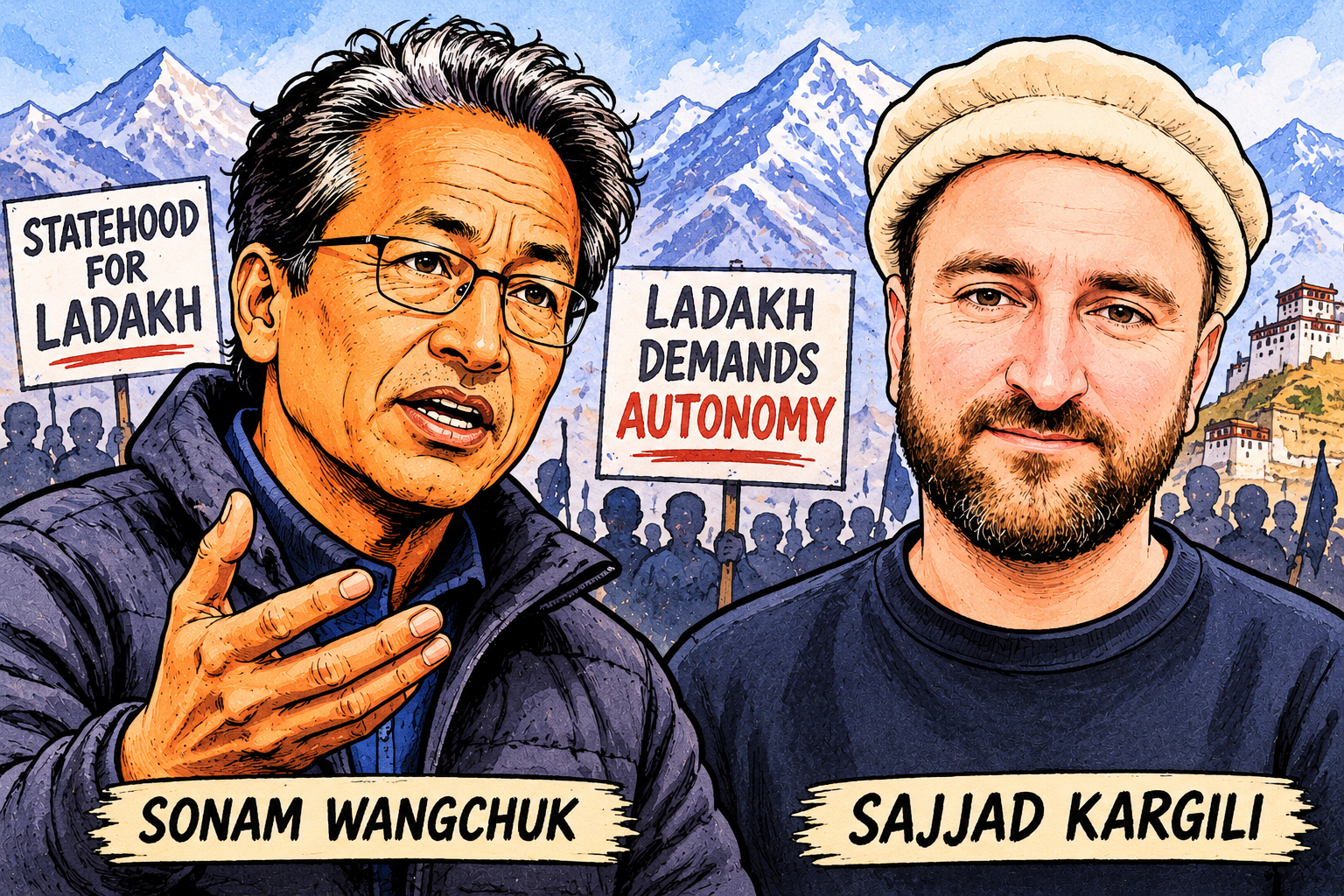
The detention of climate activist Sonam Wangchuk and the protests that followed in Kargil on November 13 have once again brought into focus an unusual political coming together in Ladakh. Despite decades of historical differences, people in Leh and Kargil have increasingly found common ground in their demand for democratic representation, constitutional safeguards and political autonomy.
Wangchuk, who has been at the forefront of Ladakh’s campaign for statehood and constitutional safeguards, alleged on Thursday that he had been placed under house arrest, with dozens of armed personnel deployed outside his residence in Leh. The development came amid renewed protests in the region over the Centre’s handling of Ladakh’s political demands.
The action triggered a strong reaction in Kargil, where the Kargil Democratic Alliance (KDA) condemned the restrictions imposed on Wangchuk. KDA leaders, including co-chairman Sajjad Kargili, addressed a press conference alongside Ladakh MP Mohmad Haneefa Jan and other representatives. The alliance announced a candle march in Kargil and said a delegation would travel to Leh to express solidarity with the protesters.
Wangchuk, in a video message, said he was under house arrest and questioned why the judicial inquiry report into the September 24, 2025 violence in Leh had not been made public. He also objected to the decision to hold the Ladakh Autonomous Hill Development Council elections on December 4, during the harsh winter months.
“The whole of Ladakh is in protest,” he said, while alleging that the reach of his social media accounts had been restricted.
For Kargil, the response to Wangchuk’s detention is about more than solidarity with an individual activist. It reflects a political understanding that has developed between two regions that were historically divided over their political aspirations.
A political divide that began to narrow after 2019
To understand the significance of this coming together, it is important to revisit the political history of the two regions.
Leh, with its predominantly Buddhist population, had for decades demanded separation from the erstwhile Jammu and Kashmir state and the creation of a Union Territory. Kargil, with its predominantly Muslim population, largely opposed the idea, fearing that separation from Jammu and Kashmir would weaken its political representation and leave the region more vulnerable.
Consequently, the August 2019 decision to revoke Jammu and Kashmir’s special status and reorganise the erstwhile state into two Union Territories produced sharply different reactions.
In Leh, the creation of Ladakh as a separate Union Territory was initially celebrated as the fulfilment of a longstanding political demand. In Kargil, however, there was considerable opposition. People feared losing the constitutional protections and political relationship they had enjoyed as part of Jammu and Kashmir.
But the arrangement that followed gradually changed political calculations in both regions.
Ladakh became a Union Territory without a legislative assembly. Its administration came under the direct control of the Centre through the Lieutenant Governor and the bureaucracy.
What initially appeared to be two different political experiences began producing similar anxieties.
For Leh, the principal concerns increasingly revolved around the protection of land, employment, cultural identity and the preservation of its fragile ecological environment.
For Kargil, the loss of statehood and the absence of an elected legislature raised questions about political representation, accountability and the future of its constitutional safeguards.
Both regions began confronting a common question: who would make decisions about Ladakh, and how much say would its people have in those decisions?
The emerging political consensus was that the Union Territory arrangement had failed to deliver the democratic autonomy that people had expected.
From competing aspirations to a common political platform
The formation of the Kargil Democratic Alliance brought together religious organisations, political representatives and civil society groups in Kargil. In Leh, the Apex Body emerged as the principal platform representing the region’s political and social organisations.
The two platforms, despite their different historical positions on the creation of Ladakh as a Union Territory, eventually found common ground.
Their coming together was particularly significant because it required both sides to reconsider decades of political differences.
The common demands included statehood for Ladakh, constitutional safeguards under the Sixth Schedule, reservation in government employment for local residents and greater democratic representation.
In January 2023, the Ministry of Home Affairs constituted a High Powered Committee to discuss these demands. However, disagreements over its mandate and the scope of negotiations prevented the initiative from resolving the underlying concerns.
The subsequent negotiations and joint mobilisation further consolidated the relationship between the two regional platforms.
Speaking to Karvaan India, Sajjad Kargili said the experience since 2019 had helped people in Leh and Kargil recognise that their political aspirations were fundamentally connected.
“Our aspirations are common. We have come to understand that the government does not want the people of this region to have political autonomy, irrespective of their religion,” Kargili said.
He argued that the political circumstances following August 2019 had brought the two regions closer, as people increasingly recognised that their concerns over representation, land, employment and constitutional protections were shared.
Whether someone comes from Buddhist-majority Leh or Muslim-majority Kargil, the fundamental question, according to Kargili, remains the same: why should the people of Ladakh not have the right to decide their own political future?
Ladakh MP Mohmad Haneefa Jan has also acknowledged the significance of this political coming together. The MP has described the joint mobilisation as a historic development, pointing to the unprecedented cooperation between the populations of Leh and Kargil in the movement for statehood and constitutional safeguards.
Jan has consistently argued that Ladakh’s lack of an elected legislature and its administration through bureaucratic structures have contributed to public frustration.
For him, the demand for constitutional protection is closely connected to the region’s tribal character, its distinct identity and the need for democratic institutions that can represent local aspirations.
The convergence is significant because it is being articulated not merely by activists and civil society organisations, but also by elected political representatives.
A movement that crossed religious boundaries
The political relationship between Leh and Kargil became particularly visible during the protests of September 2025.
The agitation, led by the Leh Apex Body and supported by the Kargil Democratic Alliance, was demanding statehood and constitutional safeguards. The protests in Leh turned violent on September 24, leaving four people dead and more than 70 injured.
The violence and subsequent detention of Wangchuk under the National Security Act intensified the political confrontation between the region’s leadership and the Centre.
Even during that period, Kargil’s political representatives maintained their association with the larger movement, demonstrating that the demands had acquired a regional character.
The subsequent release of Wangchuk and renewed engagement between the KDA and the Leh Apex Body kept the question of Ladakh’s political future alive.
The latest developments have provided another illustration of this relationship.
On one side, the Leh Apex Body has renewed its protests, demanding the resumption of dialogue with the Centre, the release of the judicial inquiry report into the September 2025 violence and a resolution to the region’s political demands.
On the other, the Kargil Democratic Alliance has condemned the restrictions imposed on Wangchuk and announced solidarity programmes.
Kargili has described the police action as unjustified, arguing that the constitutional right to peaceful protest cannot be curtailed through administrative orders.
The participation of Haneefa Jan in the press conference alongside KDA representatives also reflects the growing political coordination between the two regions.
What holds the two regions together?
The political convergence between Leh and Kargil should not be mistaken for the disappearance of their historical differences.
Their political histories remain distinct. Their religious and cultural institutions have their own interests, and there are differences over the nature of constitutional safeguards and the future administrative arrangement for Ladakh.
However, the experience since 2019 has demonstrated that these differences do not necessarily prevent political cooperation.
At the heart of the movement is a shared concern about the concentration of administrative power in the hands of an unelected bureaucracy, the absence of a legislative assembly and the limited authority available to locally elected institutions.
The demand for the Sixth Schedule, statehood and employment safeguards has provided a common political framework within which people from both regions can articulate their concerns.
There is also a larger question of identity. For many in the movement, being Ladakhi has acquired a political meaning that transcends religious affiliation.
The coming together of Leh and Kargil challenges the assumption that religious differences must necessarily translate into competing political interests.
The movement has also exposed the limitations of an administrative arrangement that has left a strategically important and culturally distinct region without an elected legislature. While the Centre has repeatedly engaged with representatives of Ladakh, the absence of a political settlement has sustained public discontent.
The question now is whether this unity can be sustained and translated into a political settlement that gives Ladakhis meaningful control over their land, resources, institutions and future.
As protests continue in both regions and Wangchuk faces restrictions on his movement, the message emerging from Leh and Kargil appears increasingly clear: political autonomy has become a shared regional aspiration, one that cuts across the religious and historical divisions that once kept the two regions apart.