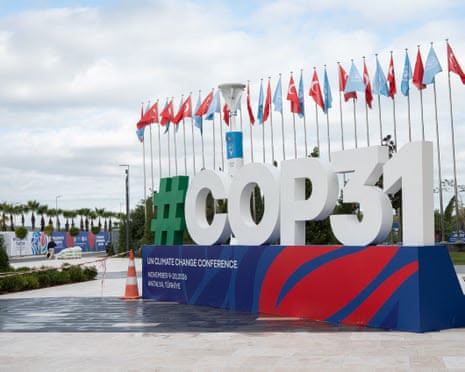
ANTALYA, Türkiye, November 13, 2026, The 31st United Nations Climate Change Conference (COP31), being held in Antalya from November 9 to 20, has brought climate finance, fossil fuel dependency and corporate influence into focus, as developing nations seek greater financial support and environmental organisations raise concerns over the participation of major polluting industries.
A report released on November 12 by Kick Big Polluters Out (KBPO), a global climate justice collective coordinated by the Global Campaign to Demand Climate Justice, identified 103 groups associated with major polluting industries among those admitted to the conference.
According to the report, the groups included 60 fossil fuel industry organisations, 16 fossil fuel financiers, six industrial agriculture and food companies, three Big Tech firms and 20 cross sector organisations. Their combined delegations reportedly outnumbered those of several climate vulnerable nations, including Saint Vincent and the Grenadines (100:1), Niger (25:1), the Philippines (8:1) and Nepal (6:1).
Among the largest delegations were the International Emissions Trading Association (IETA), with 29 delegates, BNP Paribas with 22, HSBC with 19 and Amazon with 12.
The report further stated that 30 of the world’s 100 largest banks financing fossil fuels were represented at COP31. Citing the Banking on Climate Chaos database, KBPO said these institutions collectively accounted for more than US$2.2 trillion in fossil fuel financing between 2021 and 2025.
Lien Vandamme of the Centre for International Environmental Law, a KBPO partner, said, “Big Polluters and their financiers continue swarming COP’s corridors, working to protect their profits, obstruct climate action, and keep business as usual alive.”
Maikel Peuki of WALHI Papua highlighted the impact of corporate projects on forests and coastal communities, stating, “Those who cause pollution should be the ones to pay for the damage they have created.”
Guterres calls for climate justice and corporate accountability
Addressing world leaders on November 11, United Nations Secretary General Antonio Guterres warned that global emissions and rising temperatures were outpacing international climate action.
“The brutal truth is that the climate crisis is outrunning us. Emissions in 2025 reached all time highs. Heat records keep shattering,” he said.
Referring to the influence of fossil fuel companies, he added, “Fossil fuels must go the way of the dinosaurs, but that won’t happen on its own. The dinosaurs did not have a lobby, but fossil fuels do.”
Guterres called for governments to tax the windfall profits of fossil fuel companies to finance climate recovery. He cited US$95 billion in quarterly profits earned by the world’s nine largest oil companies, compared with approximately US$600 million received by the Loss and Damage Fund.
“Polluters must pay,” he said, proposing a global climate justice compact to support developing countries in their transition towards cleaner energy and climate resilience.
World leaders present differing climate priorities
During the Leaders’ Summit, Turkiye’s President Recep Tayyip Erdogan highlighted the relationship between environmental protection, international cooperation and the consequences of armed conflicts.
Brazilian President Luiz Inacio Lula da Silva called for greater international cooperation, while warning that wars and trade disputes were diverting attention from climate commitments.
China’s Vice President Han Zheng emphasised the responsibility of developed countries to reduce emissions and provide climate finance, while urging all nations to fulfil their climate commitments.
Australian Prime Minister Anthony Albanese highlighted cooperation on clean energy, electrification, oceans and climate finance.
Maldives President Mohamed Muizzu called for predictable, grant based climate finance that would not increase the debt burden of vulnerable countries.
Iranian President Masoud Pezeshkian also raised the environmental consequences of military actions, saying he would use the conference to address environmental destruction associated with the actions of the United States and Israel.
Electrification target and emerging commitments
One of the major initiatives presented by the Turkish COP31 presidency is the 35 by 35 Global Electrification Pledge, which seeks to increase electricity’s share of global final energy consumption from approximately 23 per cent to 35 per cent by 2035.
At least 14 countries had publicly endorsed the voluntary initiative by November 12, according to Climate Home News. These included Germany, Norway, Finland, South Korea, Pakistan and several small island nations.
However, the proposal has prompted discussions over whether increased electrification should be accompanied by a corresponding expansion of renewable electricity.
Saudi Arabia’s Energy Minister Prince Abdulaziz bin Salman said, “The expansion of electrification does not necessarily mean cutting emissions, so long as we do not consider the sources of its production.”
Turkiye’s COP31 President Murat Kurum said the summit aimed to move beyond declarations towards implementation, adding that adaptation and loss and damage should remain central to the climate agenda.
Another announcement came from the Leaders Level Methane and Other Non CO₂ Greenhouse Gases Summit on November 12, which secured more than US$480 million in new philanthropic commitments, alongside an additional US$25 million for the Super Pollutant Country Action Accelerator.
Activists question the influence of corporate interests
Swedish climate activist Greta Thunberg, who attended COP31 on November 10, criticised the presence of fossil fuel lobbyists at international climate negotiations.
“It’s a hypocrisy every year that the host countries are given an opportunity to whitewash themselves and we know that these negotiations are filled with lobbyists, paid by the very destructive industries which are benefiting from our extremely violent status quo,” she told reporters.
She also urged governments to prioritise people and the environment over corporate profits, warning that “everything and everyone we love is at stake, the world is heading toward more genocides and ecocides. It is not dying, it is being killed, and we know by who.”
As the conference enters its fifth day, negotiations continue over climate finance, emissions reduction, adaptation and the transition away from fossil fuels. With the summit scheduled to conclude on November 20, participating countries are yet to agree on a final negotiated outcome.