On the afternoon of 15 October, four villagers set out from Molvailup in Manipur‘s Kamjong district towards Phaikoh to buy essential commodities. Hatneikim Haokip, travelling with her husband, Jangkhongam, and another couple, D. Paokhothang Haokip and his wife Boishi, did not reach the market. According to the Kuki-Zo Council (KZC), the four were ambushed between 4 and 5 pm. Hatneikim died on the spot. Her husband escaped with a gunshot wound. The other couple’s whereabouts remain unknown.
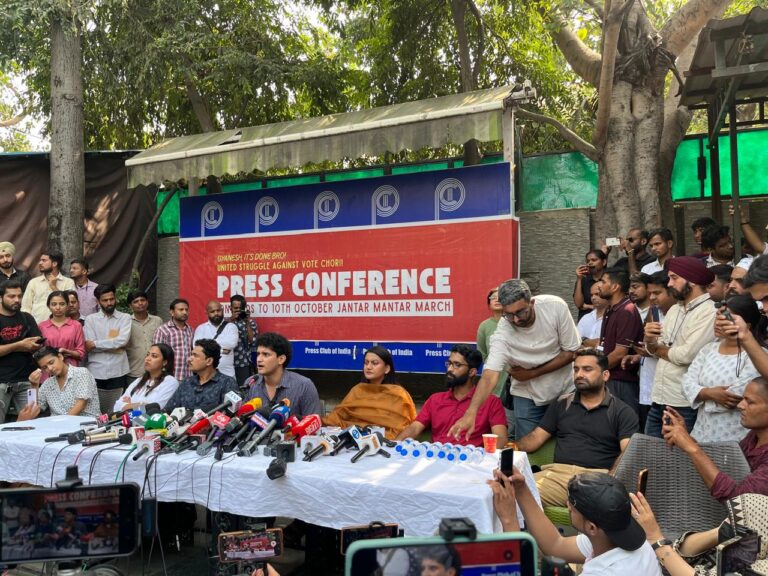
Six days later, the Kuki-Zo Women’s Forum, Delhi and NCR (KZWFD), held a press conference in the capital and submitted a memorandum to the Prime Minister’s Office and the union Home minister. The memo, dated 21 October and stamped as received by the PMO Dak Section on 22 October, puts the number of reported Kuki-Zo civilian deaths at 35, including 13 women and two unborn children.
A chronology of Kuki-Zo Civilians killings
The forum’s press note cites the KZC’s record of 32 deaths between 11 March and 20 October 2026. The KZC chronology, which was shared with Karvaan India, attributes most of them to suspected NSCN-IM and ZUF-K militants. These are the council’s accounts and have not been independently verified.
The record begins in Ukhrul district. According to the KZC, seven Kuki-Zo people were abducted on 10 March, and the bodies of Thangboimang Lunkim and Thengkhogin Baite, who had gone to repair a water pipeline, were found at Thawai Kuki the next day. On 24 April, two men were killed in a pre-dawn attack on Songphel and Mullam villages. On 13 May, three church leaders were killed in an ambush between Kotzim and Kotlen in Kangpokpi, an attack the KZC says came while they were working on peace efforts with Christian leaders from Nagaland.
On 5 June, an attack on Loibol village left three people dead, including Tinmary Haokip. Further killings followed at Kultuh, Lasan and along the IT Road. On 31 August, the KZC says, a woman was shot at point-blank range as she hid under a bed at N. Teikhang, where three people died.
In mid-September came the deadliest stretch. The KZC lists two killed at L. Tollen on 13 September, two at Longpi, and, two days later, a woman in her seventies who had gone to collect firewood and a 28-year-old nursing graduate who had come home to help her parents farm, shot at Leisangphai in Tamenglong. Hemjang Haokip was captured while working in his paddy field on 3 October, and his body was found the next day with his hands and legs bound, the KZC says. The most recent entry is a man who went into the forest with a friend to collect bamboo shoots on 20 October.
What stands out in the record is how ordinary the circumstances are. The dead include a lineman on duty, farmers, a man carrying out repair work and a woman going to buy provisions.
Women in the line of fire
Speaking for the forum, Kim Haokip told Karvaan India that its concern goes beyond the number of women killed. “These women were mothers and primary caregivers, whose deaths have left children and families devastated,” she said in written responses. She said women and other civilians appear unable to rely on safe passage even when they are not taking part in hostilities.
The effect on daily life, she said, reaches well beyond the villages that are attacked. “Parents worry about their children’s safety, women fear travelling alone, and elderly people and those requiring medical attention are particularly vulnerable,” she said. “Our people cannot be expected to live normally when their lives, homes and freedom of movement remain under threat.”
Chassad
The village at the centre of the latest violence is Chassad. The forum describes it as an ancestral Kuki village that played a key role in the Anglo-Kuki War of 1917 to 1919, and says it has suffered three episodes of arson in a single year.
The KZC chronology records two deaths in the village in October. On 9 October, it says, personnel of the Indian Reserve Battalion tried to disperse the Chassad village guards from their posts. When women of the village came forward to defend them, the KZC says, the personnel opened fire, killing Domkhonei Touthang, a mother of five. The next day, it says, 22-year-old Ngamminlen Haokip died in an NSCN-IM attack on the village around 4:30 am. On 17 October, it says, an attack by NSCN-IM and Tangkhul militants from Myanmar killed Seikhohao Haokip and injured three Kuki-Zo leaders, including the village chief.
These allegations, including the one involving state forces, have not been independently verified, and the state government has not responded to them in the reports reviewed by Karvaan India. The Chassad village authority has asked the Centre to intervene.
Security without safety
The forum’s central question is how killings continue where soldiers are present. Its press note cites security officials quoted by The Indian Express on 17 July as saying about 320 companies of Central Armed Police Forces, excluding the Assam Rifles, are deployed across Manipur. “How can such an extensive security presence coexist with repeated attacks?” the note asks.
Kim Haokip put the standard plainly. “Security must be measured not merely by the presence of armed personnel or security camps, but by whether civilians can live without fear, travel safely and return home with dignity,” she said.
On accountability, she was careful. The forum’s accusations against the NSCN-IM, she said, rest on incident-specific accounts and information received, and responsibility for each incident must be established through a proper investigation. Unless the forum has verified details of specific arrests or prosecutions, she said, they should not be presented as established facts. “Allegations must be investigated impartially, evidence must be protected, and those found responsible must be held accountable, regardless of their identity, affiliation or position,” she said. “A ceasefire arrangement or political understanding cannot be a substitute for criminal accountability or a licence for violence against civilians.”
The NSCN-IM has denied involvement in the 15 October ambush, according to the Sentinel.
The political demand
The forum asks the Centre to review the NSCN-IM ceasefire and begin proceedings to abrogate it wherever violations are established. Its press note asks the Home Minister, “What is the purpose of a ceasefire if it fails to protect innocent civilians?” The memorandum also seeks effective enforcement of the Armed Forces (Special Powers) Act and an end to what the forum calls selective NIA operations.
It wants President’s Rule reimposed. Kim Haokip said the return of an elected government does not by itself mean normalcy has returned, and asked whether displaced families can go home safely and whether killings are being investigated effectively. She said President’s Rule should be reconsidered as an interim measure if the present arrangements cannot guarantee security, and only alongside an action plan, independent oversight and a credible political roadmap.
The most far-reaching demand is for a separate administration, in the form of a Union Territory with a legislature. “This is a demand for survival, dignity, justice and lasting peace,” the press note says. Kim Haokip described it as “a pursuit of a secure and dignified future” and not a demand rooted in hostility toward any community.
Ginza Vualzong, a spokesperson for the Kuki-Zo Council, said at a press conference in New Delhi that the demand is a matter of survival. “Our political demand is not merely a political demand. It is a question of our survival. We want to survive,” he said. “Manipur is not a security problem, it is a political problem and requires the solution accordingly,” he said, arguing that continuing violence, both in the Meitei and Kuki-Zo conflict and in recent clashes involving Naga and Kuki-Zo groups, shows the need for a political settlement.
Displacement and a long memory
Beyond the killings, Kim Haokip said, families have lost homes, livelihoods and security. Many depend on relief, and access to healthcare, education and essential supplies remains a serious concern. Women who have lost husbands carry the burden of children and grief alongside financial hardship.
“Rehabilitation cannot be meaningful without security and justice,” she said.
The forum also places the present in a longer history. It recalls the Joupi massacre of 13 September 1993, which it says killed 88 Kuki people, and cites Human Rights Watch for about 1,000 deaths during the conflict of the 1990s. It notes that Kukis faced violence under two different administrations, a Tangkhul Naga chief minister in 1994 and a Meitei chief minister in 2023.
The Naga side
Naga bodies describe a different set of victims and a different set of perpetrators. These civil society organisations are not the NSCN-IM, and their accounts give the Naga civilian perspective, not the armed group’s own.
The Naga People’s Organisation (NPO), Senapati, said on 21 October that KNA-B cadres, together with the Village Volunteers of Eastern Zone (VVEZ), attacked Tangkhul Naga civilians near Kamjong police station gate and Chassad public ground on 17 October. Three civilians were injured, it said, as reported by The Sangai Express. The NPO listed earlier attacks on Tangkhul villages, including Pilong on 24 September and Ningchou on 10 October, and said six Tangkhul Naga civilians have lost their lives. The Tangkhul Naga Long (TNL) also announced a shutdown in protest at the killing of four civilians near Pilong.
The All Naga Students’ Association, Manipur (ANSAM), condemned attacks on 9 and 10 October. It reported six Naga men killed in Kangpokpi and Kamjong and alleged the involvement of KNA-B, Kuki armed groups under the Suspension of Operations (SoO) agreement and the VVEZ. It called the incursions foreign aggression. The United Naga Council has also demanded that the SoO agreement with Kuki groups be abrogated.
A Chassad resident, Oration Jajo, questioned the government’s response to attacks on Naga civilians, The Sangai Express reported. His remarks reflect the anger reported among Naga residents, but they are his own account and do not establish who was responsible.
The NSCN-IM has denied any role in the 15 October ambush. It called the allegation malicious propaganda aimed at stoking ethnic tension, as reported by the Sentinel. When the Kuki Inpi named the group in killings earlier this year, it called the allegation an “opportunistic attempt to exploit human tragedy for political gain”, according to Ukhrul Times, cited by Newsreel Asia. In the reports reviewed, the group has not responded in detail to the specific allegations in the forum’s press note and memorandum.
What remains unanswered
In the material reviewed, the Union government has not responded to the memorandum or explained how the ceasefire applies in Manipur. No public account has been given of what became of Paokhothang and Boishi Haokip, the couple missing since the 15 October ambush. The forum says its demand is simple: that a mother can travel to a market, a farmer can reach his field and a family can return home without fear.