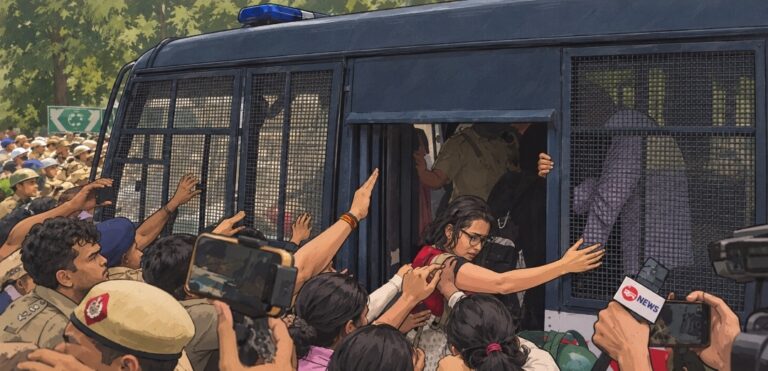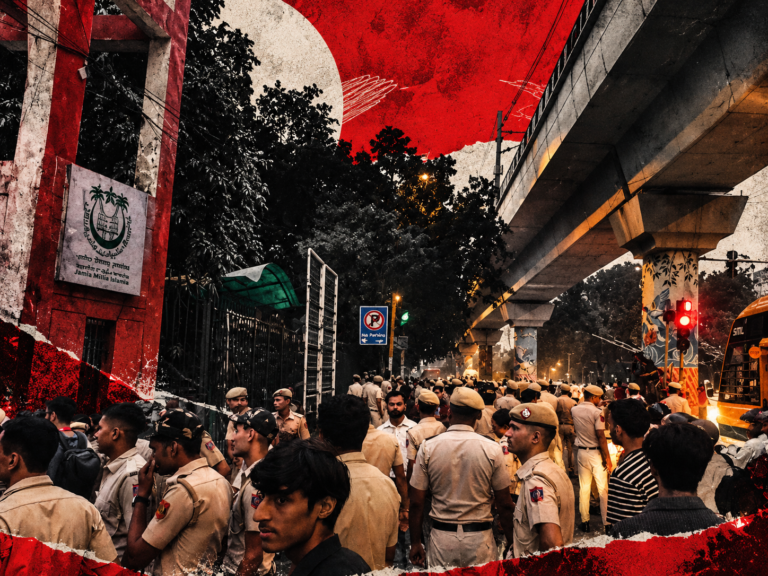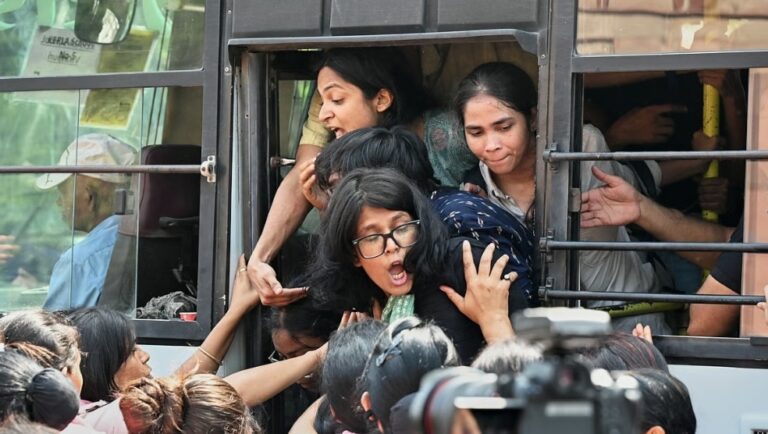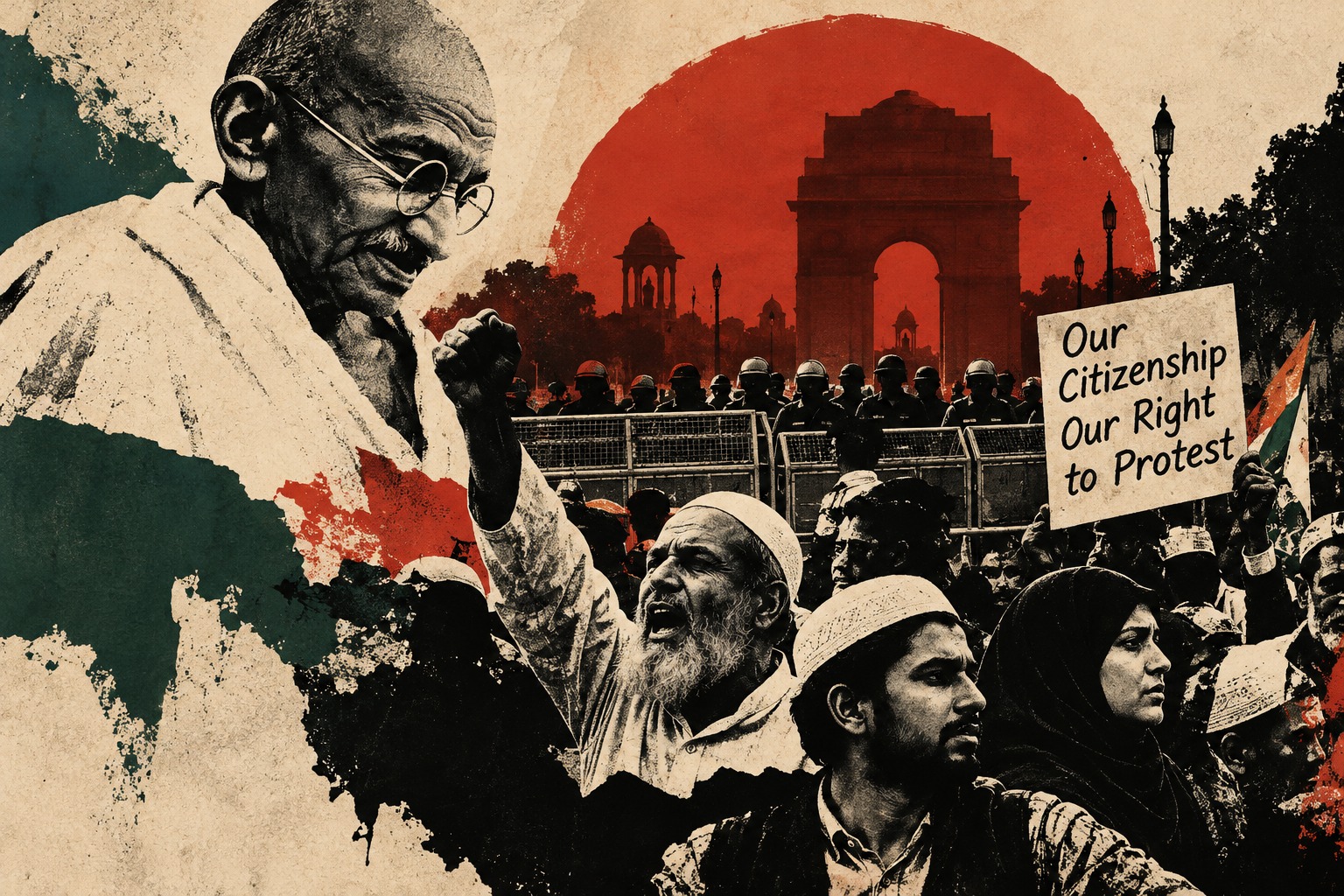
Earlier this month, on October 9, the day before a planned protest against Chief Election Commissioner Gyanesh Kumar, a Delhi Police officer used a mosque’s microphone in Old Delhi to instruct worshippers to keep their children and families away from the protests. An imam was later seen repeating the message to the community. The demonstration, called by the Cockroach Janta Party (CJP) and supported by student groups and opposition organisations, was scheduled for October 10. It demanded Gyanesh Kumar’s resignation over electoral rolls and allegations of disenfranchisement.
The appeal was part of a wider security operation. Delhi Police deployed around 35,000 security personnel, installed barricades, set up detention centres and used extensive surveillance. Muslims neither organised this protest nor made it a community-led agitation, yet Delhi Police chose to deliver their warning through a mosque.
Seventy-eight years ago, in the same city, Mahatma Gandhi was prepared to die so that Delhi’s Muslims could live without fear. On January 13, 1948, at the age of 78, he began his last fast, which he said he would end only when peace returned to Delhi. He ended it on January 18 and was assassinated twelve days later, on January 30.
Today, Muslims are taught to calculate the consequences before they join a protest. The community may not join every protest, but when it does, the state makes its choices suspicious.
When Gandhi refused to let Delhi abandon its Muslims
Delhi was still reeling from the violence that followed Partition in January 1948, which had devastated communities and displaced millions. Muslims who remained in the capital faced threats, economic boycotts and restrictions on movement. According to the accounts of the time, 117 mosques had been occupied or converted into homes and temples.
Gandhi refused to accept this as the price of Partition. His fast began amid a dispute over the ₹55 crore owed to Pakistan under the Partition settlement. He supported releasing the money, but the fast was about something more fundamental: whether Muslims could continue to call Delhi home without living in fear.
On January 17, Maulana Abul Kalam Azad announced seven conditions under which Gandhi would end his fast. Muslims had to enjoy complete freedom of worship at the shrine of Khwaja Qutbuddin Bakhtiar Kaki in Mehrauli, including the Urs. Mosques converted into temples or residences had to be restored. Muslims had to be able to move freely through the areas where they had lived before the disturbances, and to travel by train without fear of attack. The economic boycott had to end. Muslims also had to retain the freedom to decide whether Hindu refugees could live in their localities, and those who had fled to Pakistan had to be allowed to return to Delhi if they wished.
These were not requests for special treatment. They were demands that Muslims be allowed to exercise rights that should never have depended on the goodwill of their neighbours. On January 18, more than a hundred representatives signed a pledge to restore communal harmony and meet Gandhi’s demands, and the frail old man ended his fast. His fast was a refusal to accept a peace that required Muslims to make themselves invisible. Peace meant confronting those who threatened them, not asking the vulnerable to retreat from the city they called home. That is the very principle missing today.
The cost of speaking, and the pressure to stay silent
Muslims have not always stayed away from protests. During the anti-CAA movement of 2019–20, Muslim women, students, workers and families occupied public spaces to challenge a law they believed threatened India’s secular foundations. At Shaheen Bagh and across the country, women braved winter nights reading the Constitution, singing the national anthem and asserting their place as equal citizens.
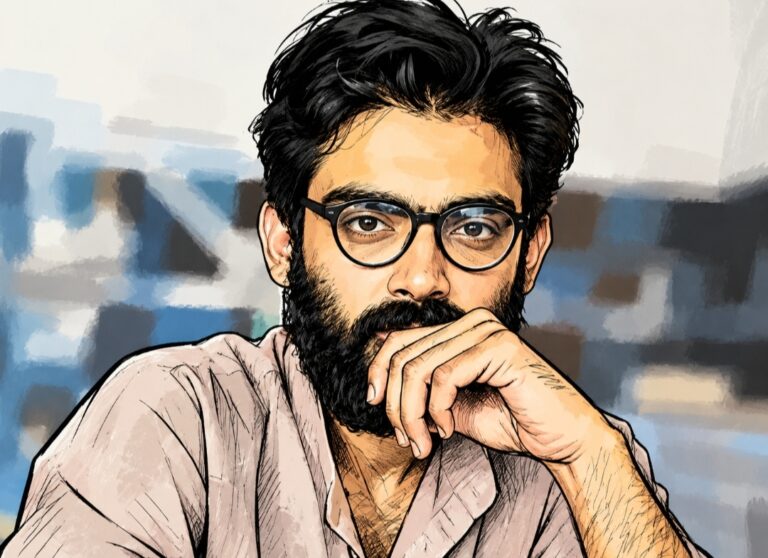
The fear has accumulated since then: the violence of February 2020 in northeast Delhi, the criminalisation of dissent and the prosecution of activists who opposed the citizenship law. Fifty-three people were killed in the Delhi violence, most of them Muslims. Umar Khalid and Sharjeel Imam were arrested in the larger conspiracy case linked to the riots and have spent years in custody without trial. Their prolonged incarceration is one of the clearest examples of the consequences that political dissent carries for Muslims, visible to everyone watching.
The message was reinforced in June 2022, when Muslims took to the streets after remarks about Prophet Muhammad by the then BJP spokesperson Nupur Sharma and party leader Naveen Kumar Jindal.
Authorities responded with arrests and force. Police firing killed two protesters, including a 15-year-old boy in Jharkhand, and videos showed police beating detained protesters in Uttar Pradesh. Javed Mohammad, an activist, was detained in Prayagraj, and his family home was demolished two days later. The notice was issued in his name, although the property belonged to his wife, who had not received one.
In a report released in February 2024, Amnesty International examined 128 properties demolished across Assam, Delhi, Gujarat, Madhya Pradesh and Uttar Pradesh in 2022, affecting at least 617 people. It described the demolitions as punitive and unlawful forced evictions.
For Muslims exercising their democratic rights, the risks of arrest, prolonged prosecution, violence, loss of livelihood or even the demolition of a home are not abstract. Over time, many have begun to hold themselves back, weighing what speaking out might mean for their families and what happened to those who spoke before them. This is self-censorship.
There is another layer to this pressure. Members of the majority community, including some who have long stood alongside Muslims, discourage them from joining protests in good faith, assuring them that others will fight for their electoral rights. On April 1, 1947, when a Hindu man objected to the recitation of a Quranic verse at his prayer meeting in Delhi, Gandhi refused to let that objection determine the terms of the gathering. Defending the vulnerable when they are under attack is a solidarity that must extend to their right to occupy public spaces and raise their voices, and to shape the struggles that determine their own lives.
When the right to vote is also under threat
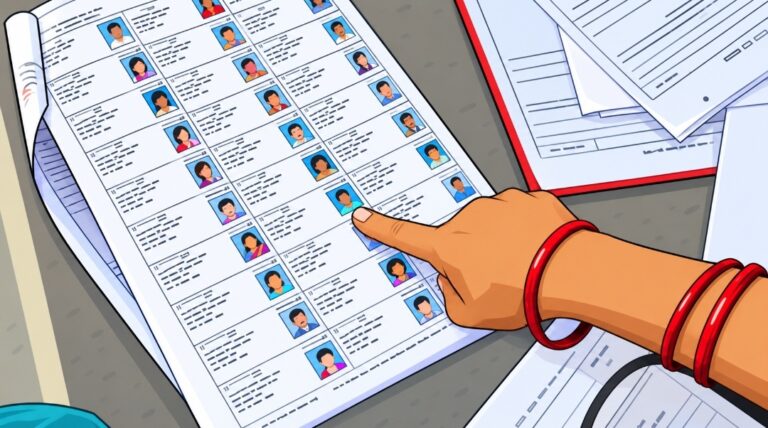
The warning inside the mosque came amid a wider struggle over the right to vote. More than 13 crore names were deleted from draft electoral rolls during the controversial Special Intensive Revision (SIR) process, which began in June 2025, raising serious questions about the scale of electoral exclusion. The deeper concern is the disproportionate impact of these deletions on already marginalised communities, particularly Muslims.
Muslims accounted for 95.5% of deletions across seven supplementary lists in Nandigram, although they make up roughly a quarter of the population. An investigation by The Reporters’ Collective documented bulk deletion attempts targeting Muslim voters in Tarabganj and Pilibhit in Uttar Pradesh, where 90% of deletion requests were filed against Muslims. The same publication documented repeated attempts to remove 78,384 voters in Bihar’s Dhaka constituency, with a letter on BJP Bihar headquarters letterhead claiming they were not Indian citizens. Almost all the names on the list were Muslim.
UN Special Rapporteurs flagged that the SIR may have disproportionately affected Muslims, Bengali-speaking citizens and other minorities, including people reportedly excluded despite possessing valid identity documents. Around 27 lakh voters were declared ineligible after adjudication and could not vote in the April 2026 Assembly election while their appeals were pending. Tribunals had decided only about 2% of nearly 38 lakh appeals by August 7, and of those decided, 91.13% resulted in voters being restored to the rolls. They had already missed an election. The burden of proving eligibility is itself an obstacle for the elderly, for poor families and for those without readily available records.
The right to vote is not a favour granted by the state. It is how citizens hold power to account. For Muslims, the fear of exclusion now extends from the street to the ballot box: their voting rights are under threat, yet they are being discouraged from taking to the streets to defend them.
The burden of being a citizen
In Pakistan or the Partition of India, B.R. Ambedkar asked whether independence would produce a democracy of equal citizens: “Are the Hindus to be a ruling race and the Muslims and other minorities to be subject races under Swaraj?” Muslims facing discrimination is not the only problem. Their rights are increasingly treated as conditional: on where they live, what they say, whether they protest, how they respond to the police and whether their presence is politically convenient.
Muslims do not become less entitled to democratic participation because they are vulnerable to intimidation. They do not lose the right to protest because other people fear unrest. And they should not have to accept humiliation as the price of staying safe. The irony is that some people who urge Muslims to stay away also insist that they will defend Muslim rights. A right defended only by others, while its holders are expected to remain silent, is a fragile right indeed.
Gandhi was prepared to die because Delhi’s Muslims could not live freely. Seventy-eight years later, the test remains. The difference is that the warning now comes before they even step outside. Gandhi’s final fast insisted that the safety and dignity of Delhi’s Muslims were a matter of national honour. Indian democracy today faces a test of its own: whether Muslims can exercise their rights without fear, and whether the state recognises their protection as a duty, not a concession. A democracy that takes pride in its freedom cannot ask a section of its citizens to stand aside while others exercise it. Muslims are not spectators to Indian democracy. They are its citizens, and their rights are not negotiable.