Public art lies in a complex matrix of public space, art, and government policies and their implementation. These elements affect not only how works of art are conceived, funded, formed, placed and received, but also the very meaning of the artworks themselves and whether they can be said to truly constitute public art. When one talks about public art policies and their implementation, it is usually their stated aims and intentions, the number of artworks, or their preservation for the future that is considered important. However, by applying Rosalyn Deutsche’s critique of public art, in her seminal essay “Agoraphobia” (1996), to the specific case of the Lodhi Art District, this essay analyzes the gap between Indian public art policy and whether such works are truly for the people, by the people and used by the people.
What counts as public art
There have been vigorous debates about the very definition of public spaces and public art. “Public Art?” asks the British sculptor Antony Gormley, as if rhetorically, in an essay with the same title. Instead, Gormley asserts that there is no such thing as public art; either it is art or it is not (Gormley 2016). However, Rosalyn Deutsche contends that public space is a necessary corollary of democracy (Deutsche 1996) and, by extension, of the difference between private and public art. According to Gormley as well, all art, whether permanent or impermanent, deserves to be seen, celebrated and contested in spaces that are not privately controlled. Art, for Gormley, has always been a part of our collective commons and, from time to time, artists have even been able to escape the clutches of the patronage of power, allowing even consumers of art to participate in the co-production of value and meaning in art (Gormley 2016). The very definition of public art is therefore closely connected with public space, public policies and patronage.
Public art in India: from temples to the state
In the Indian context, during pre-modern times, monumental sculptures, murals and architecture formed public art that was openly accessible and served public or community functions. The purpose of these artworks was instructional, ritualistic or spiritual, and they also acted as historical or social records at the behest of their patrons. Fundamentally integrated into the community and funded by monarchs or elite patrons, these were rarely intended to be critical of the social order they depicted. Yet a few examples survive of spaces and artworks where critical commentary or subversion existed implicitly or explicitly. Among these can be cited secular carvings on temple walls featuring human figures and scenes from everyday life alongside depictions of gods and goddesses. One interpretation of the erotic sculptures at Khajuraho also sees them as challenging the rigid puritanical or Brahmanical social codes of that time by openly celebrating sexuality, which was and still is not a common topic of public discourse. Critique or subversion in public art in pre-modern India can therefore be said to be rare or implicit, but not non-existent.
In post-colonial times, the state began using art to create a national or civic identity, often through a top-down, non-dialogic, non-critical model. Rooted in religious and communal narratives, art was explicitly commissioned for political and ideological goals. The purpose was nation-building and modernism, to unify a diverse populace after Independence in 1947. Patronage also shifted from the court, the temple or the religious patron to the state and its institutions, such as the Lalit Kala Akademi. Commissioned by central and state governments, ministries or state-run enterprises, these artworks were located in public spaces chosen by planners. Instead of complex public discourse, they were intended to evoke national pride, historical memory and commemoration. Works such as The Triumph of Labour, a sculpture made in 1959 by Devi Prasad Roy Chowdhury, highlighted the marginalized by celebrating the dignity of work and the common person. However, this also fell in line with the socialist-leaning Indian state.
Critical and participatory practice
Subsequently, the focus shifted to critical, site-specific and participatory practices centred on the specific histories, materials or communities of a place. Through independent artist movements, genuinely critical public art began to emerge with socially engaged practices. As early as the 1970s, Jogen Chowdhury’s murals and drawings acted as critiques of political corruption and the erosion of moral values in post-colonial Indian society. Vivan Sundaram’s Structures for Memory in 1998 critiqued the persistence of a colonial legacy and questioned which monuments we choose to remember and which to forget. Ephemeral public art, such as theatrical performances on streets and in rural public spaces, also highlighted land rights, social injustice and political corruption.
Independent artists, therefore, actively used art forms to protest, promote and provoke, turning public spaces into sites for debate and dissent on social and political issues.
At the same time, public art programmes in India have tried to unify public spaces under the banners of historical continuity, preservation of cultural tradition, civic beautification and utilitarianism. This is most recently exemplified by Project PARI (Public Art of India), launched in 2024, which states among its aims to “highlight the aesthetic and cultural diversity of India… contributing to a sense of pride and belonging within a community” (Ministry of Culture 2024).
Public space and public art have therefore often been associated with consensus, unity and universalism, while pluralism, division and difference have been relegated to the realm of the private and the individual artist (Deutsche 1996: 281). But Deutsche contends that public space is actually where the identity, meaning and unity of society are debated and constituted (Deutsche 1996: 273). PARI also seems to agree with this, as another of its aims is to stimulate “dialogue and reflection” (Ministry of Culture 2024). But how far is this truly applicable in the case of the Lodhi Art District?
The Lodhi Art District: a partnership model
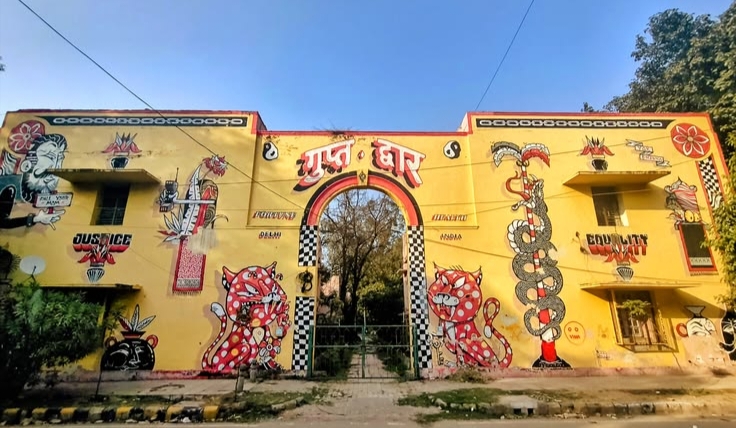
Although the Lodhi Art District was not created under PARI or any one specific public art policy, the collaboration of an NGO, government bodies, government campaigns and corporate sponsors complicates its case. The Lodhi Art District was initiated in 2015 by the St+Art India Foundation, a non-profit organization focused on making art accessible in public spaces beyond conventional museum and gallery spaces. The foundation partnered with the Central Public Works Department (CPWD), the New Delhi Municipal Council (NDMC) and campaigns like the Swachh Bharat Mission (Clean India Mission). The project also collaborated with corporate sponsors such as Asian Paints, which supplies paints for the foundation’s works. The government-owned buildings of Lodhi Colony, dating to the 1940s, were used as the canvas for the murals, which number over 60. More than 50 renowned artists from India and the world worked on the project. The murals focus on a wide range of themes, such as social issues and empowerment, environmental concerns, Indian culture and mythology, community and everyday life, globalization, and the social media and smartphone revolution (Lodhi Art District).
Safe themes and consensus
For Deutsche, public space and public art cannot be defined simply by their physical accessibility to the people. Inclusion and exclusion are not defined only by the physical location of public art. Instead, it is by provoking and encouraging critical thought, deep reflection and necessary public discourse that a work of art becomes truly public (Deutsche 1996). This argument can be used to critique the “publicness” of the majority of the Lodhi Art District murals, which lean toward “safe” or consensus-driven themes. Many murals in the district focus on themes that generate wide-scale agreement and positive emotion. Examples of Indian culture and heritage include Vishwaroopa by Inkbrushme, Padma by Chifumi, Crazy Katha Twins by Harsh Raman, Miniature Painting by Mahendra Pawar, Fusion Art in Gond style by Rakesh, Valley of Elements in Warli style by the Vayeda Brothers, The Lotus by Suiko, The Sacrosanct Whole by Aaron Glasson, Dilliwalle in Gond style by Bhajju Shyam and Dead Dahlias by Amitabh Kumar, among others (Lodhi Art District).
Murals emphasizing nature, ecological themes, climate change or organic unity include Visions of Altered Landscapes by Aaron Li Hill, Colours of the Soul by Senkoe, These Rock Pigeons Chose the Trees by Adele Renault, Gracious Heritage by Majlis Art Forum, Terracotta by Tellas, Original Aboriginal by Reko Rennie, Order in Chaos by DALeast, How is Global Warming by Gaia, Facing Walls by Bicicleta Sem Freio and Untitled by David Leitner, among others (Lodhi Art District).
Everyday life and local scenes find visualization in Impressions of Lodhi by Yip Yew Chong, We Love Delhi by LEK and Sowat and Hanif Kureshi, The Tourist by Avinash and Kamesh and Social Media Friendly Plants by Sameer Kulavoor, among others (Lodhi Art District).
At the same time, the Lodhi Art District does feature artworks that comment on gender and class hierarchies, such as Trans Lives Matter by the Aravani Art Project, Flowers of Dharavi by Alaniz, Shakti by Sajid Wajid Shaikh, Pink by Dwa Zeta, From Strength, I Weave Beauty by Shilo Shiv Suleman, Amma by Blaise, Don’t Let This Symbolism Kill Your Heart by Nafir and Lavanya by Henrik, among others. Such works make marginalized people and voices visible, address mental health, satirize social media consumption and comment on urban alienation and decay (Lodhi Art District).
Community, permission and sanction
A lot of the work for the Lodhi Art District happened with residents, local municipalities and governments, for access and permissions, and that involved the community directly. The artist Dattaraj Naik created the design, and residents shared words or phrases on what their neighbourhood means to them. These words were visualized on the wall called “Saath Saath” (Guided Walking Tour 2019). The Trans Lives Matter mural was led by Chandri N, Purushi, Jyothi, Poornima Sukumar and Sadhna Prasad of the Aravani Art Project, making a statement on social inclusivity (Aravani Art Project). For the New Delhi mural, the Polish artist NeSpoon, along with the women at the Aga Khan Foundation, developed patterns inspired by lace, which were later incorporated into the painting (Lodhi Art District). At the same time, can murals such as Lavanya by Henrik, featuring the portrait of Vimla, a woman who works at Old Khanna Market in Lodhi Colony, and Flowers of Dharavi by Alaniz and Federica, featuring a young girl from one of the world’s largest slums, really be said to bring in questions of female empowerment and class hierarchies and discrimination?
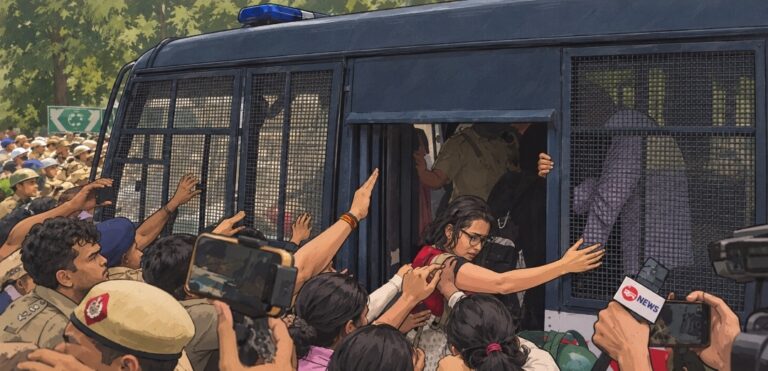
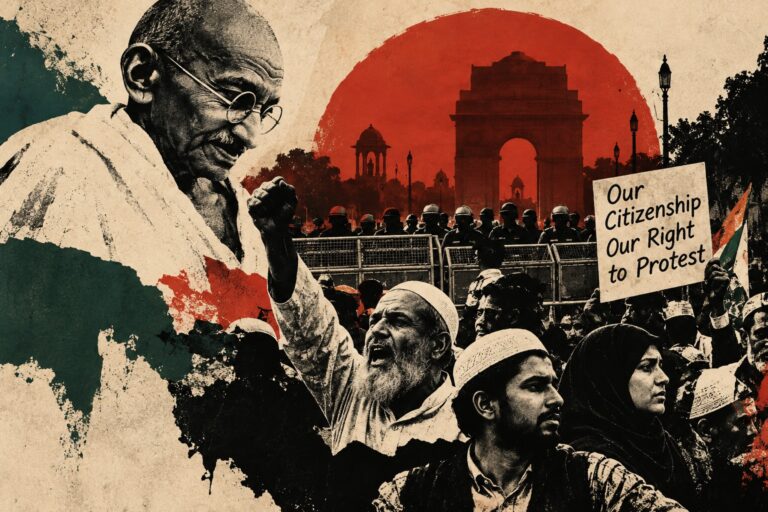
More importantly, does the high degree of official sanction restrict the critical power of the artworks and thereby prevent the Lodhi Art District from becoming a space for dialogue and reflection, as stated and intended by a public art initiative such as PARI? Avoiding direct, explicit political confrontation with the state or controversial socio-economic policies, the themes feature approved social commentary or universal, digestible messages. Socially focused, instead of state-focused, these are public art with permission, which inherently limits their potential for contestation. How does the Lodhi Art District, sanctioned by public art policies, fare against public art that has been erased and for which artists have been detained? The partnership model also suggests that the artworks’ creation and propagation are managed by powerful institutions and branded by commercial sponsors. This moves the public experience of art away from rational-critical debate and toward the passive consumption of sponsored publicity.
Beautification and city branding
This, however, falls in line with Deutsche’s argument that the true uses of public art within contemporary urban processes are ideological and political. The construction of such images of well-managed and beautiful cities is part of a technocratic vision, according to Deutsche (Deutsche 1992). The development of public art or the Lodhi Art District is also closely linked to contemporary architecture, urban planning and patronage. As stated, the murals use government CPWD buildings as their canvases. The arched gateways and windows, along with meandering creepers and tree branches, are fully integrated into the works of the artists and often add to the effect of the paintings. The designation of Lodhi as “India’s first open-air art district” transformed a quiet residential quarter into a major tourist destination.
The art now functions as a powerful tool for city branding and attracting visitors, a key goal of urban planning and development. One only needs to visit the area once to see people busily photographing the wall paintings. The number of YouTube videos and social media posts featuring the artworks also attests to their attraction and to how the area has been beautified. The association of the project with campaigns like the Swachh Bharat Mission, which also finds visual mention in one of the murals by the painter Kafeel, implies a mandate for civic improvement and aesthetic cleanliness. Accordingly, the art functions as a kind of public clean-up, using colour and creativity to address the erstwhile monotone walls and palette of the district.
Power or political decision-making is essential for policies of public art. However, Deutsche argues that when such social spaces are given a “proper” meaning, this diminishes the meaning of public spaces and their public art. Such “beautification” projects, which claim to serve the people, instead hide underlying conflicts such as displacement or the suppression of marginalized narratives. Genuine democratic public art policies, and the public works that result from them, do not aspire to unify but rather actively accommodate plurality, difference and political disagreement (Deutsche 1996).
Where the gap lies
The gap between public art policies and their implementation in the Lodhi Art District, therefore, does not lie in the material deterioration of the murals under human and environmental interference, as many have lamented. Indeed, the preservation of these artworks seems to be the first worry that arises when one sees them. Concerns about permanence supersede concerns about criticality, which is a vital element of public art. However, the gap between policy and implementation lies in the very themes and their visualizations, which avoid conflict and political struggle almost entirely. The actual policy limitations, therefore, lie in the artworks not realizing the true potential of public art.