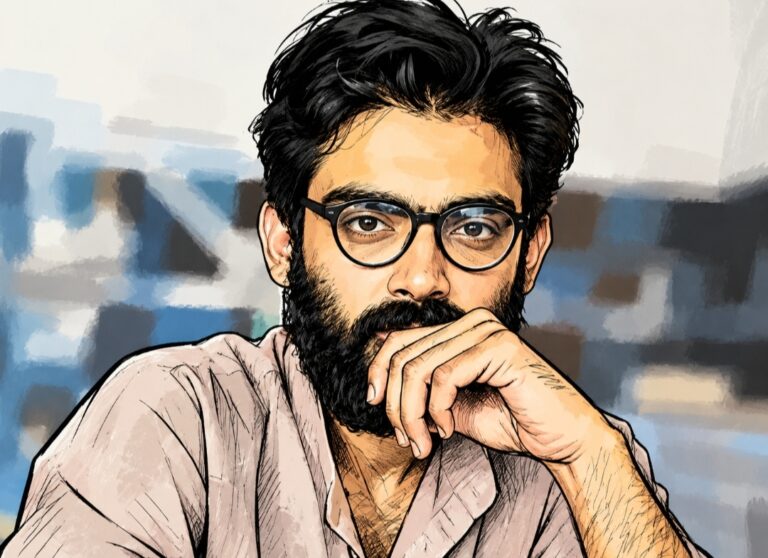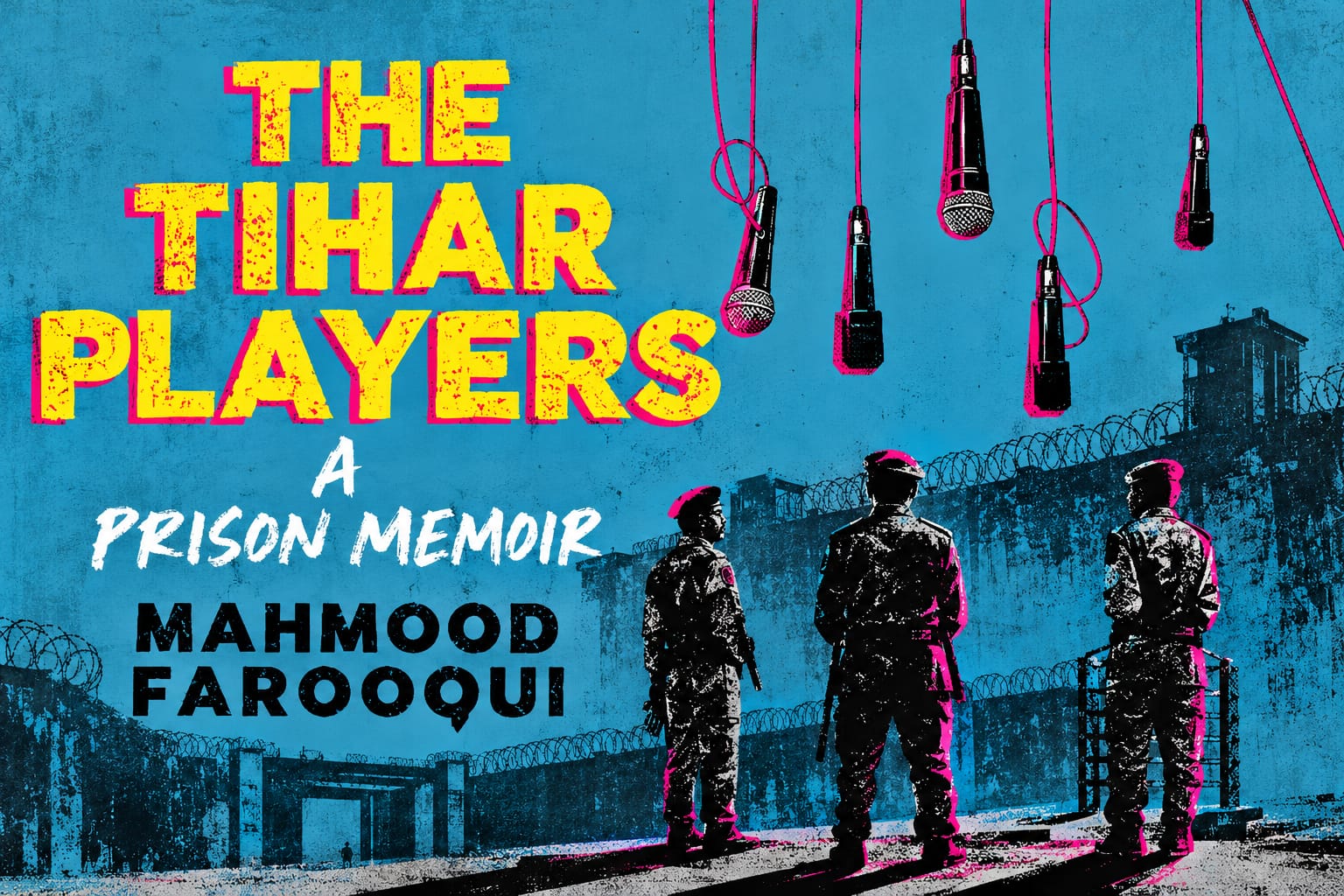
Mahmood is an old friend, an intellectual with a deeply emotional core and a remarkable capacity for resilience. He has an almost insane ability to carve creativity out of chaos. A historian and storyteller par excellence, he brought the nearly forgotten art of Dastangoi back to life, making an old tradition speak to contemporary audiences again. There is a sly humour, a sharp eye for the absurd and an understated satire in his storytelling. There is much more to Mahmood than even his immense popularity as a Dastangoi performer might suggest. The Tihar Players offers another window into that remarkable mind.
There are prison memoirs written by people who survive incarceration, and there are prison memoirs written by people who discover a world inside it. The Tihar Players belongs to the second, rarer category. Mahmood Farooqui enters Tihar under circumstances that could easily have destroyed a sensitive, intellectually restless man. He is not Faiz, Maulana Azad or Nehru, entering prison with a political cause and the companionship of a movement. He is a filmmaker, theatre director and writer arrested under Section 376, carrying the particular ignominy and stigma of a rape accusation. The legal battle is being fought outside by Anusha, his brothers, friends and lawyers. Inside there is no revolutionary fraternity to sustain him. There is only the prison, the charge, the waiting, and the possibility that the liberal, cultural world to which he belonged may now look at him differently.
Yet the extraordinary thing about Farooqui is that he does not allow prison to become the whole story. He begins, almost instinctively, to look.
The prison becomes a world
There is a useful comparison here with Mary Tyler’s My Years in an Indian Prison. Tyler, writing as a foreign prisoner, gradually discovers that incarceration is made less of spectacular punishment than of the mundane choreography of prison life: the counting, waiting, food, bathing, movement, warders, permissions and routines that eventually become an entire world. Farooqui discovers much the same world at Tihar, but from an entirely different position. He is not an outsider observing India; he is a filmmaker, theatre director and writer who has suddenly been forced inside the frame.
Tihar is encountered through its small machinery: ginti, deodhi, chakkar, wards, barracks, munshis, warders, superintendents, permissions, prohibitions and endless waiting. The grand authority of the State is experienced through very small things. When he is summoned by the DG Prisons, the highest authority in Tihar, he imagines that Zeus himself has called him. The joke is characteristic. Even when the institution possesses almost absolute power over him, he instinctively turns the experience into something he can observe.
What saves the memoir from becoming simply an account of his own ordeal is that he starts looking outward. He notices the routines, the hierarchy, the petty rituals of authority, the language of the warders and the strange social order produced by confinement. The prison becomes a society, and Farooqui becomes its observer.
That is the beginning of his survival.
How The Tihar Players turns a prison into a society
What distinguishes Farooqui is his capacity to move across the prison’s social landscape. He talks to men accused of petty offences and men accused of terrible crimes; to barely educated inmates and educated ones; to warders and senior officials. He prays with Muslim inmates, observes Hindu rituals, reads, teaches and eventually directs plays. His education, from Doon School and St Stephen’s to Oxford and Cambridge, has not made him incapable of curiosity about people outside that world. Nor does his own stigma make him eager to reduce others to their charges.
Badal is one of the most affecting examples. A Bangladeshi inmate who began with little formal education educates himself in prison, passes examinations and struggles to argue his own case. The achievement is inspiring, but the circumstances are devastating. Prison becomes the place in which he has to discover the person he might have become outside it. His continued incarceration also exposes something more painful: how a petty case or wrongful conviction can become an almost endless punishment when a family lacks the money, knowledge or support to fight the system effectively.
The elderly Sikh prisoner, Rathi the former policeman, Haji Sharafat, Bhanu and the others gradually cease to be “inmates” and become characters. Farooqui neither sanctifies nor demonises them. They are frightened, vain, funny, cruel, generous and vulnerable, often within the same afternoon. The charge remains, but it does not become the whole person.
There is a dry comedy in this observation. The male prisoners worry that imprisonment has made them thinner, weaker and less virile. The anxiety about the body is really an anxiety about agency: the man who can no longer control his life begins to wonder whether he can still clench a fist or remain sexually potent. Then the men shout at people outside the prison van and discover that they can still make a free man blush. Power has not disappeared; it has merely become ridiculous.
The same instinct appears when prisoners borrow good clothes and shoes for tarikh. If the institution insists on seeing them as accused bodies, they arrive at court dressed as somebody. Farooqui sees the suffering and the absurdity of the suffering without allowing either to cancel the other.
Doubts in prison: how faith returns
The deepest inward movement of the memoir is his return to faith. Farooqui had lost his belief at eighteen after years of prayer, argument and rebellion, eventually becoming, in his phrase, a “confirmed and veteran atheist.” Prison does not suddenly make him a believer. It makes him vulnerable to belief again.
The question has a larger cinematic history. Ingmar Bergman’s Winter Light, Robert Bresson’s Diary of a Country Priest, Andrei Tarkovsky’s Andrei Rublev, Martin Scorsese’s Silence and Paul Schrader’s First Reformed all ask what happens to belief when certainty disappears. In Winter Light, the pastor confronts God’s silence; in Silence, faith survives even when its external forms appear destroyed; in Andrei Rublev, the possibility of creation itself becomes a way back from spiritual paralysis. Farooqui’s answer is less theological and more intimate.
He is frightened, hurt and humiliated. He enters the roza barrack, reads the Quran, fasts and prays. Muslim inmates include him in their rituals. At the same time he encounters a Hindu religiosity very different from the liberal, cultural Hinduism familiar from his education: Monday and Tuesday fasts, Navratri, food taboos, tulsi, sandhya puja, Hanuman Chalisa, Sundar Kand and the Mahamrityunjaya Mantra. One inmate survives a fast on a single laung and water. The promise in the Hanuman Chalisa of release from chains acquires an almost painfully literal meaning inside a prison, and Farooqui begins reciting it himself.
The intellectual has spent years thinking about religion; the prisoners simply practise it. His own return is therefore not a conversion but a gradual re-entry into something he thought he had left behind. Faith returns not as certainty, but as an act of survival.
Perhaps you begin with a book. Then a pen. Then another human being. Then a prayer. Then a story. And somewhere inside the telling of it, faith returns.
The father, remembered in fragments
This becomes more poignant because his father keeps returning to the narrative, not as a solemn monument but in fragments: annoying, affectionate, funny, difficult, devout and vulnerable. The father knew innumerable verses by heart and prayed five times a day. After his stroke, he lost his memory and independence. Farooqui watches the humiliation of a man who once controlled his own life and then recognises something disturbingly similar in himself. The father loses control of his body; the son loses control of his life.
There is a beautiful irony in the inheritance. The father loses the memory of the verses he once carried within him; the son, who had rejected that inheritance, now finds himself in prison reading and reciting them. His father’s faith becomes something he can no longer simply dismiss. And when what Farooqui longs for in prison is to embrace his father and cry on his shoulder, the philosophical question becomes suddenly human. The God he had rejected is entangled with the father he had resisted.
A pen, a book, another world
For a writer, the search for a pen and paper is almost a miniature drama of freedom. Then comes the library and the books: Dostoevsky, Chekhov, Tolstoy, Faiz, Premchand, Intizar Husain, Maulana Azad. Literature begins to furnish the prison with another geography.
At first Farooqui resists Dostoevsky. Dostoevsky in prison? Surely that would be too bleak. There is something wonderfully comic about a man actually incarcerated worrying that The House of the Dead might make his circumstances psychologically worse. But the joke reverses itself. Prison makes Dostoevsky recognisable.
Chekhov feels safer; Farooqui reaches for him almost as one might invite a civilised person into a grim room, hoping some goodness or ordinary human warmth might enter with him. War and Peace suddenly becomes situational; Pierre Bezukhov’s reflections on imprisonment and freedom acquire an immediacy they could never have had outside a cell. Azad offers the example of a mind remaining intellectually expansive in confinement. Faiz becomes especially poignant.
Faiz had entered prison as a revolutionary poet. Farooqui is there under Section 376. Faiz’s imprisonment was part of his political identity, whereas Farooqui has to fight the possibility that imprisonment will become his identity. Faiz possessed, as Farooqui observes, the security of knowing who he was even inside jail. Farooqui has to reconstruct that security for himself.
Even John Grisham’s The Broker acquires unexpected relevance when Farooqui notices its observations about prisoners sleeping for extraordinary lengths of time. High literature and popular fiction are now being tested against the same walls. He does not merely read literature in prison; he keeps testing literature against prison.
The inmates become the education
This is where the memoir becomes something more than a record of suffering. Farooqui begins to understand that prison is an institution that reduces difference. Different crimes, histories, classes and personalities are placed inside one machinery of confinement. Angela Davis’s distinction between the “lawbreaker” and the “criminal” becomes relevant because the category can swallow the person.
Farooqui’s answer is to differentiate. He remembers faces, records voices, notices religious rituals, male anxieties, borrowed clothes, jokes, friendships and humiliations. The charge sheet says what a man is accused of; Farooqui wants to know who the man is.
That requires humility, because he is himself living under the weight of a charge. It also requires nerves. To remain curious about other people while living inside what he experiences as a living hell is itself a form of resistance.
And this is where his willingness to live among people rather than retreat into his intellectual world becomes important. He could have isolated himself with books. Instead he reads and interacts; observes and participates. His intellectual life expands rather than contracts.
Theatre in Tihar: an escape without escape
The theatre project gives this observation a physical form. The early attempts are messy, scripts have to be adapted, actors found, lines learnt and permissions negotiated. But gradually the drama class becomes a world within the prison. Farooqui moves around for rehearsals and, for once, the ward is not the whole prison. Senior officials begin to take interest; inmates who already know him as the filmmaker whose case has appeared on television become collaborators.
Then something extraordinary happens on stage. Farooqui writes that “we exuded authority,” an almost unheard-of quality in inmates. Men accustomed to being ordered around suddenly belt out commands with such conviction that even the administration jokes they might start shouting at the guards. “That was just the point.” In Court Martial, the powerless inhabit judges, lawyers and men in uniform. The inmate temporarily acquires the voice of authority.
Even the old Hindi-film song becomes theirs. Shakeel Badayuni’s “Ae Ishq Ye Sab Duniya Wale” from Mughal-e-Azam is transformed into a prison satire.The original song mocked those who spoke about love without knowing its pain; the prisoners now mock officials who speak about rights and duties without knowing what it means to be imprisoned. Even Bollywood acquires a political life inside Tihar.
The performance before the women’s jail reveals something still deeper. The tough men suddenly remember mothers, wives, sisters and children. The bhai disappears; the son, husband and father returns. Mothers holding infants break them. The men who have spent so much time performing toughness discover that homesickness is stronger than masculinity.
When Bhanu receives praise from the DG, his delight resembles someone receiving an IIFA award in front of millions. For a moment, prison disappears. Theatre has not opened the gates, but it has altered the prisoner’s sense of himself.
The prisoner becomes the storyteller
This is also why the comparison with political prisoners such as Faiz, Azad and Nehru has to be handled carefully. Their incarceration belonged to a history of political struggle; Farooqui’s belongs to the far murkier territory of accusation, stigma and personal disgrace. Yet his experience brings him into contact with the same fundamental question: what can remain of a person when the institution has the power to define him?
The answer he discovers is not heroism. It is attention.
He notices the old man whose case has swallowed decades, the self-taught Badal, the prisoner obsessed with virility, the inmate fasting on a clove, the Muslim who invites him to prayer, the Hindu who recites the Hanuman Chalisa, the official who can terrify a ward and the prisoner who can suddenly command a stage. He discovers that the apparently ordinary rituals of prison (ginti, deodhi, food, clothes, prayer, books, rehearsals) contain an entire anthropology of confinement.
The prison reduces people to charges, numbers, routines and waiting. Farooqui keeps returning them to faces, voices and stories.
Perhaps that is what makes The Tihar Players so different from the usual prison memoir. Farooqui enters Tihar with every reason to become absorbed in his own suffering. Instead, he becomes curious about the society around him. He observes its hierarchies and absurdities, its religions and superstitions, its criminals and innocents, its officials and victims. He reads, writes, prays, remembers his father, makes friends, teaches, directs plays and turns an old film song into a prisoner’s song.
He also discovers that his education has not ended. The educated man learns from the illiterate inmate; the lapsed Muslim learns something about faith from men who practise it without intellectual argument; the filmmaker learns from prisoners who know how to hold an audience; the writer discovers that the people around him are not merely subjects but teachers.
He enters Tihar as a man being watched. He survives by becoming the watcher. Then he begins making the people he watches visible.
That may ultimately be the memoir’s most moving achievement. The prison tries to reduce people to charges, numbers, routines and waiting. Farooqui answers with faces, voices, books, prayers, jokes, songs and stories. He cannot leave Tihar, so he enlarges the world inside it.
And in doing so, he becomes a sharper storyteller than the man who entered it.
The prison did not give him his freedom back. It gave him something more complicated: a new way of seeing what freedom, dignity, faith and another human being might mean.