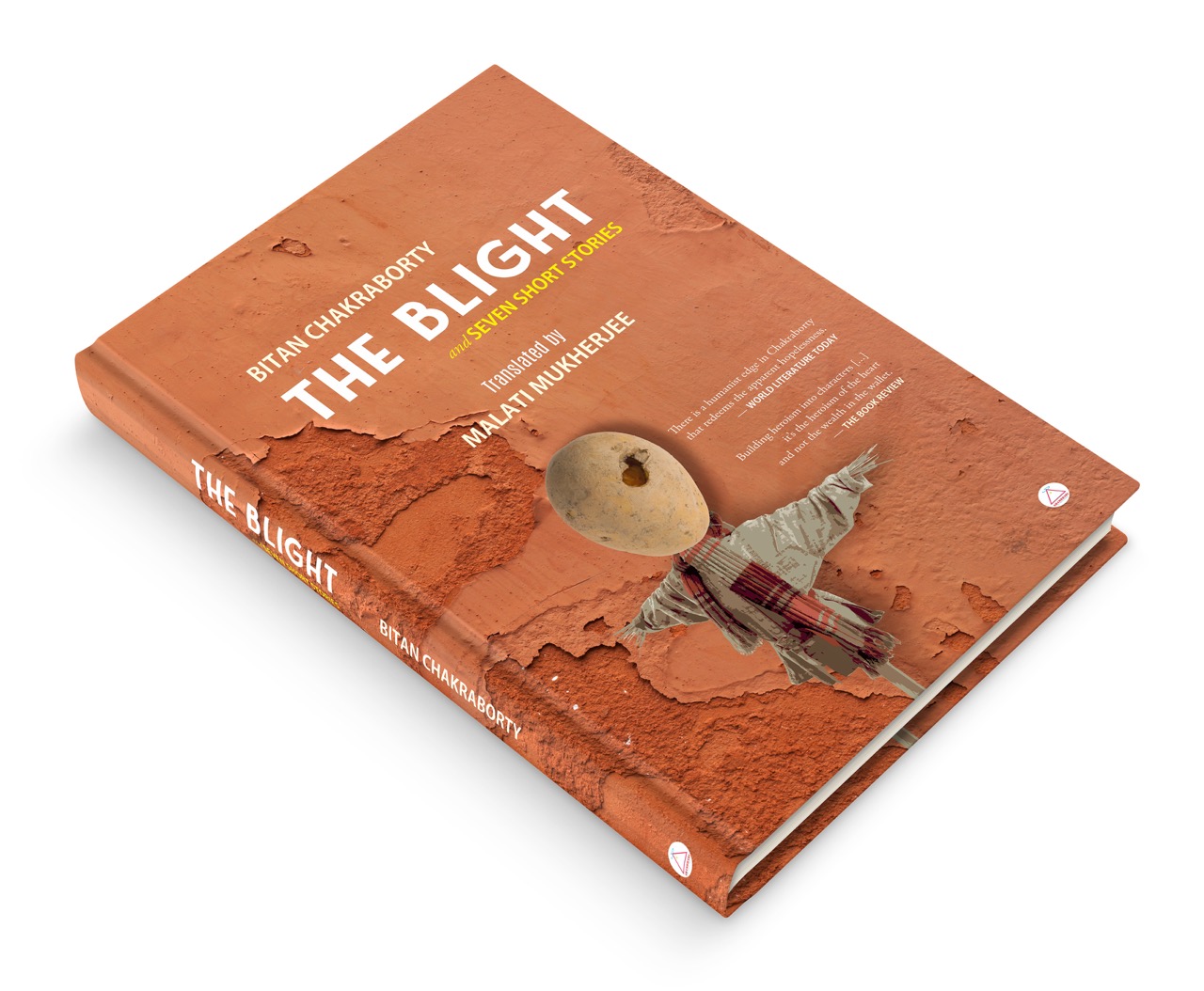
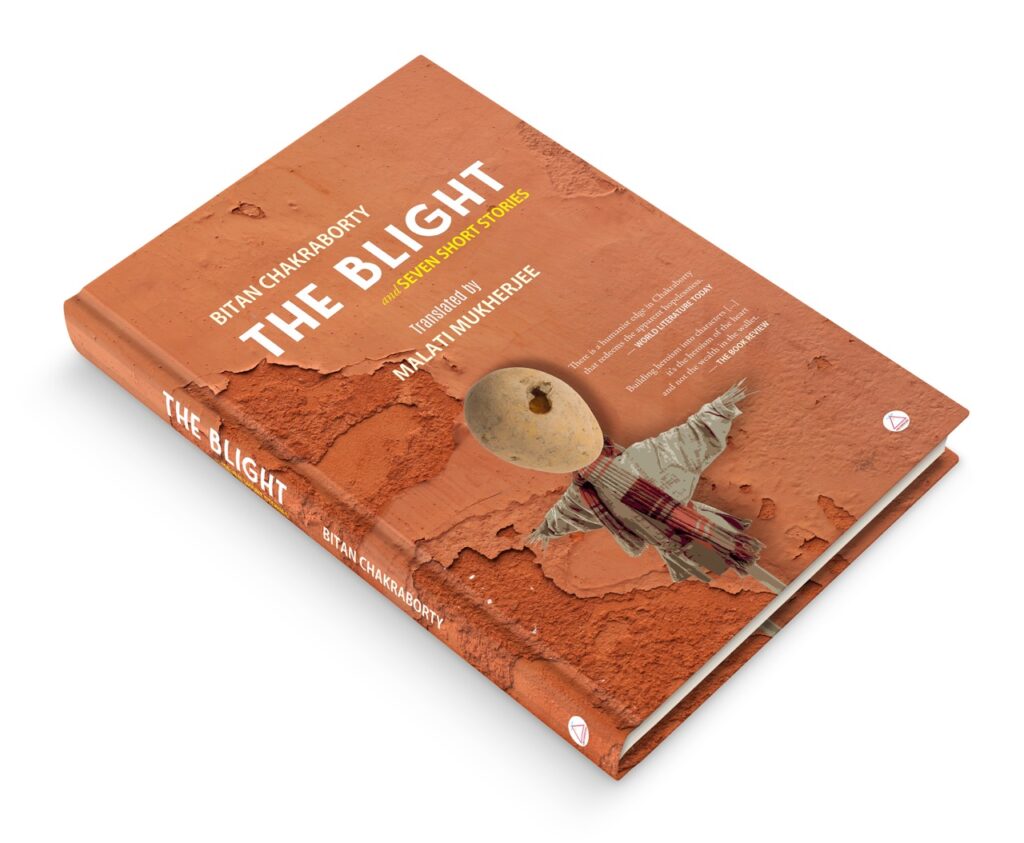
Bengali fiction in contemporary times has increasingly become a significant site for examining the anxieties, contradictions, and moral uncertainties of a rapidly transforming society. In The Blight and Seven Short Stories, Bitan Chakraborty offers a compelling exploration of these concerns through narratives that move fluidly between social realism, psychological introspection, and the surreal. The collection presents a gallery of ordinary individuals caught within systems of deprivation, ambition, corruption, and emotional dislocation. At its centre stands the novella The Blight, translated with remarkable sensitivity by Malati Mukherjee, which serves as both the thematic nucleus and artistic culmination of the volume. Yet the accompanying stories—particularly “Reflection,” “Land,” “Spectacles,” and “The Mask”—extend and deepen the novella’s concerns, collectively mapping the invisible wounds of contemporary existence. At first glance, The Blight appears deceptively simple. The narrative revolves around Moni, a lower-middle-class man whose growing obsession with potatoes gradually acquires grotesque and surreal dimensions. What begins as anxiety over an everyday staple becomes an all-consuming fixation. Chakraborty elevates the potato from an ordinary object of subsistence into a complex symbolic structure embodying economic insecurity, social vulnerability, and existential dread. Moni’s visions of diseased potato mountains, his frantic search for remedies, and his strange desire to inhabit the wounds of the blighted crop create an atmosphere in which reality and hallucination become inseparable.
What makes the novella particularly striking is its refusal to reduce Moni’s condition to individual pathology. His obsession stems from material deprivation and the precariousness of lower-middle-class life. In a social world where survival itself remains uncertain, anxiety over food takes on metaphysical significance. Through this symbolic economy, Chakraborty transforms a local concern into a universal meditation on fear, scarcity, and human fragility. The “blight” of the title therefore transcends its agricultural meaning to become a metaphor for a wider moral and social contagion. This metaphor reverberates throughout the collection. The disease that attacks crops in the novella resurfaces in various forms across the stories as corruption, greed, alienation, self-deception, and ethical compromise. Chakraborty’s fictional universe is populated by characters who are neither heroic nor villainous but deeply flawed individuals struggling within oppressive social structures. Their failures are not dramatic collapses but gradual erosions of dignity, integrity, and hope. It is this slow attrition of moral certainty that gives the collection its distinctive emotional power.
Among the stories, “Reflection” offers one of the most incisive explorations of fractured identity and self-recognition. The motif of reflection functions not merely as a literal image but as a psychological and ethical mirror. The protagonist’s confrontation with his reflection becomes an encounter with suppressed desires, anxieties, and moral ambiguities. Much like Moni’s hallucinations in The Blight, the story destabilises the boundary between external reality and inner consciousness. The reflection exposes truths the protagonist would rather ignore, suggesting that the greatest source of unease often lies within oneself. In this respect, “Reflection” transforms a familiar motif into a meditation on guilt, self-alienation, and the elusive nature of identity. “Land” shifts attention from the psychological to the socio-political while retaining the collection’s preoccupation with moral decay. The story examines the contested significance of land as both a material resource and a symbolic possession. In a society increasingly shaped by speculative economies, political patronage, and aggressive development, land becomes a site of conflict where human relationships are subordinated to greed and self-interest. Chakraborty demonstrates how economic desire corrodes communal bonds and ethical values. The narrative exposes the violence embedded within systems of acquisition and ownership, revealing how aspirations for security and prosperity frequently generate exploitation and betrayal. Here, the blight assumes an institutional form, infecting social structures rather than individual minds.
The theme of distorted perception reaches its most sophisticated expression in “Spectacles.” The story uses the object in the title as a powerful metaphor for the mediated nature of reality. Seeing, Chakraborty suggests, is never a neutral act. The spectacles become symbolic lenses through which characters interpret, distort, or conceal the truth. The narrative interrogates the relationship between appearance and reality, exposing the fragility of human judgement. What characters perceive often reflects their fears, prejudices, and desires more than objective reality. The story thus extends one of the collection’s central concerns: the instability of perception in a world marked by uncertainty and deception. Like Moni’s visions, the altered modes of seeing in “Spectacles” reveal deeper social and psychological truths beneath everyday appearances. Perhaps the most unsettling exploration of identity occurs in “The Mask.” Here, Chakraborty examines the performative dimensions of social life through the metaphor of masking. The story suggests that modern existence often requires individuals to conceal their authentic selves beneath carefully constructed personas. The mask becomes both protection and imprisonment, enabling survival while eroding genuine selfhood. As characters navigate social expectations, ambition, and fear, the distinction between the wearer and the mask gradually collapses. The narrative resonates strongly with broader contemporary concerns regarding identity, authenticity, and social performance. At the same time, it reinforces the collection’s recurring insight that moral corruption often begins with self-deception.
Taken together, these stories illuminate Chakraborty’s remarkable ability to connect personal anxieties with broader social realities. The urban and semi-urban landscapes of Bengal are not passive backdrops but active forces that shape human behaviour. Construction syndicates, political networks, informal economies, and entrenched hierarchies create an atmosphere of latent menace. Power operates not only through overt coercion but also through subtle pressures that infiltrate everyday life. The violence in these narratives is often systemic rather than spectacular, embedded within institutions and relationships. In this regard, Chakraborty extends the tradition of Bengali social realism while adapting it to the complexities of contemporary society. Yet it would be reductive to describe him solely as a realist. One of the collection’s most distinctive features is its sustained engagement with the uncanny. Dreams, hallucinations, reflections, masks, and symbolic objects repeatedly disrupt ordinary reality. Chakraborty employs surrealism not as an escape from social reality but as a means of revealing its hidden dimensions. The fantastic emerges from the everyday, exposing psychological tensions and ethical contradictions that realism alone might fail to capture. The result is a body of fiction that remains grounded in material conditions while probing deeper existential questions.
Equally noteworthy is Chakraborty’s narrative restraint. He avoids melodrama even when depicting profound suffering. Significant events are often conveyed through implication rather than explicit exposition, allowing silences and absences to carry considerable expressive power. Readers are invited to participate actively in constructing meaning, interpreting ambiguities and filling narrative gaps. This economy of expression lends the stories a density and subtlety that reward careful reading. The collection also demonstrates an acute understanding of human psychology. Chakraborty excels at portraying envy, guilt, resentment, insecurity, and self-delusion. His characters are haunted less by external antagonists than by unresolved internal conflicts. Again and again, the narratives reveal the painful gap between aspiration and reality. Those who pursue success discover its emptiness; those who cling to memories or illusions find themselves trapped within them. Such psychological complexity elevates the collection beyond social commentary and situates it firmly within serious literary fiction.
If there is a limitation to Chakraborty’s fictional universe, it lies in its pervasive bleakness. Despair, betrayal, and moral compromise dominate the narratives, leaving little room for redemption or hope. While this tonal consistency contributes to the collection’s thematic coherence, it occasionally risks producing emotional monotony. Nevertheless, the darkness is never gratuitous. It emerges organically from the social and psychological realities the stories seek to portray. A substantial part of the collection’s success in English is attributable to Malati Mukherjee’s accomplished translation. Literary translation demands more than linguistic accuracy; it requires the recreation of cultural texture, narrative rhythm, and emotional nuance. Mukherjee’s prose is lucid, elegant, and unobtrusive. She preserves the regional flavour of the original Bengali while ensuring accessibility for a wider readership. Particularly impressive is her ability to convey tonal shifts between realism and surrealism, and between irony and pathos, without sacrificing clarity. The translation avoids both excessive literalism and unnecessary domestication, allowing the original’s distinctive voice to remain intact. From a broader literary perspective, The Blight and Seven Short Stories occupies an important place within contemporary Indian writing in translation. By foregrounding lives rooted in Bengal’s smaller urban and semi-urban spaces, the collection challenges the predominance of metropolitan narratives in Indian English publishing. Chakraborty demonstrates that literature’s most profound insights often emerge from the quiet tragedies and hidden anxieties of ordinary lives.
Ultimately, The Blight and its companion stories offer a powerful cartography of contemporary human vulnerability. Whether through Moni’s obsession with diseased potatoes, the fractured selfhood in “Reflection,” the corrosive politics in “Land,” the distorted vision in “Spectacles,” or the performative identities in “The Mask,” Chakraborty repeatedly exposes the invisible blights that afflict modern existence. His fiction transforms commonplace realities into resonant allegories of moral uncertainty, social decay, and existential unease. Supported by Malati Mukherjee’s sensitive translation, these narratives cross linguistic boundaries without losing their emotional intensity. The collection lingers in the reader’s imagination long after the final page, revealing layer upon layer of meaning and affirming Bitan Chakraborty’s place among the most perceptive voices in contemporary Bengali fiction.