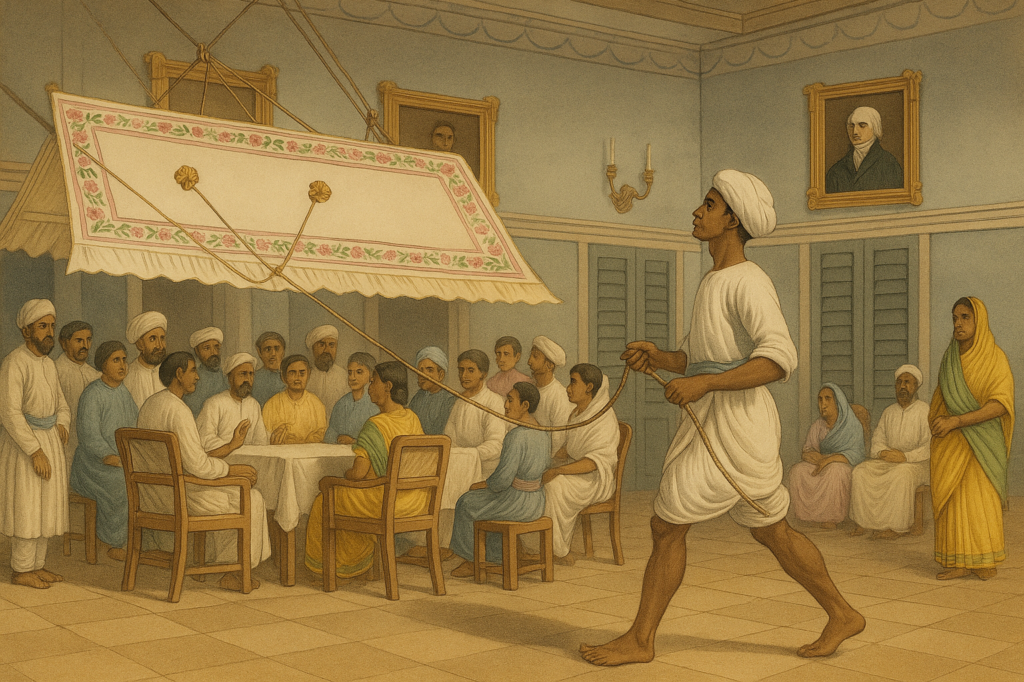
British planters, administrators and their households in colonial India relied on a vast, largely unrecorded workforce of servants. Among them were the punkahwallahs, men and boys employed to operate the large swinging cloth fans, suspended from ceilings, that moved air through homes and offices. In British India, Ceylon, the Straits Settlement and British Malaya alike, the punkahwallah became a fixture of colonial domestic and official life. He appeared, briefly, in letters home, in travel writing, in memoirs and paintings, and most famously in E.M. Forster’s novel A Passage to India (1924). Historians of empire have paid him little attention, however. Recent scholarship has begun to recover the labour of other colonial servants, ayahs and khansamas among them, but the punkahwallah has stayed largely outside this work, perhaps because his was not a form of labour that left visible traces.
A fixture, kept out of sight
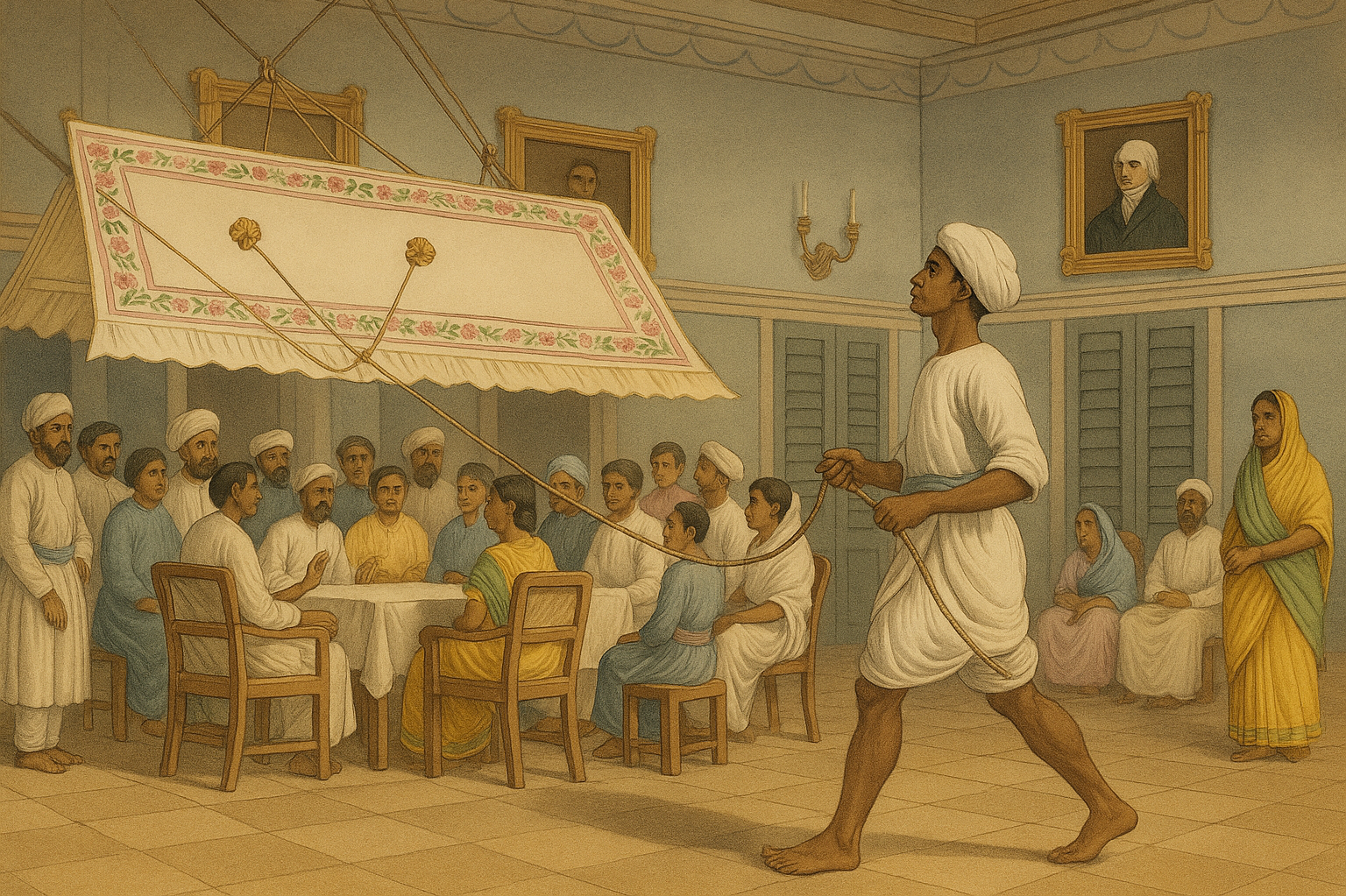
Heat posed a constant problem for the British in India. They altered their clothing and their diets, planted gardens for shade, and built homes with thick walls, high ceilings and covered verandas. None of it was enough. Before electricity reached most of the country, and long afterwards in places where supply remained unreliable, the only real remedy for heat and humidity was a fan worked by hand. Most British offices and households therefore employed Indian men to pull fans through the day and night.
The word punkha comes from the Hindi pankh, meaning a bird’s wing, the motion that produces a draught when flapped. Wallah denotes the person who does the work. By the late nineteenth century, the arrangement was common enough that the Canadian travel writer Sara Jeannette Duncan, in A Social Departure (1892), called it an institution in its own right. She noted that the punkha stayed visible, swaying above the heads of the mems and sahibs, while the wallah who pulled it sat outside the door, unseen.
This separation was deliberate. British colonists went to considerable lengths to keep physical distance from their servants, a pattern scholars have documented in other contexts too. Smaller hand fans, used to cool one or two people directly, brought the punkahwallah closer than most employers preferred.
Neither the fan nor the servant who worked it was a British invention. Both had served Indian nobility long before colonisation, but British rule multiplied their numbers and made them far more visible. Early administrators sometimes assigned the role to convicted petty criminals, though this practice faded as more British women and children arrived and officials grew uneasy about allowing convicts into family spaces.
Most punkahwallahs were boys or old men, generally drawn from lower castes, though some accounts mention able-bodied adult men in the role as well. Forster gave the punkahwallah one of the most striking cameos in A Passage to India. At the courtroom scene he appears nearly naked, finely built, seated on a raised platform, and somehow governing the proceedings from his corner. By day the men pulled the rope with their hands; at night they sometimes tied it to a foot, so the work could continue even in half sleep.
Suspicion and resistance
For all the comfort a punkha provided, its operator unsettled the households he served. British residents worried constantly about a servant who sat within earshot of official business, private conversation and family disputes. Colonial magazines carried this anxiety openly. The Asiatic Journal and Monthly Register, sponsored by the East India Company, along with Planters Magazine and The Eagle, a St John’s College Cambridge publication aimed at graduates settling into colonial careers, printed letters urging employers to hire deaf or hard-of-hearing men as punkahwallahs.
Some households followed the advice, though it created new problems. Deaf servants were harder to instruct, and mems complained they could not easily signal a change of pace. Reverend Z.F. Griffin, writing in India and Daily Life in Bengal (1903), captured the frustration well. Households would retire at ten, comfortable while the fan moved, only to wake later drenched in sweat because the punkha had stopped. A shout of “Punka tannow!” might rouse the servant into pulling too hard, prompting a second complaint to slow down.
Punkahwallahs also feigned incomprehension, a tactic that appears repeatedly in colonial accounts. Duncan recorded one memsahib in Calcutta whose servant claimed not to understand whether she wanted the fan pulled harder or stopped, until she bought a Hindi dictionary out of sheer necessity. The Eagle told a similar story in 1881. A punkahwallah, tired of being shouted at, learned to fan harder whenever his employer’s papers lay scattered on the desk, scattering them further and blaming the closed doors for any misunderstanding. Language became a shield behind which servants could push back without open confrontation.
Falling asleep was the other recurring complaint, and one that generated its own genre of letters, postcards and magazine anecdotes. Punishment for a sleeping punkahwallah, verbal or physical, was common enough to be treated as ordinary. In February 1891 The Graphic printed an account of a sahib who summoned his household staff to beat a sleeping punkahwallah, partly as discipline and partly as a warning to the rest of his servants.
Machines, and the persistence of violence
By the early 1900s electric fan manufacturers were marketing directly against the punkahwallah’s supposed unreliability. The Jost Fan Co., advertising in 1908, promised a machine that ran continuously without “annoyance through sleepy punkah coolies.” Cost and unreliable electricity kept mechanical fans from replacing human labour in most households, but the advertising told its own story about how British employers had come to regard their servants.
Some found the change unwelcome for a different reason. Correspondents in the Electrical Record and Buyer’s Reference and the Literary Digest, both from 1908, mourned the loss of what they called the charm of the old system, including, in some cases, the nightly ritual of throwing a slipper or a jug of water at a sleeping servant. That casual cruelty had been folded into nostalgia.
Abuse of punkahwallahs was not confined to planters and officials. The Atlantic Monthly, writing in 1866, noted that missionaries and college teachers grew abusive too, when tired servants disrupted their comfort. James Kerr was said elsewhere to be mild-mannered. He reportedly cursed his sleeping punkahwallah with terms such as soar, banchut and junglee-wallah, and struck his head against the wall.
The violence could go further still. On 14 February 1882 the Madras Mail reported that a tea planter in Assam, a Mr Fox, had struck his punkahwallah for sleeping and caused his death. The North West Provincial High Court accepted the argument that the blow would not normally have been fatal, and that the servant’s undiagnosed enlarged spleen was to blame. Fox received a month of rigorous imprisonment and a fine of two hundred rupees. In 1893 Private John Rigby was fined one hundred rupees for a beating that killed his punkahwallah, on similar reasoning. A healthier man, it was argued, would have survived the “slight strikes.” One hundred rupees appears to have been the going rate for a servant’s life in British India, and in both cases medical testimony from friends of the accused helped secure a lenient outcome.
The punkahwallah’s story shows how thoroughly the British Empire depended on labour it refused to acknowledge, and how much violence sat beneath that dependence. Recovering these lives gives a fuller picture of what colonial daily life actually required. Workers of this kind were never written out of labour history. They were never written into it at all.