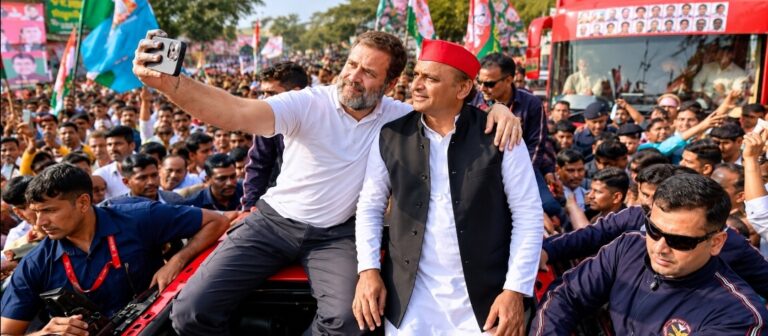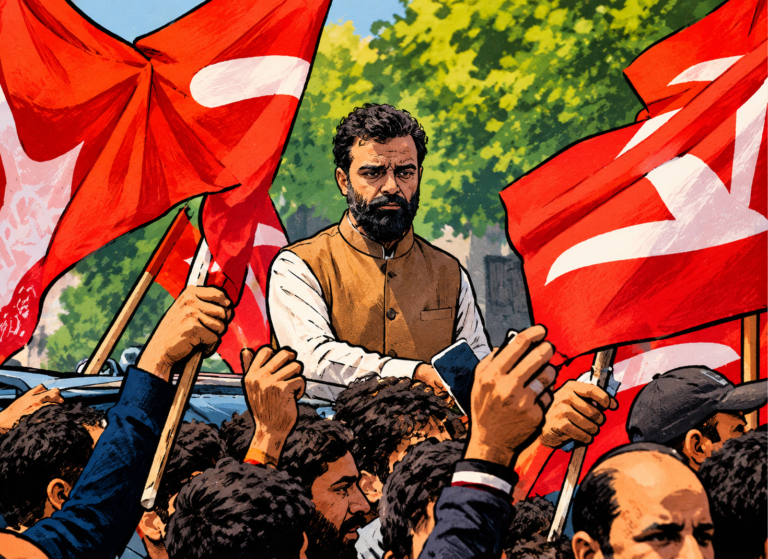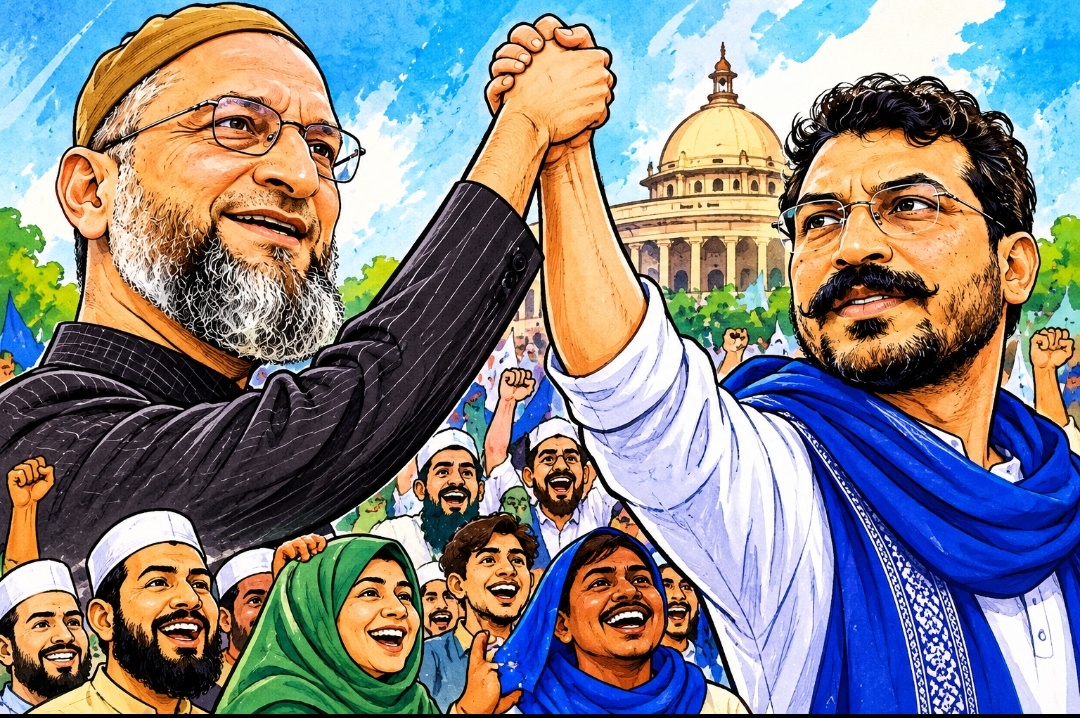
The coming together of Asaduddin Owaisi and Chandrashekhar Azad could mark an important moment in the changing grammar of electoral politics in Uttar Pradesh. Their announcement of the Samajik Parivartan Morcha, a political alliance between the All India Majlis-e-Ittehadul Muslimeen (AIMIM) and the Azad Samaj Party (Kanshi Ram), ahead of the 2027 Assembly elections, brings two political figures with distinct social constituencies onto a common platform. More significantly, it raises a question that Indian politics has repeatedly postponed: can Muslims and Dalits move beyond being electoral constituencies and become active stakeholders in the exercise of political power?
For decades, Muslims in Uttar Pradesh have occupied an uncomfortable position in electoral politics. Their votes have been actively sought, their concerns have featured in election speeches and their political anxieties have been invoked whenever parties have needed to consolidate a secular or anti-BJP constituency. Yet their presence in the corridors where political decisions are made has remained disproportionately limited.
Muslims have frequently been asked to vote strategically, to prevent a particular party from coming to power, to support a larger political formation and to prioritise immediate electoral calculations over their own political aspirations. This has produced a peculiar situation in which a community with considerable electoral significance has often had to negotiate its representation through political parties whose leadership and decision-making structures remain largely outside its control.
The Owaisi-Azad alliance introduces another possibility.
From political accommodation to political participation
The most significant aspect of this arrangement is the coming together of two political formations that have attempted to build independent political identities around communities historically pushed to the margins of power.
Owaisi has consistently argued for independent Muslim political representation. His politics has often attracted criticism from parties that believe his electoral interventions could divide the opposition vote. But the question worth examining is why independent Muslim political assertion is so frequently treated as a problem, while the political ambitions of other communities are regarded as legitimate expressions of democratic participation.
Chandrashekhar Azad, meanwhile, has attempted to build a political movement rooted in Ambedkarite and Bahujan politics. His emergence has provided a new political vocabulary to sections of Dalit youth who want representation beyond established political arrangements.
Their partnership creates an opportunity to connect two political experiences: the Muslim experience of marginalisation, insecurity and inadequate representation, and the Dalit experience of caste oppression, social exclusion and the continuing struggle for dignity.
This is where the alliance could acquire significance beyond its immediate electoral calculations.
The arithmetic and the possibility
Uttar Pradesh offers a substantial social foundation for such an experiment. Muslims account for approximately 19 per cent of the state’s population, while Scheduled Castes constitute around 21 per cent. Together, these communities represent a considerable section of the state’s electorate.
The alliance has announced its intention to contest all 403 Assembly constituencies. Owaisi has also declared Chandrashekhar Azad its chief ministerial candidate. The two leaders have described the alliance as an alternative for marginalised communities and invited other opposition parties, including the Samajwadi Party and Congress, to join the front.
These are significant political announcements. But numbers alone do not create political power. The challenge is to translate demographic strength into an organised political constituency capable of negotiating representation, influencing policy and participating in government.
For Muslims, this distinction is particularly important. A community can be numerically significant and yet remain politically dependent. Its electoral importance does not automatically translate into ministerial representation, influence over policy or participation in the institutions that determine the distribution of resources and opportunities.
A political arrangement that brings Muslim leadership into a broader coalition with Dalit and other backward communities could potentially change the terms of this negotiation.
Political sociologist Arshad Alam believes the timing of this experiment is particularly significant. He points out that Muslims in Uttar Pradesh are currently largely consolidated behind the Samajwadi Party. This consolidation has meant that much of Muslim electoral participation has been channelled through a single dominant opposition formation, often leaving limited space for independent political negotiations.
Alam believes that the Owaisi-Azad alliance could open up an alternative political possibility for Muslims, particularly in the context of the declining electoral influence of Mayawati and the Bahujan Samaj Party. Explaining his assessment, he says:
“At present, Muslims in Uttar Pradesh are largely consolidated behind the Samajwadi Party. But political experiments such as the Owaisi-Chandrashekhar Azad alliance could create new possibilities for Muslims in terms of representation and power-sharing. With Mayawati’s political influence declining, the emergence of an alternative Dalit-Muslim political formation could potentially change the balance of political negotiations and give Muslims greater space to bargain for an actual share in power.”
Alam’s observation shifts the discussion from electoral arithmetic to the question of political bargaining. If the BSP’s traditional political space continues to weaken, new formations could attempt to bring together constituencies that have historically experienced social and political exclusion.
For Muslims, this could mean having another avenue through which to negotiate their political interests rather than remaining dependent on their consolidation behind one established party. It could also create the possibility of a political arrangement in which Muslim representation is discussed as part of a partnership, rather than treated as an electoral necessity.
The important distinction is between being accommodated by a political party and having the organisational strength to negotiate a share in power.
The other side of the argument: Can Azad command Dalit consolidation?
However, not everyone sees the alliance as an opportunity for marginalised communities to gain political power. Some observers believe its electoral consequences could be quite different.
Satish Prakash, a social scientist at Meerut College, offers a more sceptical assessment. He draws attention to Owaisi’s earlier electoral experiment with the BSP in Bihar, where the two parties were constituents of the Grand Democratic Secular Front during the 2020 Assembly elections. AIMIM emerged with five Assembly seats, while the BSP secured one. The results gave Owaisi’s party considerably greater electoral visibility and representation than its alliance partner. https://indianexpress.com/elections/bihar-polls-owaisi-arrives-with-5-big-wins-hits-grand-alliance-7046738/
Prakash believes the Uttar Pradesh arrangement could reproduce a similar imbalance. In his assessment, Chandrashekhar Azad has yet to establish himself as a fully consolidated Dalit leader across Uttar Pradesh, and the Dalit vote cannot automatically be assumed to move behind him in the way it historically consolidated around Mayawati.
Explaining his reservations, Prakash says:
“The earlier alliance between Owaisi and the BSP in Bihar demonstrated that Owaisi could benefit considerably more from such an arrangement than the BSP. Uttar Pradesh is a different political landscape. Chandrashekhar Azad has emerged as an important Dalit political figure, but he is yet to establish himself as a fully recognised leader capable of commanding Dalit consolidation across the state. The kind of support that Mayawati once enjoyed among Dalits cannot automatically be transferred to him.
“Similarly, Muslims may find it easier to vote for Owaisi because this alliance gives AIMIM greater political legitimacy and a broader platform to contest elections in Uttar Pradesh. But the larger question is whether this arrangement will actually translate into power-sharing for Muslims and Dalits. If the alliance draws votes away from the Samajwadi Party and the BSP without building a sufficiently strong alternative, the principal beneficiary could ultimately be the BJP. In that sense, the alliance could end up helping the BJP rather than bringing marginalised communities closer to power.”
Prakash’s assessment introduces an important distinction between political visibility and electoral strength. Owaisi has established a recognisable political identity among sections of Muslim voters, but AIMIM’s previous electoral performance in Uttar Pradesh has remained limited. Chandrashekhar Azad, despite his victory from Nagina in the 2024 Lok Sabha elections, faces the challenge of extending his political influence beyond his existing support base.
The concern about the BJP benefiting from a division in opposition votes has also featured in the political debate surrounding the alliance. The Samajwadi Party has traditionally attracted a substantial share of Muslim voters, while the BSP has historically enjoyed considerable support among Dalits, particularly Jatavs. Any movement of these voters towards a new formation could affect the electoral calculations of both parties. https://indianexpress.com/article/political-pulse/asaduddin-owaisi-chandra-shekhar-aazad-tie-up-uttar-pradesh-polls-bjp-t-10960346/
The question, therefore, is whether the new alliance can consolidate a sufficiently broad social coalition or whether it will primarily redistribute votes within the opposition electorate.
The Dalit-Muslim question
The history of Indian politics offers several examples of attempts to bring Dalits and Muslims together. The possibilities of such an alliance have been discussed for decades, particularly in states where both communities have substantial electoral presence.
Yet social proximity does not automatically translate into political unity. Dalit and Muslim communities have their own histories, internal differences, political aspirations and competing local interests. Building a sustainable partnership would require acknowledging these differences rather than assuming that shared experiences of marginalisation are sufficient to create a common political identity.
The Ambedkarite tradition offers an important intellectual foundation for this conversation. Constitutional equality, representation, dignity and the annihilation of caste are questions that can connect different communities without requiring them to abandon their distinct identities.
For Muslims, engaging with this tradition also means moving beyond the narrow framework in which their political concerns are reduced to religious identity. Questions of land, labour, education, unemployment, access to public institutions and economic opportunity are equally central to their democratic aspirations.
Similarly, a meaningful Dalit-Muslim partnership would have to recognise that minority rights and caste justice are not competing political demands. They can form part of a wider constitutional programme.
The test of political power
There are serious questions before the new alliance.
Both parties have had limited electoral footprints in Uttar Pradesh. In the 2022 Assembly elections, AIMIM secured approximately 0.49 per cent of the vote, while the Azad Samaj Party also struggled to convert its campaign into significant electoral representation. Chandrashekhar Azad’s victory from Nagina in the 2024 Lok Sabha elections gave his party an elected parliamentary presence, but translating that achievement into a statewide organisation remains a considerable task.
The alliance will also have to address questions of leadership, candidate selection, organisational capacity, resources and the distribution of political influence between its partners.
Its decision to name Azad as the chief ministerial face is noteworthy. It gives the alliance a publicly identified leadership proposition while bringing Owaisi’s party into a partnership where the principal executive face belongs to the Dalit political movement.
Whether this arrangement can sustain a common political programme and build trust across communities will become clearer as the alliance develops its organisation and campaign.
Muslims must be participants in power
Perhaps the most important conversation this alliance should generate is about the political future of Indian Muslims.
For too long, Muslims have been caught between two competing expectations: that they should demonstrate political loyalty to larger parties and that they should avoid independent political assertion for fear of weakening an opposition coalition.
This debate deserves to be revisited. Democratic politics allows communities to organise, negotiate, contest elections and seek representation. Independent political participation is a constitutional right, not a political transgression.
At the same time, independent representation must be accompanied by the ability to build alliances, accommodate other communities and develop a programme that addresses concerns beyond one’s immediate constituency.
The coming together of Owaisi and Azad presents an opportunity to explore precisely this possibility. It could allow Muslims to participate in a political formation where their representation is negotiated as part of a partnership rather than treated merely as an electoral afterthought.
But the opportunity should not be confused with an achievement. The real measure of this alliance will be whether it can create durable political institutions, produce accountable leadership, expand representation and make the concerns of marginalised communities central to governance.
The larger question is not simply whether Dalits and Muslims can come together to defeat a political opponent. It is whether they can build a political arrangement in which neither community has to depend entirely on the goodwill of established political parties to secure its share of power.
For Muslims in particular, the distinction between being courted for their votes and being recognised as participants in governance is fundamental.
The Samajik Parivartan Morcha has opened a new political conversation in Uttar Pradesh. Whether it becomes a lasting political alternative will depend on its ability to turn that conversation into organisation, trust, representation and a credible programme of governance.
For a community repeatedly asked to vote strategically, the possibility of negotiating power collectively deserves serious political attention. But as the contrasting assessments of Arshad Alam and Satish Prakash suggest, the challenge is not merely to create a new political alliance. It is to ensure that the alliance can translate political assertion into an actual share of power.