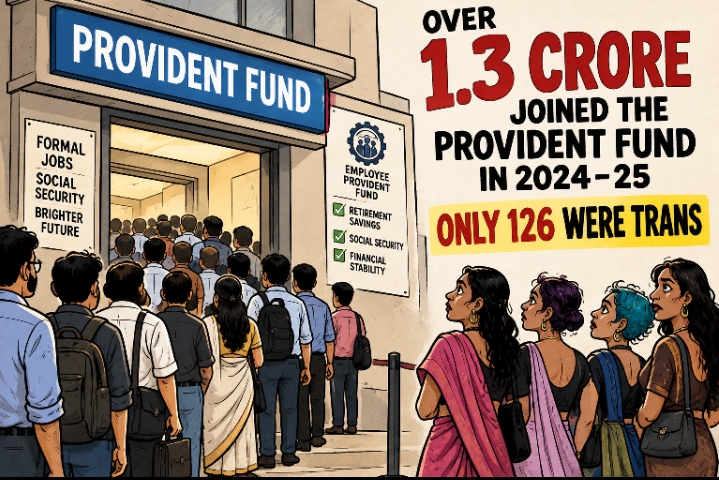
Transgender persons make up a very small share of subscribers to the Employees’ Provident Fund (EPF), and their numbers have barely grown in seven years. In 2024-25, nearly 1.3 crore Indians were added to the fund on a net basis, and just 126 of them were transgender. The 2011 Census counted 4,87,803 transgender people in India, a figure that is likely an undercount.
What the Employees’ Provident Fund show
The EPF is a government-backed retirement scheme administered by the Employees’ Provident Fund Organisation (EPFO), under the Ministry of Labour and Employment. Establishments with 20 or more employees must register. Employees contribute 12 percent of their basic salary and dearness allowance, and employers match it. Coverage was mandatory for those earning below Rs 15,000 a month, and the ceiling was revised in September 2026 to Rs 25,000.
Across the financial years from 2018-19 to 2024-25, men made up about eight of every ten net additions to the fund. Net additions for men and women nearly doubled over that period. For transgender subscribers, they stayed negligible. In 2018-19, 639 transgender members exited the fund while 558 joined or rejoined, a net fall of 81. The net additions in the years since have been 166, 168, 166, 170, 146 and 126, in that order.
Data and analysis in this report are drawn from queerbeat’s reporting on EPFO payroll data.
Why the figures may undercount
The low numbers could point to limited access to formal jobs. Kanmani Ray, a trans rights activist and financial lawyer, told queerbeat that exclusion may not be the only reason. Official identification often records only male or female, so a transgender subscriber may not be visible in the data. Many people also remain closeted at work and use their old name and gender to keep their jobs, she said.
A job lost after transition
Yash, a 37-year-old trans man, worked as a restaurant host at a hotel chain in Pune and held a provident fund account. After he began hormone therapy in early 2025, he said, his employers told him to wash dishes in the kitchen or quit. He left later that year and now helps his mother run a vada pav stall. He can no longer contribute to the fund, which still records him as a woman. “It’s a safety net,” he said of having had an EPF.
The paperwork gap
In January 2026, the government amended the rules so that transgender people holding a Transgender identity card, issued under the 2020 Transgender Persons (Protection of Rights) Rules, could update their name and gender with the provident fund. Yash does not have that card. He applied in December 2025, just before the new Transgender Persons (Protection of Rights) Amendment Act was passed, and he says district officials are unsure how the amendment will affect existing rules. He updated his Aadhaar to transgender earlier this year, but his PAN and voter ID still say female.
What remains unanswered
The government has changed the rules on updating records, but it has not said how many transgender workers are actually covered, or why so few appear in the data. Nor has it explained what it is doing to help them enrol. Ray described a two-fold problem: the data may not reflect real subscriber numbers, and more measures are needed to bring transgender persons into such schemes.