Festivals are among the most beautiful expressions of culture. They preserve traditions, bring communities together and allow people living far from their homeland to remain connected to their roots. For millions of Indians overseas, Diwali is much more than a religious occasion. It represents identity, belonging, family and heritage. For Hindus, Jains, Sikhs and others who observe the festival, it carries different cultural, spiritual and historical meanings. Across countries, Diwali celebrations have become an important expression of the Indian diaspora’s cultural presence, offering an opportunity to share its traditions with wider society.
However, cultural celebrations also involve responsibilities towards the communities and environments in which they take place. When public events involve unsafe fireworks, excessive noise, littering or disregard for local regulations, they can create difficulties for residents, businesses and public authorities. Reports from the United States and the United Kingdom in November 2026 have brought these concerns into focus, raising questions about how communities can preserve their cultural traditions while ensuring that public celebrations remain safe, orderly and environmentally responsible.
The debate should not be about whether Indian communities have the right to celebrate Diwali abroad. They unquestionably do. Rather, it should examine how celebrations can be organised in a manner that respects local laws, public spaces, environmental concerns and the rights of other residents. Cultural freedom and civic responsibility are complementary principles, and both deserve equal consideration.
New Jersey: Diwali Celebrations and Concerns Over Firecracker Waste
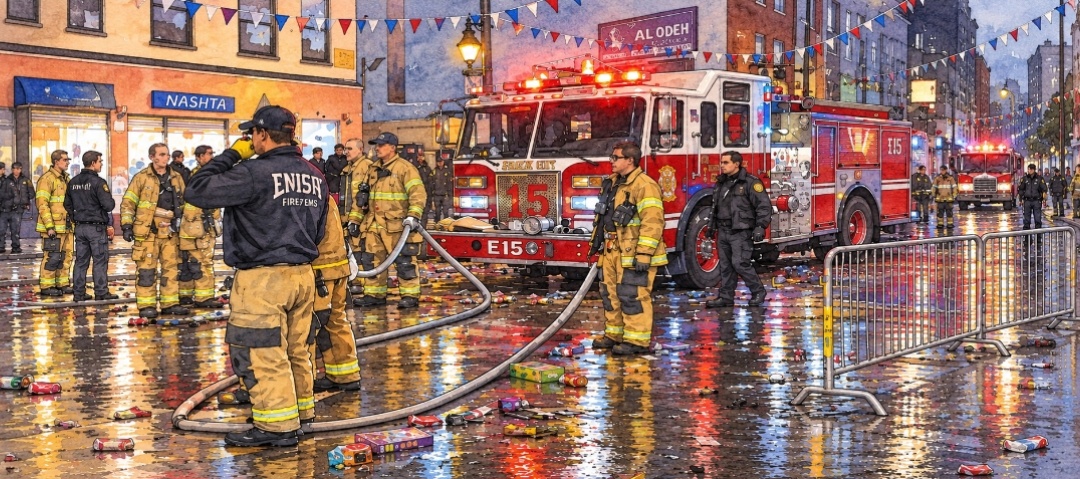
Videos circulating online from areas including Jersey City and India Street showed public roads covered with discarded firecracker boxes, cardboard packaging, wrappers and ash following Diwali celebrations. Firefighters were seen using powerful water jets to clear the debris, while police personnel monitored the situation and crowds gathered to watch the clean-up. The footage attracted considerable criticism online, with residents questioning why public streets had been left in such a condition after a cultural celebration.
Local concerns about fireworks were also reported by Patch on November 8. Residents in Hoboken, Jersey City and neighbouring New York areas took to social media after hearing fireworks without clear prior notice of an authorised display. The report noted that residents had previously raised concerns about unexpected fireworks disturbing pets and waking babies. These complaints reflected a wider concern about the impact of unannounced fireworks on neighbourhoods where people may not necessarily be participating in the celebrations.
The question of public cleanliness also deserves attention. Municipal workers and emergency services have an important role in maintaining public spaces, but event organisers and participants must also take responsibility for the waste generated during their celebrations. Arrangements for cleaning streets, disposing of firecracker packaging and managing crowds should be part of the planning process, particularly when events attract large gatherings.
At the same time, the criticism surrounding these incidents must be distinguished from the hostility directed at Indian communities by far-right groups. Far-right activist Jake Lang and associate Thomas Allen disrupted a public Diwali festival celebration at the Seattle Center using highly offensive anti-Indian slurs and signs. Similarly, an anonymous far-right group calling itself “Take Action Texas” staged protests in Irving, Texas, disparaging the festival and displaying xenophobic signs calling for the deportation of H-1B visa holders.
These incidents illustrate how legitimate concerns about public safety and civic discipline can be exploited by groups seeking to promote hostility against immigrants. Complaints about littering, noise or fireworks must be addressed through appropriate civic and legal processes. They cannot become a justification for racial discrimination or attacks on an entire community. Indian communities have every right to preserve and celebrate their cultural traditions without facing intimidation or xenophobia.
The challenge, therefore, is to ensure that public celebrations are organised responsibly while resisting attempts to turn isolated incidents into sweeping judgements about Indian culture or the people who practise it.
West London: Fireworks, Police Intervention and Public Safety
Diwali celebrations in Southall, West London, on November 8, 2026, brought similar concerns into focus. Videos shared by a local community news account showed fireworks being set off along The Broadway, with crowds gathered close to traffic and smoke filling parts of the street. The footage prompted concerns about pedestrians, motorists, local businesses and residents who had not necessarily chosen to participate in the celebrations.
Southall has a long-standing South Asian community, and Diwali is an important annual occasion for many residents. The festival has become an integral part of the area’s multicultural identity, bringing together families and communities through religious observances and public festivities. However, public streets are shared spaces, and fireworks in crowded areas can expose pedestrians, motorists and nearby properties to considerable risks.
According to The Standard, two men were issued penalty notices and dispersal orders after police officers encountered them setting off fireworks on South Road, Southall. A Metropolitan Police spokesperson said: “Police on patrol were alerted to two men releasing fireworks on South Road, Southall. They were issued with penalty notices and dispersal orders by officers.”
The legal distinction is important because fireworks may be used until 1 a.m. on Diwali in the UK, but setting them off in streets and other public places is illegal. The regulations are intended to protect public safety and apply regardless of the cultural or religious occasion. Organisers and participants must therefore ensure that fireworks are used only in permitted locations and under appropriate conditions.
The consequences of unsafe celebrations can extend beyond the immediate location. The Standard also reported two house fires during the same weekend, one in Chingford, where a firework accidentally sparked a blaze, and another in Croydon, where a candle being used for religious celebrations caused a fire. In the Croydon incident, firefighters rescued a dog from the property, while part of the house and the front of a neighbouring property were damaged.
These incidents were not reported as being connected to the Southall gathering, and it would be inaccurate to suggest otherwise. Nevertheless, they underline the importance of exercising caution when handling fireworks, candles and other sources of fire. Public awareness campaigns, appropriate safety arrangements and responsible handling of fireworks can help prevent accidents while allowing communities to celebrate important occasions.
UK: Pollution Concerns Following Diwali Celebrations
Environmental concerns have also featured prominently in the aftermath of Diwali 2026. The Guardian reported on November 9 that fireworks celebrations, combined with foggy conditions, contributed to a sharp rise in pollution across England. Government monitoring recorded very high pollution at 11 locations, mainly in London and Greater Manchester.
Hillingdon recorded a 24-hour PM2.5 average of 129 µg/m³, more than eight times the World Health Organization’s daily guideline. The Mayor of London’s office also announced a high-pollution alert for November 10, following forecasts from Imperial College London. These figures have renewed discussions about the environmental impact of fireworks in densely populated urban areas, particularly when weather conditions prevent pollutants from dispersing effectively.
The health implications of particulate pollution are well established. Fine particles can penetrate deep into the respiratory system and aggravate existing conditions, particularly among children, older people and individuals with respiratory or cardiovascular illnesses. Although fireworks are not the only source of urban pollution, their contribution during periods of already deteriorating air quality deserves consideration.
Environmental Warnings Over Fireworks
Environmental authorities in North America have also documented the environmental and public-health consequences of fireworks. Michigan’s Department of Environment has warned that fireworks release fine particulate matter and harmful gases, which can worsen respiratory conditions and affect vulnerable communities. Canadian environmental authorities have similarly recognised particulate matter as a significant public-health concern.
These warnings are relevant to all public celebrations involving fireworks, irrespective of their religious or cultural origins. Whether fireworks are used during Diwali, New Year’s Eve or other public festivities, their environmental consequences remain broadly similar. The responsibility to minimise pollution and protect public health should therefore be applied consistently across different communities and occasions.
There is also considerable scope for community organisations to introduce more environmentally conscious ways of celebrating. Organised displays at authorised venues, improved waste management, awareness campaigns and alternatives to excessive fireworks can help preserve the festive atmosphere while reducing the burden on local environments.
Delhi: An Already Choking City
The environmental implications of Diwali celebrations are particularly concerning in Delhi, which was already experiencing severe winter pollution. According to reports citing Central Pollution Control Board data, Delhi’s AQI reached 370 on the morning of November 9, 2026, placing it in the Very Poor category, while several localities crossed 400. Separate Diwali-night monitoring data reportedly recorded PM2.5 concentrations as high as 3,744 µg/m³ at certain locations.
Healthcare workers have estimated that respiratory patient numbers increase by 60–70 per cent during periods of severe pollution compared with days when air quality is relatively better. Children, older people and patients with pre-existing respiratory and cardiac conditions remain particularly vulnerable to prolonged exposure to polluted air.
Delhi’s pollution crisis, however, cannot be attributed to Diwali or fireworks alone. Vehicular emissions, construction dust, industrial pollution, seasonal agricultural burning and meteorological conditions all contribute to the city’s deteriorating air quality. Treating fireworks as the sole explanation would overlook the structural and policy failures that have allowed the capital’s pollution crisis to persist year after year.
Nevertheless, the additional pollution generated by fireworks during an already difficult period cannot be ignored. The environmental impact of celebrations should be considered alongside the larger challenges of urban planning, public transport, industrial regulation and pollution control. A comprehensive response requires authorities and citizens to address all significant sources of pollution rather than selectively assigning responsibility to one festival or community.
Global Headlines and India’s International Image
International media coverage has also drawn attention to the environmental consequences of Diwali celebrations in India. Reuters reported, “Delhi air quality deteriorates as revellers mark Diwali with illegal fireworks”. The Washington Post described how “New Delhi wakes to toxic smog after Diwali”, while Al Jazeera reported, “Smog blankets New Delhi as Diwali firecrackers worsen air quality”. The Independent highlighted the toxic smog following Diwali firecrackers, while Khaleej Times reported worsening air quality amid celebrations involving illegal fireworks.
Such headlines have brought India’s pollution crisis into international conversations and presented its festive celebrations through the lens of environmental degradation and public-health concerns. For a country with a rich cultural heritage and a large diaspora, this coverage also raises questions about how cultural celebrations are represented internationally. However, it is important to recognise that these reports are primarily addressing an environmental and public-health crisis, rather than questioning the legitimacy of Diwali as a cultural or religious festival.
India’s international image cannot be reduced to the conduct of individuals at public celebrations. Nor should isolated incidents overseas be used to stereotype Indian communities or portray their cultural traditions as inherently incompatible with civic discipline. At the same time, the Indian diaspora has an opportunity to demonstrate how cultural heritage can be celebrated with sensitivity towards the societies in which its members live.
A Festival’s Reputation Is Also a Community’s Responsibility
The principle of respecting local laws and customs is universal. Every community celebrating its cultural or religious traditions in a shared public space has responsibilities towards its neighbours and the environment. This does not require communities to abandon their traditions or dilute their cultural identities. Rather, it calls for a thoughtful approach to public celebrations that recognises the rights and concerns of everyone who shares those spaces.
For Indians living abroad, Diwali is an opportunity to introduce wider communities to the richness of Indian heritage through food, music, art, religious observances and public gatherings. Such celebrations can strengthen cultural exchange and create meaningful connections between communities. Their success, however, also depends on effective planning, communication with residents and respect for local regulations.
Community organisations can play a significant role by obtaining the necessary permissions, choosing appropriate venues, arranging waste collection, informing residents in advance and ensuring that fireworks are handled only in lawful and safe settings. Participants, too, must recognise that public spaces belong to everyone and that the freedom to celebrate carries an obligation to protect the safety and comfort of others.
Local authorities, meanwhile, must enforce regulations fairly and consistently, without discrimination based on the religious or cultural identity of those organising events. It is equally important to challenge xenophobia whenever legitimate civic concerns are turned into attacks on an entire community. Criticism of irresponsible behaviour must remain distinct from prejudice against Indians, Hindus or any other religious or ethnic group.
Diwali is widely associated with light, hope, prosperity and renewal. Its cultural significance deserves to be appreciated, and its celebrations should be remembered for the sense of togetherness they create rather than for preventable incidents involving littering, unsafe fireworks or environmental damage. Preserving the spirit of the festival and respecting the society in which it is celebrated are not competing obligations.
Ultimately, cultural pride and civic responsibility should reinforce each other. For Indian communities overseas, responsible celebrations can help ensure that their festivals remain occasions of cultural exchange, mutual understanding and shared happiness. Respecting local laws, protecting the environment and ensuring public safety do not diminish the meaning of a tradition. They demonstrate how that tradition can continue to thrive in an increasingly diverse and interconnected world.