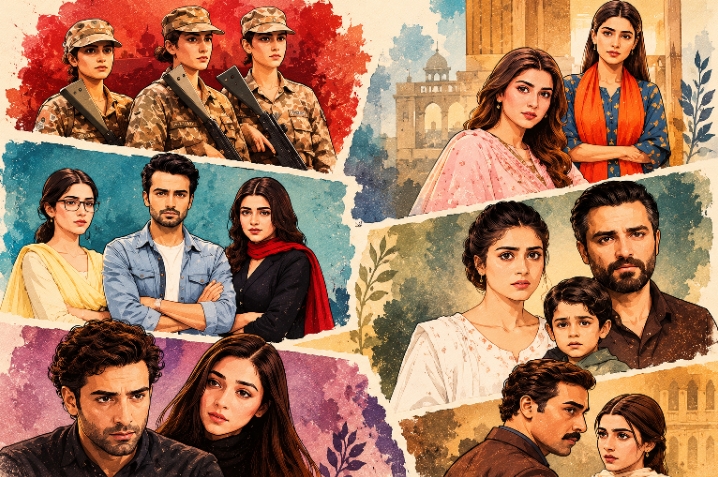
I have always found Umera Ahmed‘s writing fascinating, particularly her exploration of faith, human vulnerability and the search for spiritual fulfilment. Through dramas such as Shehr-e-Zaat, Peer-e-Kamil, Alif, Zindagi Gulzar Hai, Durr-e-Shehwar and Meri ZaatZarra-e-Benishan, she has explored the relationship between worldly attachments and the desire for something more meaningful. Her characters struggle with heartbreak, vanity, insecurity and disappointment, often turning towards God when the lives they imagined begin to fall apart.
I find much of this storytelling genuinely moving. For many Muslims, faith is not something reserved for religious gatherings or moments of celebration. It is part of everyday life, a source of comfort during grief, uncertainty and personal crises. Why, then, should the presence of Islam in a television drama automatically be interpreted as an ideological agenda? I do not entirely agree with the criticism Ahmed’s work has attracted, particularly when her spiritual themes are treated as evidence of an attempt to promote conservative gender roles.
However, I also find myself questioning some of the ways she portrays women, marriage and forgiveness. My disagreement is not with her spiritual message. It is with the unequal burden of transformation that sometimes emerges from her stories.
Take Shehr-e-Zaat. Falak’s journey from vanity and romantic obsession towards spiritual awareness remains one of Ahmed’s most compelling narratives. When Salman betrays her, she begins questioning the importance she has attached to beauty, wealth and romantic love. She discovers that lasting fulfilment cannot depend on another person’s affection. I have always found this aspect of the drama beautiful. Our relationship with God should not rise and fall with the fortunes of our relationships with other people.
But I have wondered why Falak’s spiritual journey eventually brings her back to Salman. Forgiveness is a personal choice, and there is nothing inherently wrong with reconciliation. But forgiveness and reconciliation are not the same thing. Falak could have rediscovered her relationship with God, developed greater self-awareness and found peace without returning to an unfaithful husband. Why must a woman’s spiritual growth culminate in the restoration of her marriage?
A similar contradiction appears in Zindagi Gulzar Hai. Kashaf is a remarkable character, particularly in the way her upbringing shapes her determination to become financially independent. Her father’s preference for sons leaves deep emotional scars on the family, while her mother’s struggles underline the importance of educating daughters. The drama makes a powerful case for women’s education and independence.
Zaroon, meanwhile, is educated and privileged but carries deeply problematic assumptions about women. He is possessive, judgemental and often expects women to conform to his preferences. Yet his shortcomings are gradually softened through his relationship with Kashaf. I remember the tenderness of the moment when he prevents a cup of tea from spilling onto her hand. It is a beautiful domestic detail. But it also makes me wonder why women so often undergo profound emotional transformations, while men are allowed to redeem themselves through romance and occasional gestures of affection.
Dar-e-Nijat offers another interesting examination of religious identity. Zamil represents a form of male entitlement that is not unfamiliar in our society. He wants a woman who conforms to his ideas of purity and submissiveness, while remaining considerably less critical of his own behaviour. His turn towards religion following personal loss does not immediately make him more compassionate. Instead, he sometimes uses his religious identity to judge Zaryab and establish his moral superiority.
Abubakr offers a striking contrast. His goodness is expressed through kindness, restraint and his refusal to expose another person’s past. He does not use Zaryab’s vulnerabilities to establish his own moral standing. To me, this is a far more meaningful understanding of religious character. Faith should make us more considerate towards others, not give us another reason to judge them.
I do, however, have reservations about Abubakr’s storyline, particularly the emotional pressure his mother places on him to marry someone different from the person he had imagined for himself. Respecting one’s parents should not necessarily mean surrendering the right to make deeply personal decisions.
Zaryab, meanwhile, is a particularly believable character. She is educated and accomplished, yet emotionally invested in a relationship that repeatedly gives her reasons to reconsider her choices. She struggles to acknowledge Zamil’s shortcomings, including his addiction. I find this realistic. Education and professional success do not make women immune to unhealthy relationships. A woman can be financially independent, intellectually confident and still find herself emotionally attached to someone who does not treat her well.
What troubles me, however, is the character of Zaryab’s grandmother, who is often presented as the voice of reason despite her frequently intrusive and judgemental behaviour. Her lines, “Tum betikebaap ho” and “Larkikebaap ko jhuknapadtahai”, have stayed with me. Why should the father of a daughter occupy a different moral position when a marriage encounters difficulties? If Islam is the moral framework through which a drama asks us to understand family relationships, why should kindness and empathy not apply to elders as well?
My reservations become even stronger when I think about Durr-e-Shehwar. I remember watching it with my mother and being appalled by what Shehwar was expected to endure. My mother, however, felt validated by the story. She recognised women who had spent years adjusting to their husbands and in-laws. Perhaps that difference in our responses says something about how differently generations experience the same stories.
Mansoor’s failure to stand up for Shehwar when his mother mistreats her is not simply a minor marital disagreement. It is a failure to recognise his responsibility towards his wife. His mother’s objection changes the living arrangement the couple had initially expected, leaving Shehwar to adjust to a household where she struggles to find acceptance. Why does the response to her suffering become advice about patience rather than an effort to change the circumstances making her unhappy?
The difficulties in Haider and Shandana’s marriage raise similar questions. Not every troubled relationship involves infidelity or obvious cruelty. Emotional neglect, resentment and poor communication can damage a marriage just as deeply. I am not convinced that a husband deserves another chance simply because he is not as openly cruel as someone else. The absence of extreme mistreatment is a very low standard for being considered a good husband.
This brings me to my central question about Ahmed’s writing. If turning towards God is supposed to make us better human beings, why does that transformation not always demand more from the men who cause women’s suffering?
Research on Pakistani television, including Elliot Montpellier’s study of religious imagery and piety in dramas such as Shehr-e-Zaat, Meri ZaatZarra-e-Benishan and Khaani, offers an interesting context for thinking about how television represents faith. These stories do more than portray religious practice; they shape conversations about morality, gender and everyday life.
I do not believe every unhappy marriage must end in divorce, or that choosing reconciliation makes a woman less independent. But women should be allowed to forgive without being expected to return. They should be allowed to find meaning in suffering without being asked to accept injustice. The Quran itself speaks of kindness within marriage and the possibility of separation with dignity. These principles deserve as much attention as the familiar emphasis on patience and sacrifice.
I continue to appreciate Umera Ahmed’s writing. Her stories have made many viewers reflect on faith, humility and the limitations of worldly attachment. But admiration should not prevent us from questioning the ideas embedded in the stories we love.
Perhaps what I want from these dramas is not a different understanding of faith, but a more equal one. A woman’s spiritual journey should not simply teach her how to live with what has been done to her. It should also remind the people around her of their responsibility not to cause that suffering in the first place.
After all, being a good woman should not mean learning to endure everything. And being a good man should mean considerably more than knowing how to ask for forgiveness.