In Pakistani television, women’s stories often begin with love and end with a lesson. Heartbreak becomes an opportunity for self-discovery, betrayal a reason to turn towards faith, and personal suffering the first step towards becoming a better woman. In the dramas of celebrated Pakistani writer Umera Ahmed, these journeys raise questions about how women are portrayed, what their struggles are meant to teach them, and whether their transformation comes at the cost of their agency.
Two of Ahmed’s dramas, Shehr-e-Zaat and Dar-e-Nijaat, offer a way into this conversation. Their female protagonists, Falak and Zaryab, are educated, ambitious women whose romantic relationships force them to confront questions of identity, faith and self-worth. Yet their stories also invite a more uncomfortable inquiry: when women are hurt by men, why does the narrative so often turn towards correcting the women themselves? And what happens to the accountability of the men responsible for their suffering?
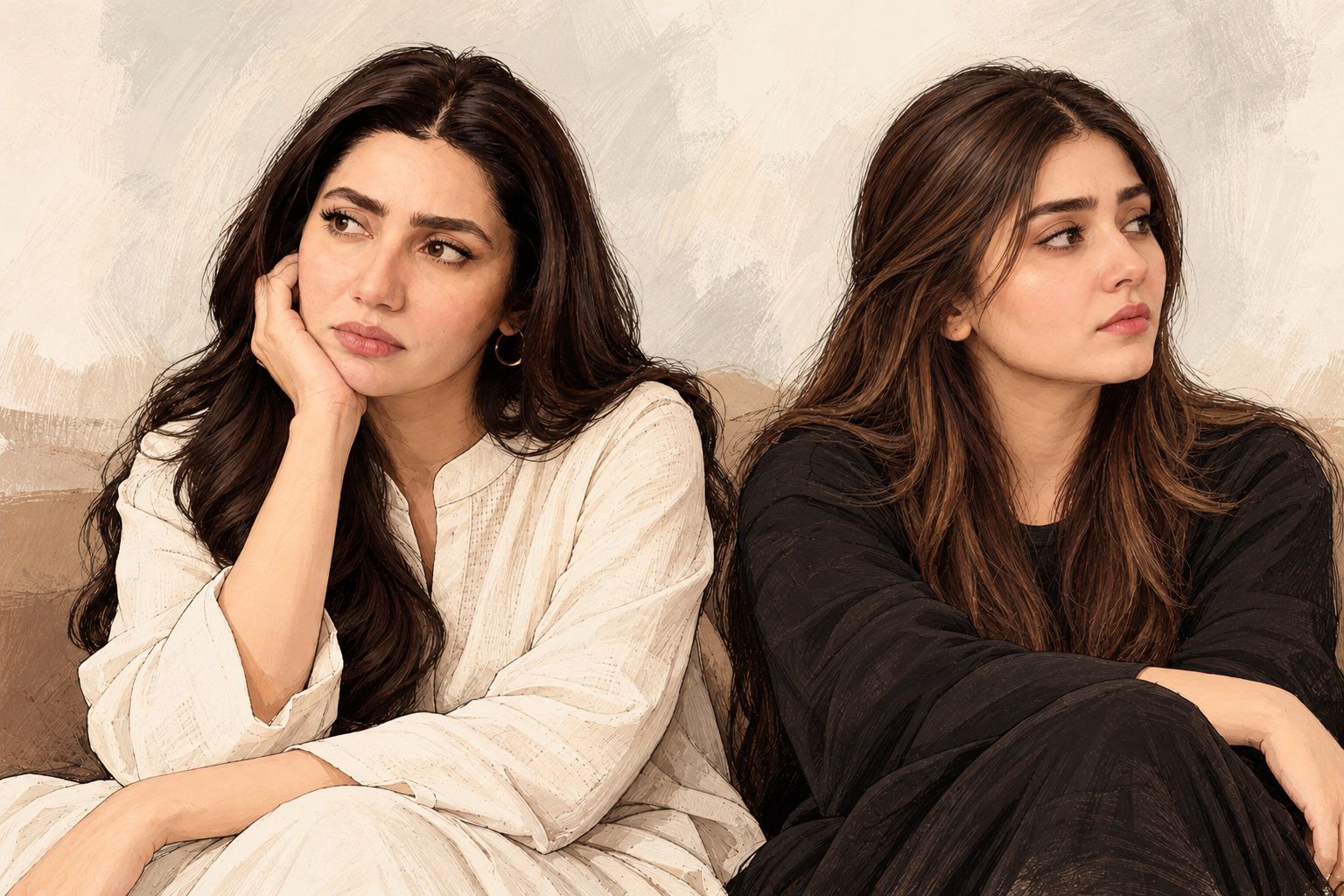
In Shehr-e-Zaat, Falak, played by Mahira Khan, sees her world unravel after her husband’s infidelity. In one of the drama’s most unsettling scenes, she stares at the mud, screams and smears it across her face. The gesture marks a dramatic rupture in the life of a woman who once appeared to have everything, having built much of her identity around beauty, wealth and romantic love.
Falak’s heartbreak sets her on a spiritual journey. She begins questioning her attachment to material comforts and searching for a closer relationship with God. In one conversation with her mother, she acknowledges that she was never taught to seek knowledge of God; instead, she learned to desire wealth, beautiful clothes and other luxuries.
Her transformation is central to the drama. But as Falak turns inward, the narrative’s attention shifts from her husband’s betrayal to her own shortcomings. Her suffering becomes the beginning of a moral and spiritual reckoning, raising a question about the way women’s pain is represented on screen.
Hafsa Qureshi, a sociologist at the University of Karachi and an activist working for women, minorities and workers, sees this pattern in Ahmed’s treatment of her female protagonists. She argues that their suffering is often presented as a necessary stage in their development, lending their pain a moral purpose.
“In most scripts, what Umera Ahmed does with her heroines is make them go through suffering. It is painted as something you can relate to but somehow it is understood that it was needed for these women,” Qureshi says.
For Qureshi, the concern is not that women turn towards religion after a painful experience. It is that their relationship with faith can become entangled with expectations of how a woman ought to behave. Educated and seemingly empowered women, she argues, are sometimes portrayed as spiritually inadequate when they do not conform to prescribed ideals.
“Their relationship with God is not presented as an independent, personal connection with spirituality. It is intertwined with patriarchy and prescribed gender roles,” she says. “When we look closely at these narratives, we see how women’s suffering becomes a means of correcting them, while the wrongdoing of their male partners recedes into the background.”
The tension between personal faith and social conformity becomes more pronounced in Dar-e-Nijaat. Zaryab, played by Dur-e-Fishan Saleem, faces criticism from her partner, Zamil, played by Nameer Khan, over her lifestyle and distance from religion. He tells her he cannot marry her because she does not observe purdah and does not fit his idea of a religious wife.
His rejection turns Zaryab’s personal choices into a test of her spiritual and moral worth. When she begins to reconsider her relationship with religion after the heartbreak, it becomes difficult to separate her own search for meaning from the standards imposed on her by the man who rejects her.
Rooshan Alam, a clinical psychologist, trauma specialist and educator, believes this kind of character arc can leave too little room for female agency. Rather than asking only how a woman might grow through adversity, Alam argues, a story must also examine the people and social structures that have caused her pain.
“For me, Umera Ahmed sometimes sells the idea of a weak female protagonist. Why is a woman’s suffering so often an opportunity for her spiritual correction rather than an indictment of the people and social structures causing her suffering?” Alam asks.
Her objection is to the suggestion that a woman’s growth must involve some form of submission, or that her ability to recover depends on accepting the circumstances that hurt her. Spirituality, she argues, need not require a woman to abandon her ambitions, identity or boundaries.
“Women can be spiritual without being submissive. They can forgive without reconciling, grow through adversity without accepting mistreatment, and love God without abandoning their ambitions, identities or boundaries,” Alam says.
This distinction matters particularly in stories where a new romantic relationship appears to offer a way out of an earlier one. In Zaryab’s relationship with Abu Bakar, played by Sheheryar Munawar Siddiqui, the question is whether a kinder man becomes the answer to the damage caused by another. If so, the narrative risks returning to a familiar formula in South Asian television: one man harms a woman, and another restores her.
There are other ways Zaryab’s story could unfold. She could return to Harvard, rebuild her confidence, pursue a career, deepen her friendships and develop an identity that does not depend on romantic relationships. She could grow closer to her faith without marriage becoming the ultimate proof of her transformation.
Such possibilities do not diminish the importance of marriage or spirituality. They simply allow women a wider range of futures, in which love, faith and personal fulfilment need not be mutually dependent.
The limited space given to therapy as a route to recovery raises a related question. In stories of troubled relationships, women are often directed towards reconciliation or spiritual introspection, while the men who betray them may receive less sustained moral scrutiny. For some critics, this reflects a broader worldview in which religious transformation and the right kind of romantic partner become the principal routes to redemption.
Sabahat Zakariya, a writer, cultural critic and creator of video essays, reads Ahmed’s work through this lens. She sees a tension in the way the writer approaches Western ideas and modern aspirations.
“Therapy is very much a Western liberal idea, and Umera Ahmed’s jihad is against whatever can be deemed Western, even as she upholds certain other symbols of Western modernity as the highest achievements possible, such as studying at Harvard. That is why therapy is obviously not an option. It doesn’t further her agenda. It is only the love of a good Islamic man that can redeem a woman, or her turning towards religion,” Zakariya says.
She compares Ahmed’s worldview with that of Bano Qudsia, another influential figure in Pakistani popular fiction. In Zakariya’s reading, both writers return to the idea of women as temptresses who require reform. She argues that the narratives may condemn certain male characters without necessarily examining the assumptions that shape the women around them.
In Dar-e-Nijaat, for instance, Zamil may be positioned as an antagonist, but Zakariya believes he does not face the same degree of moral scrutiny as the female characters. She also questions the portrayal of Faryal, Zaryab’s elder sister, whose desire for divorce can appear unreasonable when viewed through the narrative’s framing of her and her family.
The concern, in Zakariya’s view, is that women’s choices are repeatedly treated as evidence of their moral failings, leaving them to defend their decisions even when those decisions concern their own lives.
Ihtisham Kazim, a Lahore-based Punjabi writer, educationist and cultural activist, takes a similarly critical view of Ahmed’s writing. He argues that the religious messaging in her stories can overshadow the individuality of her characters.
“All her themes, therefore, are propagandistic in nature. It is a form of tabligh, religious preaching. She is essentially preaching through her writing. She romanticises these ideals to such an extent that the characters lose their own individuality,” Kazim says.
He worries that audiences who absorb these narratives may be more inclined to judge women for their choices than to question the behaviour of men who hurt them. The criticism is not simply about what happens to the characters, but about the values that viewers may take away from their stories.
Yet Ahmed’s work does not inspire a uniformly critical response. For many readers and viewers, her dramas offer a meaningful exploration of faith, family, morality and the emotional struggles that shape human relationships. Their appeal lies partly in the possibility that suffering can lead to reflection and change.
Dr Junaid Raza, who holds a PhD in Urdu and is a lecturer at Government College University, Lahore, argues that Ahmed’s writing should be considered with this complexity in mind. Her dramas, he says, explore the ways family expectations, social pressures and religious beliefs influence women’s lives.
“Umera Ahmed’s writing is compelling because it connects personal suffering with questions of morality, faith, identity and human relationships. Her dramas explore how family expectations, social pressures and religious beliefs shape women’s lives,” Raza says.
He cautions against treating her body of work as a single, unchanging argument. The significance of women’s suffering, he suggests, depends on what an individual drama makes of it: whether the story exposes injustice, normalises endurance or allows resistance and transformation to coexist.
This distinction helps explain why viewers can come away from the same dramas with very different interpretations. A character’s turn towards faith may be read as an assertion of independence by one viewer and as a response to restrictive expectations by another.
Shanzay, 24, from Lahore, has admired Ahmed’s writing since she began reading her novels at a young age. She finds the female characters empowering because they confront difficult circumstances and change their lives. She also values the emphasis on spirituality, particularly the way the dramas open up conversations within families about faith and behaviour.
For Shanzay, these stories offer women a way to make sense of difficult experiences and emerge from them with a renewed sense of purpose. But the question of what that transformation demands of women remains open to interpretation. While some viewers see it as a source of strength, others are more concerned with the emotional burden these journeys place on the women themselves.
Saleha Irfan Khan, a PhD scholar in sociology at Istanbul University, Türkiye, and an academician, researcher and empath counsellor, offers a more qualified assessment. She notes that Ahmed’s heroines are often liberal, educated and modern, yet can be portrayed as emotionally naïve, giving too much of themselves to others without establishing boundaries.
Falak’s journey, in Khan’s reading, ultimately helps her recognise that loving a man, or being loved by one, is not the purpose of life. Zaryab’s story is less settled. Khan believes she continues to struggle with self-worth and religious identity, even seeing herself as beyond forgiveness.
Khan acknowledges that spirituality can help women recover from emotional distress. Her concern is that the responsibility for recovery often falls disproportionately on them. Women are more likely to be encouraged to pray and seek divine help, she says, while men who betray their partners or move on are not necessarily asked to undertake the same process of reflection.
“If that ideal girl/woman is made through a spiritual journey, then it’s good. If the same spiritual journey is also giving self-confidence, independence and no more reliance on anyone, it’s good too,” Khan says. “Because men when they betray or move on, they move on completely. Then why would women stay behind in any aspect of life?”
For Khan, these stories should be part of wider academic and public conversations about relationships and social values. Their significance extends beyond the characters themselves to the expectations that shape how women and men are judged in everyday life.
Ultimately, Falak and Zaryab reveal a central tension in the portrayal of women in Ahmed’s dramas. Their spiritual journeys can be read as attempts to reclaim their lives, find meaning in suffering and move beyond their dependence on romantic love. At the same time, these journeys raise questions about why women’s pain so often becomes an occasion for self-correction, while the conduct of the men who hurt them receives less attention.
There is nothing inherently wrong with turning towards God after heartbreak or finding strength through faith. Nor does personal growth have to be understood as submission. The difficulty arises when a woman’s suffering is treated as evidence of her moral shortcomings, or when redemption appears possible only through religious conformity or another relationship.
Women can find comfort in faith, seek therapy, set boundaries, pursue their ambitions and choose whether or not to marry. They can forgive without reconciling and rebuild their lives without accepting blame for another person’s actions. Their growth need not depend on proving that they have become better women because they were hurt.
The question, then, is not whether women should find meaning in suffering. It is whether the stories told about them allow room for their anger, independence and right to hold others accountable, alongside their faith and capacity for change.