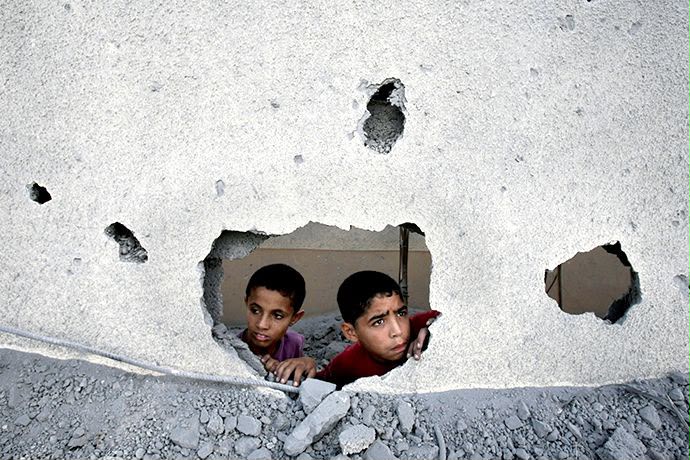
Eleven-year-old Sally finds moments of happiness dancing dabke, laughing and playing with other children in a displacement shelter. Nine-year-old Suhaib, despite losing his home and family members, finds comfort in making others laugh. These may seem small moments, but they are a desperate attempt by Gaza’s children to reclaim a childhood stolen by war. Gaza’s children do not need pity. They need a world willing to defend their right to grow up without fear. Beyond Survival, the Invisible Psychological Scars of Gaza’s Displaced Children
Some wounds do not appear on an X-ray. They neither bleed nor can they be bandaged. They live in the body’s startle response, in a child’s refusal to sleep alone, in the silence of a parent who cannot find words for what they have seen, and in the terrifying question that follows displacement again and again. “Where and when can we feel safe?”
For Palestinians in Gaza, displacement is not a single event. It is an accumulation of ruptures of home, family, school, neighbourhood, memory and future. From a psychological perspective, this goes far beyond “stress.” It is prolonged, repeated traumatic exposure to bombardment, bereavement, hunger, injury, forced movement, separation from loved ones and the collapse of the ordinary structures that make a child feel secure. Recent research among displaced children aged 3 to 12 found an average of 6.7 forced displacements and 6.6 out of 10 measured war-related exposures. Of these children, 57.8 per cent met criteria for probable post-traumatic stress disorder (PTSD), and more than 46 per cent showed abnormal psychosocial functioning on the Strengths and Difficulties Questionnaire (SDQ). These numbers are clinical. But behind each percentage is a child.
A life reduced to survival
In humanitarian psychology, we often distinguish between acute traumatic stress, post-traumatic stress and complex post-traumatic stress disorder (cPTSD). Acute stress is the mind and body’s immediate response to danger, with a racing heart, freezing, hypervigilance, nightmares and dissociation. PTSD can develop when terrifying memories remain unprocessed, returning as flashbacks, intrusive images, avoidance, emotional numbness, irritability and an exaggerated startle response. cPTSD emerges when trauma is prolonged, repeated and relational, when safety has been absent for so long that trust, emotion regulation, identity and relationships are injured too. Many of Gaza’s children have lived through all three, in sequence or at once.
A study of 250 displaced adolescents in Gaza found that every participant had experienced at least three war-related traumatic events. More than half met criteria for probable PTSD and nearly 30 per cent met criteria for probable cPTSD. Behind these diagnostic labels is a child who hears a falling utensil and believes the ceiling will collapse, a teenager who cannot concentrate in class because their nervous system is still scanning for danger, and a mother who wants to comfort her son but is herself too exhausted, frightened or grief-stricken to regulate her own body.
The World Health Organization reports that mental-health and psychosocial needs in Gaza remain “extremely high”, driven by repeated displacement and persistent uncertainty over security, shelter and livelihoods. UNICEF estimates that nearly all of Gaza’s approximately one million children need mental-health and psychosocial support. Nearly nine in ten children consulted by UNICEF said they needed psychological support, reporting sleep problems, bedwetting, withdrawal and aggressive behaviour.
What war does to a developing mind
Children experience the world differently from adults. Their brains, bodies and sense of self are still under construction. That is precisely why war is so devastating. War does more than interrupt development. It can alter the biological and relational foundations on which development depends.
In the earliest years, children need what developmental psychologists call secure attachment, the certainty that their family will protect, soothe and stay close. When family members are injured, grieving, displaced or struggling to feed their children, that certainty can be shaken. A toddler may become clingy, regress in speech or toileting, or cry uncontrollably when separated from a parent. These are not signs of weakness. They are the child’s nervous system communicating a struggle to feel safe and a search for reassurance, connection and protection.
For children in Gaza, trauma often speaks through drawings, silence and behaviour. Their pictures tell stories that words cannot, with homes reduced to rubble, families torn apart, mothers who will never return and childhoods interrupted by war. In a documented account by UNRWA, a displaced girl, Fatima al Za’anin, drew images of people killed in the conflict, while the teenager Na’emat Haboob painted her mother, killed in the war, as she struggled with the loss of her family. These drawings are fragments of childhood overwhelmed by grief.
For adolescents, the loss extends beyond family and home. It takes away friendships, education, independence and the ability to imagine a future. At an age when they should be discovering who they want to become, many are struggling to understand why their world has disappeared. Their sadness, anger, withdrawal and hopelessness may carry the weight of experiences no young person should have to bear.
The suffering does not end with emotional wounds. Hunger, sleepless nights, injuries, overcrowded shelters and the absence of safety have become part of everyday life. A child cannot begin to heal psychologically while struggling to survive physically. Before children are asked to recover from trauma, they must be given what childhood requires, namely food, shelter, safety, care and the reassurance that tomorrow will come.
The invisible grief of losing home
Home is where a family returns for comfort and warmth. It holds photographs, smells, a child’s height marked on a wall, the sound of siblings running around, the aroma of a mother’s cooking, and the places where grief and joy live. When a home is destroyed, a family loses the physical archive of its life.
Psychologists, following Pauline Boss, call this ambiguous loss, which arises when a person is physically absent but psychologically present or when something is lost without clear closure. In Gaza, many families live with a devastating version of this, with homes they cannot return to, relatives whose deaths remain unprocessed, schools that no longer exist and futures postponed indefinitely.
More than 58,000 children in Gaza have lost one or both parents. For an orphaned child, bereavement is compounded by displacement, disrupted caregiving and often the loss of the person best able to explain what has happened. Children need adults who can help them name reality without overwhelming them, with words such as “Your father died. It is not your fault. You are loved. We will find ways to keep his memory alive.”
But many caregivers are carrying their own trauma. This is why child mental health cannot be treated in isolation from caregiver mental health. Caregivers who are suffering themselves cannot always provide the calm presence that settles a child’s overwhelmed nervous system. Supporting parents is therefore, in effect, child protection.
Resilience is real, but it is no substitute for safety
It is tempting, especially from a distance, to speak only of Palestinian “resilience”. And resilience is real. It appears in families sharing bread, teachers improvising classrooms in tents, children inventing games amid rubble, grandparents telling stories, and neighbours burying the dead and then returning to search for the living.
But resilience must never be used as a reason to accept intolerable conditions. Children should not have to be resilient to bombardment, hunger, displacement or the death of their parents. Resilience is not a personality trait that makes suffering acceptable. It is a set of protective processes, among them relationships, culture, faith, meaning, community and sometimes sheer stubborn hope, that help people survive what should never have happened to them.
In Gaza, those protective processes are under extraordinary pressure. They nonetheless remain visible. UNRWA, one of the largest providers of emergency learning and psychosocial support in Gaza, reported that between October 2023 and June 2026 its social-work teams served 272,780 displaced people through psychological first aid, psychosocial services, family and individual activities and case management. Its teams also supported 7,340 children, including 3,337 unaccompanied children. These services are attempts to restore the most basic psychological conditions, namely safety, connection, predictability and dignity.
What healing can look like
There is no therapy that can undo genocide, restore a destroyed neighbourhood or return a murdered parent. But psychological care can reduce suffering, prevent symptoms from hardening into lifelong disability and help children and families reclaim some capacity to live rather than only endure.
Healing often begins with something simple, such as someone sitting beside a frightened child, listening without demanding answers, offering reassurance and making them feel less alone. This is the essence of Psychological First Aid (PFA). For a child who has lost a parent, witnessed a bombing or been separated from family, even a compassionate presence can become the first step towards feeling safe again.
In Gaza, these small interventions have carried enormous meaning. UNESCO documented the story of ten-year-old Samira, who struggled with the death of her brother. During counselling, she drew his body, expressing grief she could barely put into words. Gradually, through individual and group sessions, she began making friends again. Her words were heartbreaking. “I just want to play again.” Another child, Nada, who had lost her mother, experienced isolation and recurring nightmares. Through counselling and play activities, she slowly began reconnecting with other children and her nightmares became less frequent.
Progress is sometimes visible in the smallest everyday moments. OCHA documented the case of first-grader Salah, whose trauma left him frightened of going to the bathroom alone and unable to concentrate at school. Following psychotherapy, play therapy and family counselling, his nightmares stopped and he gradually regained his confidence. For him, completing homework and walking to the bathroom independently were signs of a childhood slowly returning.
Other children are finding moments of relief through recreational activities. UNRWA documented the experiences of 11-year-old Sally, who found happiness in dancing dabke, laughing and playing with other children in a displacement shelter. Nine-year-old Suhaib, despite losing his home and family members, found comfort in making other children laugh. These moments may appear small, but laughter in a displacement shelter is a quiet reclaiming of childhood.
For children with more persistent symptoms, specialised approaches such as Trauma-Focused Cognitive Behavioural Therapy (TF-CBT), Teaching Recovery Techniques and Problem Management Plus can provide additional support. Even so, therapy cannot bring back a murdered mother, play cannot rebuild a destroyed home and counselling cannot erase the memory of a sibling killed in war.
What these interventions can do is help children rebuild trust, express grief and rediscover moments of happiness. The most meaningful measure of recovery is not whether a child has forgotten what happened, but whether they can once again sleep without fear, make a friend, laugh without guilt and dream about tomorrow. For Gaza’s children, healing is ultimately about giving childhood a chance to exist again.
The people trying to reach them
The humanitarian response is vast, courageous and painfully insufficient.
UNICEF and partners provided multi-layered support in early 2026, including mobile family and community-based activities to help children manage stress and anxiety, build social connections and develop positive coping skills. UNICEF supported 35,707 children and 7,259 caregivers through community-based activities, while 9,266 people benefited from mental health and psychosocial support (MHPSS) interventions. In the same period, UNICEF’s Back to Learning response enabled 195,000 children to access safe learning and healing spaces.
That last phrase, “learning and healing spaces”, is psychologically profound. School is not only a place to acquire knowledge. For a traumatised child, it can be a place where time regains structure, with a morning routine, a teacher who notices, friends who laugh, a pencil that belongs to them and a lesson that points towards tomorrow. Education is a form of psychological protection.
Child-protection partners have also reached thousands of children and caregivers with counselling and group sessions. In one week in late July and early August 2026, they reached more than 5,000 children and 2,600 caregivers with MHPSS services, counselling or group sessions, giving children opportunities to express emotions and manage stress. In late March, partners reached more than 4,000 children and 2,000 caregivers through structured group MHPSS sessions, individual counselling, mind-body therapy, recreational and resilience-building activities, speech therapy and family-based psychosocial support. More than 130 children were referred to specialised services.
UNRWA’s telepsychology services, WHO-supported telemedicine, mobile clinics and Palestine Red Crescent outreach teams are trying to overcome the brutal arithmetic of war, with too few clinicians, too much need and too little safe access. Community initiatives, peer groups, youth clubs, women’s centres, local counsellors, faith leaders and teachers carry much of the emotional labour. They offer culturally familiar language, shared memory and the powerful message that a child is not alone.
The therapy Gaza needs most
No psychologist should pretend that weekly sessions alone can heal children who remain under threat. Trauma treatment assumes, at minimum, that the traumatic situation has ended or become less immediate. When danger continues, therapy must begin with stabilisation, namely safety, sleep, food, medical care, consistent routines and connection with caregivers.
This is why the most important “therapy” is also political and humanitarian, namely a ceasefire that holds, humanitarian access, reconstruction, schools, hospitals, clean water, nutrition, family reunification, protection from renewed displacement and an end to the conditions that keep children’s nervous systems locked in survival mode. A child cannot fully heal in a tent if the tent can be bombed. A mother cannot soothe her child if she does not know whether tonight will be safe.
Still, within these constraints, care is possible and it counts. A child who is helped to name fear is less likely to carry it silently for decades. A caregiver who receives support is better able to hold a frightened child. A classroom, even in a tent, can restore the idea that life contains more than loss. A community worker who remembers a child’s name can become proof that the child still exists in someone’s mind, as a person rather than a statistic.
What we owe them
From a psychological standpoint, the deepest injury of displacement is the loss of continuity, the sense that yesterday connects to today and today to tomorrow. Palestinians in Gaza are being asked to rebuild a life while the ground beneath it keeps moving.
Even amid catastrophe, they are mourning, remembering, protecting children, teaching, praying, joking when possible and insisting on dignity, as humans have always done after unimaginable loss. Our responsibility is not to admire their endurance from afar. It is to help create the conditions in which endurance is no longer required, where a child can sleep without terror, learn without fear, grieve without isolation and grow into a future that is not defined by war.
Gaza’s children do not need pity. They need a safe place to sleep, the freedom to play and the chance to grow up without fear. Their childhood cannot be restored overnight, but we can refuse to accept a world where children continue to pay the price of war. The least we can do is raise our voices, stand for their right to live and say no to war. To understand their plight, we do not need to be in Gaza. Being human is enough.