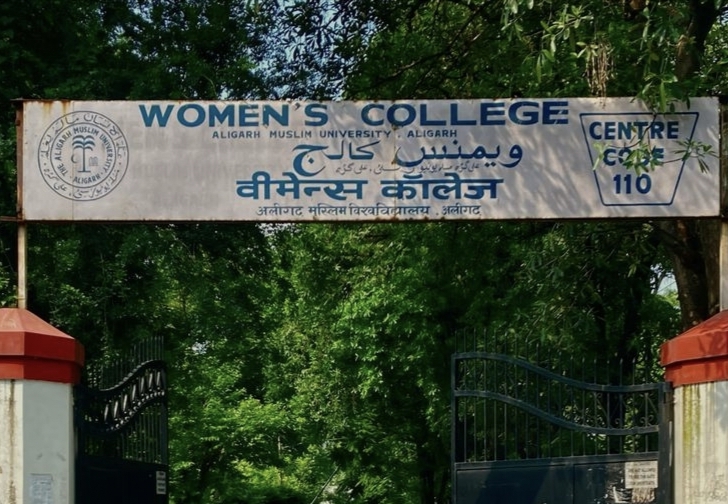
The return of the Women’s College Students’ Union (WCSU) elections at Aligarh Muslim University after an eight-year gap has reopened an important question about women’s political participation and representation within the university. The last elections, held in November 2018, saw Afreen Fatima elected as President, alongside Nahid Asad as Vice-President and Maimoona Ansari as Secretary. Since then, generations of students have passed through the college without an elected students’ union. The restoration of elections is therefore not merely an electoral exercise; it brings back an institutional platform for women’s participation in campus politics.
Yet, the return of elections also calls for a larger examination of the position women occupy within the university’s political and decision-making structures.
My decision to contest the WCSU elections emerges from this concern. Women’s College has its own elected students’ union, but the participation of its elected representatives in the larger political structures of the university remains limited. At present, only the WCSU President has representation in the Executive Committee of the AMU Students’ Union. The Vice-President and Secretary have no equivalent representation. Similarly, the elected student leadership of Women’s College has no corresponding representation in the AMU Court.
This is not simply a question of positions or designations. It concerns whose voices are present when decisions affecting the university are discussed and whose concerns find a place in its institutional framework. The demand is that the President, Vice-President and Secretary of WCSU should all become ex-officio members of the AMU Students’ Union, with appropriate representation in the AMU Court as well. While Women’s College has institutional representation through its Principal, its elected student leadership must also have a meaningful place in the university’s larger decision-making process.
If Women’s College is an integral part of AMU, why should the voices of its elected student representatives remain confined to the boundaries of the college?
However, the question of women’s representation cannot be reduced to institutional positions alone. It is neither limited to a particular section of society nor can it be understood through a single identity. It concerns the rights, existence and agency of women across different social and cultural backgrounds. It is about their right to participate, disagree, lead and determine the spaces they occupy. Women’s experiences are diverse, and their struggles cannot be accommodated within one narrow understanding of representation.
The history of Muslim Women’s College offers an important perspective on this question. The institution has a legacy that extends beyond classrooms and academic achievements. It is connected to a wider history of Muslim women’s education, social reform and the struggle to create spaces for women in a society where their access to education was frequently contested.
Ismat Chughtai, one of the most influential voices in Urdu literature, had an important association with Aligarh’s Women’s College. She went on to establish an unparalleled place for herself through her writing. Her literary work challenged established social conventions, questioned patriarchal morality and brought women’s experiences into conversations from which they had long been excluded. Through her pen, she confronted the hypocrisies of a society that often expected women to remain silent about their own lives. Her contribution reminds us that education can become a means of questioning the social structures that govern women’s existence.
The contribution of Waheed Jahan Begum, popularly known as Ala Bi, is equally central to this history. Alongside Sheikh Abdullah, she played an indispensable role in the establishment and development of women’s education at Aligarh. The girls’ school that began in 1906 eventually developed into the Women’s College we know today. Waheed Jahan’s contribution extended beyond supporting an educational initiative. She actively participated in teaching, looking after students and advocating women’s education at a time when the idea itself faced considerable resistance.
The history of this institution cannot be told through the efforts of men alone. It is also a history of women who helped build it, sustained it and made education accessible to generations that followed. Had Waheed Jahan not stood alongside Sheikh Abdullah in this endeavour, the history of women’s education at Aligarh might have taken a very different course.
These histories challenge the tendency to view women as secondary participants in social and political transformations. Women’s contributions have never been confined to supporting movements from the sidelines. They have been intellectual contributors, organisers, institution-builders and agents of change. Their participation has often been central to the very existence of the institutions and movements whose histories we celebrate today.
Throughout history, educational institutions have served as centres of intellectual awakening and political transformation. Universities, colleges and madrasas have provided spaces where established ideas were questioned, new political consciousness emerged and movements developed. Aligarh itself carries a history of intellectual and social mobilisation. Women have been part of these struggles, although their contributions have not always received the recognition they deserve.
This history must not remain confined to commemorative speeches or institutional celebrations. It must inform the way these institutions function in the present. A movement cannot claim to challenge existing inequalities while reproducing them within its own organisational structures. Women’s participation in a struggle must translate into their participation in the decisions that shape its future.
The question, therefore, is not simply whether women are allowed to participate in campus movements. It is whether they have an equal opportunity to influence the political direction of those movements and occupy positions within the structures that emerge from them.
My entry into the WCSU elections is situated within this larger conversation. The union must function as more than an electoral institution whose relevance ends with the announcement of office-bearers. It should provide an effective platform for students to articulate their concerns, question decisions and participate in matters affecting their academic and political lives. Its elected representatives must also be able to take these concerns beyond the college and into the larger university framework.
The eight-year gap has made the return of elections particularly significant. But the restoration of an electoral process, by itself, cannot address every question of representation. The challenge is to ensure that the voices emerging from Women’s College are not confined to its own campus and that its elected leadership has a meaningful role in the wider university.
The legacy of women who helped build this institution deserves more than ceremonial remembrance. It demands that the questions they struggled against continue to be addressed by the generations that follow.
We cannot celebrate women who challenged the boundaries of their time while overlooking the boundaries that continue to restrict women’s participation today. The contribution of women to social transformation has never been insignificant, and their place in the institutions they have helped build cannot remain peripheral.
A revolution cannot be complete when women are invited to participate in its struggles but excluded from shaping its direction. The question of women’s representation, therefore, is not an additional demand to be addressed at some later stage. It is fundamental to the very idea of an inclusive and democratic movement.