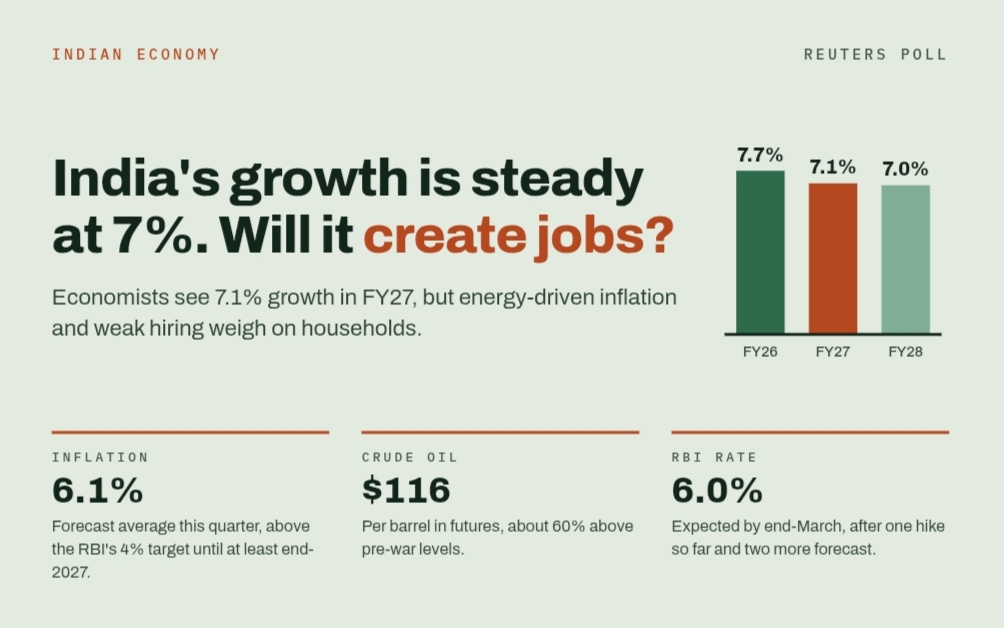
India’s economy is forecast to grow 7.1% in the financial year ending March 2027, down from 7.7% in 2025-26, according to a Reuters poll of economists. The poll, conducted between 19 and 26 October, expects growth to ease further to 7.0% in 2027-28, and finds that higher energy costs are adding to near-term inflation risks. This report is based on a Reuters poll of economists.
Growth steady, but slower
The forecast matches the Reserve Bank of India’s own expectation and an earlier Reuters survey, and broadly matches the International Monetary Fund’s. The poll found that the war involving the United States, Israel and Iran has had limited impact on growth so far, but has pushed up inflation, mainly through higher energy costs.
Economists have underestimated India’s growth in 10 of the last 12 quarters, though their forecasts have clustered close to 7%. Miguel Chanco, chief emerging Asia economist at Pantheon Macroeconomics, called the pace healthy in the current climate but “probably just average” for India.
Inflation stays above target
Price growth is forecast to average 6.1% this quarter and to stay above the RBI’s 4% medium-term target until at least the end of 2027. That is slightly higher than last month’s survey. Crude oil futures are trading around $116 a barrel, about 60% above pre-war levels, according to the report.
The RBI has raised rates once and is expected to do so twice more, taking the benchmark to 6.0% by the end of March. Kunal Kundu, India economist at Societe Generale, warned that stronger pass-through of energy costs and rising services inflation increase the risk that high prices become embedded in the economy.
A thin outlook for jobs
The poll’s most pointed finding concerns employment. Private investment, a key driver of job creation, grew nearly 12% in the June quarter, but forecasters say that pace will be hard to sustain if oil stays expensive. They also note that India has missed out on the surge in AI investment that has lifted growth in economies such as South Korea.
Chanco pointed to a double squeeze: weak private investment at home, and a global shift in which AI reduces the need to hire entry-level staff. He said this is causing dissatisfaction among young Indians. The report notes that a student-led movement, which began as online satire, has spilled onto India’s streets in recent months over concerns about education and jobs.
Households and welfare spending
Inflation is squeezing household budgets as savings dwindle. Economists warned that households face a further risk from future cuts to welfare spending, which has long supported demand and protected millions from poverty. The 2026-27 budget projected a 4.5% cut in food, fertiliser and petroleum subsidies.
Indranil Pan, chief economist at Yes Bank, said the scale of cash support from the Centre and states suggests that all is not well with consumption.
What remains unanswered
The poll offers forecasts and not outcomes. It does not say how long oil will stay at current levels, how much further the RBI will tighten, or whether the government will change its subsidy plans. With no major policy changes planned, the economists’ view is that steady growth will not, by itself, create enough jobs.