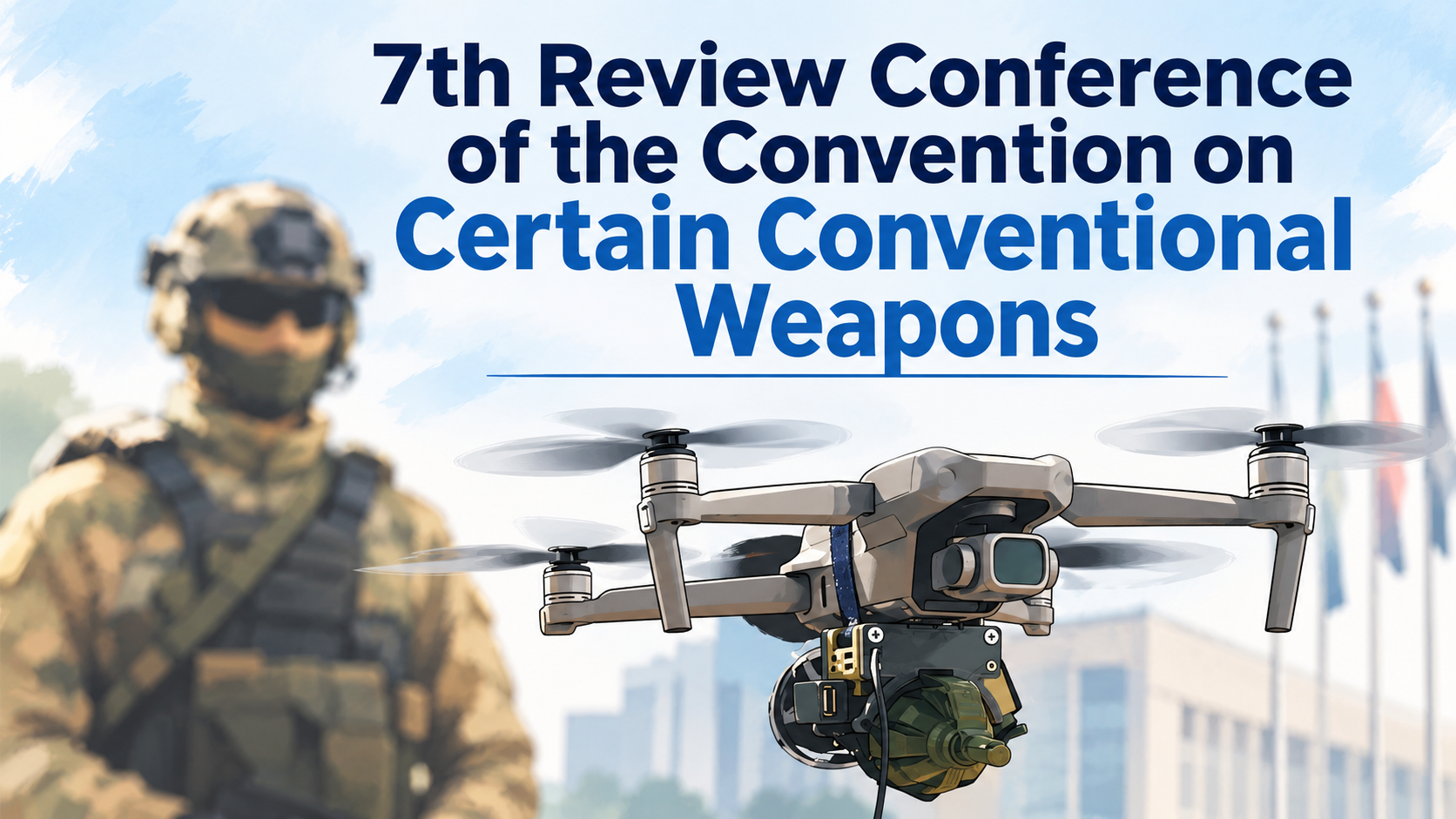
Governments are gathering in Geneva to debate international restrictions on lethal autonomous weapons, as divisions among major military powers raise questions about human accountability, civilian protection and the future of AI-driven warfare.
“We are now dangerously close to crossing a moral red line, the autonomous targeting of humans by machines.”
That warning, issued jointly by United Nations Secretary-General António Guterres and International Committee of the Red Cross (ICRC) President Mirjana Spoljaric on August 25, has gained renewed significance as governments meet in Geneva to determine the future of international regulation of lethal autonomous weapons systems (LAWS).
The United Nations’ Seventh Review Conference of the Convention on Certain Conventional Weapons (CCW), taking place at the Palais des Nations from November 16 to 20, has brought together representatives of 128 states parties. At the centre of the discussions is whether countries should begin negotiations on a legally binding international instrument establishing prohibitions and restrictions on autonomous weapons capable of selecting and attacking targets without further human intervention.
The debate is no longer confined to the future of military technology. It concerns who bears responsibility when a machine makes a decision that takes a human life.
A warning from the United Nations and the Red Cross
In their August appeal, Guterres and Spoljaric urged governments to move towards legally binding international rules. They stated, “Negotiations must begin now to urgently adopt a legally binding instrument to regulate autonomous weapon systems with clear prohibitions and restrictions.”
They also warned, “A failure to act quickly and decisively will cost lives.”
The appeal reflects growing concern that technological development is moving faster than international regulation. Autonomous systems can process information, identify objects and engage targets according to parameters established before deployment. Once activated, some systems can carry out these functions without a person making a separate decision for every attack.
The ICRC has called for prohibitions on unpredictable autonomous weapons and systems designed or used to target human beings directly. Its concern is not that every automated military system is inherently unlawful. Autonomous functions have existed for decades in certain defensive systems, including ship based anti-missile weapons. The concern is the expansion of autonomy into more complex environments, broader target categories and populated areas.
Human judgement and accountability at stake
The issue was reinforced ahead of the conference by UN High Commissioner for Human Rights Volker Turk. In a statement delivered through UN spokesperson Shabia Mantoo on November 13, Turk said, “A machine must never have the power to decide whether a human being survives or dies.”
He called for prohibitions on autonomous weapons that target people, either by design or in practice, and on systems whose functions and effects cannot be fully understood, predicted, explained and controlled by human users.
Mantoo stressed that “Human judgement and responsibility must remain at the centre of decisions involving the use of force.” She added, “Machines cannot understand the value of human life, assess context in the way humans can, or make the complex judgements required by international law. Nor can objects be held accountable when things go wrong.”
She also warned, “If not prohibited, anti-personnel autonomous weapons will inevitably proliferate and become more accessible to not only States, but a wider range of actors, including non-State armed groups and criminal organisations.”
The concerns extend beyond armed conflict. The UN human rights office has also highlighted risks involving the use of autonomous weapons in policing, including implications for the right to life, peaceful assembly, non-discrimination and access to remedies.
A divided international community Over Use of Autonomous Weapon
Despite growing calls for regulation, the Geneva negotiations face significant political divisions. Most of the 128 states parties to the CCW support moving towards an agreement. However, the United States, Russia and Israel oppose legally binding rules, arguing that existing international humanitarian law already provides an adequate framework for regulating warfare.
Washington favours guidelines rather than binding restrictions and has proposed a five year mandate for negotiations towards a non-binding agreement. The chair of the Geneva conference, Switzerland, has proposed a two year mandate to negotiate a legally binding protocol.
The United Kingdom, Germany and France support beginning negotiations on an international instrument but have left open the question of whether it should be legally binding. Diplomats have indicated that a compromise could take the form of a binding agreement, non-binding guidelines or a hybrid arrangement combining both.
China has also maintained an ambiguous position. At the UN General Assembly in October, 163 states supported a resolution calling for negotiations on rules governing autonomous weapons. Five countries, the United States, Russia, Belarus, Israel and North Korea voted against it, while nine abstained, including China, Iran and Saudi Arabia.
The figures demonstrate broad support for international action, but also underline the difficulty of reaching consensus among countries with significant military and technological capabilities.
Human Control and the Future AI Warfare
Artificial intelligence is accelerating the development of military drones, robots, tanks, submarines and other systems capable of carrying out increasingly complex operations. AI assisted and semi-autonomous weapons have reportedly been used in conflicts including Ukraine, Sudan and the Middle East. However, such systems should not automatically be described as fully autonomous, the degree of human involvement differs from one weapon and operation to another.
The distinction matters because the central concern is the possibility of systems selecting and engaging targets without meaningful human judgement. Critics warn that unpredictable behaviour, flawed data or an inability to interpret the circumstances surrounding an attack could lead to civilian casualties and make accountability difficult to establish.
Human Rights Watch has urged governments to take decisive action. Its representative Verity Coyle warned that “Machines should never be allowed to decide who lives and who dies on the battlefield, but this is a dystopian reality that is rapidly approaching.”
Can Geneva deliver an agreement?
The CCW has previously negotiated restrictions on weapons considered excessively injurious or indiscriminate, including blinding laser weapons, incendiary weapons and explosive remnants of war. Its framework allows states to develop additional protocols as military technologies evolve.
A Group of Governmental Experts working on lethal autonomous weapons adopted a final report by consensus on September 4, 2026. The report contains elements that could form the basis of an international instrument, without prejudging whether that instrument would be legally binding. The Review Conference is expected to consider those elements and decide the next mandate and process for negotiations.
The central obstacle remains political agreement. Because decisions under the CCW are made by consensus, opposition from influential military powers could prevent governments from securing a binding mandate.
The stakes extend beyond the immediate outcome in Geneva. International humanitarian law requires parties to distinguish between civilians and combatants, assess proportionality and take precautions to protect civilian lives. The challenge is determining how these obligations can be applied when machines are entrusted with increasingly independent decisions about the use of force.
As Guterres and Spoljaric warned in August, the international community is approaching a moral threshold. Whether governments can agree on rules before autonomous weapons become more widespread will test not only the reach of international law, but also the willingness of states to preserve human responsibility at the centre of warfare.