When Reuters reporters reached the site of Google’s planned data centre hub in Visakhapatnam in August, work was in full swing. A hillside above the site had been stripped to red earth and cut into terraces. In the city below, activists and schoolchildren had marched with banners reading “We cannot drink DATA” and had painted handcuffs on the Google logo.
The $15 billion project is Google’s biggest investment in India. It is being built with the Adani Group and is expected to create up to 188,000 jobs, according to the same report. Three months on, it is at the centre of a legal and political fight that has spread to Mumbai and raises a question India has not yet answered: who pays for the infrastructure of the AI age?
The water arithmetic
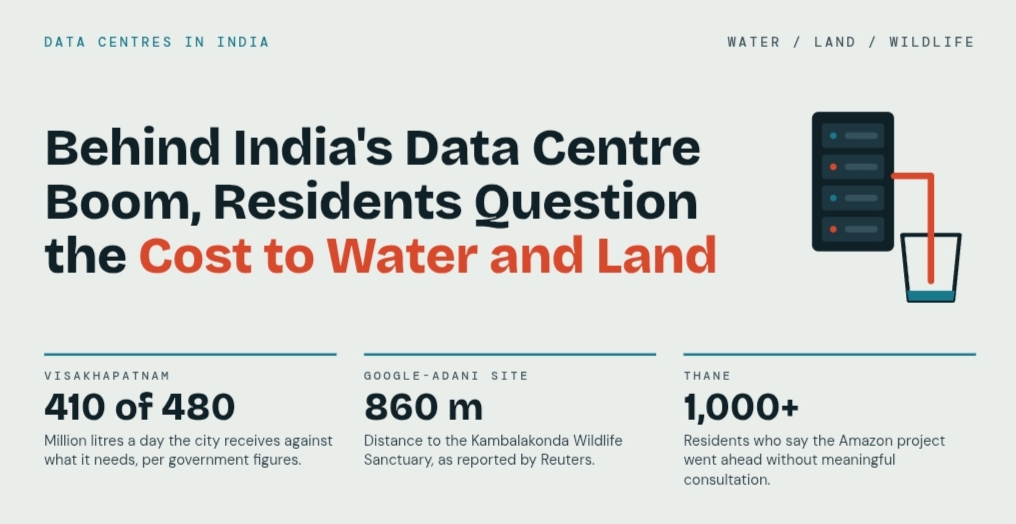
Visakhapatnam is a city of 2.5 million people where rationing is already common. The government’s own figures, cited by Reuters, show that the city receives 410 million litres of water a day against a requirement of 480 million. Raja Rama Mohan Roy of the non-profit Green Visakha told the gathering that development should not come at the cost of people’s livelihoods.
The strain is not limited to one city. A Reuters investigation published on 9 October notes that India holds 4 percent of the world’s freshwater for 18 percent of its people. It cites S&P Global’s estimate that 60 to 80 percent of Indian data centres could face high water stress this decade. It also cites research firm Mordor Intelligence, which says data centres used about 150 billion litres in 2025 and that the figure is projected to more than double by 2030.
Google said that it will use advanced air cooling to protect local water resources. The Andhra Pradesh government has said no water for rural or residential use will go to the data centres, and that a nearby reservoir will not be used. Activists say they are not reassured. Green Visakha has questioned the promise of guaranteed water for 20 years in a city that already runs short.
Whose land?
The dispute is not only about water. A public interest petition filed by environmentalist Bolisetty Satyanarayana, national convenor of Jal Biradari, contends that 160 acres allotted to the project belongs to the Simhachalam temple and should not have been transferred for commercial use. The state told the court the land was leased to the Andhra Pradesh Industrial Infrastructure Corporation, not transferred, according to The News Minute.
Elsewhere, the objections are about farming. According to The Wire, Dalit communities and farmers in Visakhapatnam have protested the acquisition of land for the project. Farmers in Bhogapuram mandal of Vizianagaram district have marched to the tahsildar’s office against land acquisition for a proposed data centre, saying fertile farmland would be lost. Some landowners have gone to court.
What the courts have said
On 24 August the Andhra Pradesh High Court declined to halt construction but directed the state to ensure that work proceeds only after all legal and environmental permissions are obtained. The petitioner argued that the existing clearance covers constructing the building, not operating the data centre.
In an interim order this month, a bench headed by Chief Justice Lisa Gill allowed the developer to continue, subject to the final outcome of the case. The Centre, the state and the developer have been asked to file counter-affidavits. The New Indian Express reported that the court told the developer it could not later claim any right or equity because of the money it had already spent.
The state’s position, as reported by the paper, is that the project falls under a category that does not need central clearance. The petitioner says it does. The project is also close to the Kambalakonda Wildlife Sanctuary, which Reuters reports is 860 metres away. The state says that is farther than the law requires.
The same fight in Thane
The pattern is repeating across the country. In Thane, near Mumbai, Reuters interviewed more than two dozen residents opposed to a planned Amazon facility on about 54 acres, part of the company’s investment of more than $21 billion in India by 2030. Residents fear strain on power and water and noise harmful to children and the elderly. More than 1,000 of them say the project was pushed through without meaningful consultation, and opposition politician Aaditya Thackeray joined their protest in September.
Amazon says the facility will use water-free cooling and a dedicated power supply separate from homes, and that it planted more saplings than trees removed. The industry itself is uneasy. Sharad Agarwal, CEO of Sify Infinit Spaces, said at an industry event, “I will never set up a data centre in a residential area.”
A fight that began abroad
Residents elsewhere have also pushed back against data centres. Reuters reports that US opponents held 142 protests across 42 states in July. Scroll has documented that Google withdrew a planned Indianapolis data centre after local opposition, and that Microsoft paused its Michigan plans to engage the community first. India is now actively courting the same companies, and the government has said that India’s data centre capacity has grown more than fourfold since 2020.
Whether companies are moving projects to India because they face friction at home is a claim the available reporting does not establish. What can be said is that the same objections are now being raised where the buildout is newest. In court, the petitioner has also argued that the government’s claim about strengthening India’s digital economy does not hold, because the facilities will not store or process Indian data. That is a contention before the court, not an established fact.
Voices under pressure
The campaign “Stop Vizag Data Centers” says Meta informed it on 19 September that its Instagram account had been restricted in India under the IT Rules. The campaign says the account had drawn more than 56 lakh views and 11,800 followers in two months. Separately, Newslaundry has claimed that an investigative video on the project’s impact on Dalit-held land was blocked in India after it went viral. The state government has not publicly explained either action in the reports reviewed.
Investors take notice
Money is also hesitating. Citing Tracxn data, The Wire reported that foreign funding for data centres fell from two or three deals a month until June to about one a month, and from roughly $600 million to $900 million a month to about $100 million. One investor quoted in the report said environmental clearances remain a major hurdle to execution.
What remains unanswered
The Andhra Pradesh High Court will decide whether the project’s approvals can stand. Neither the state nor the companies have said what happens to Visakhapatnam’s water supply in a dry year. They have not published the independent environmental assessments that residents have asked for. As the buildings rise, the people who live beside them are still waiting for answers.