A new report on ten years of parliamentary questions since the Paris Agreement finds climate gets little space in Parliament, with gaps in finance, adaptation and data.
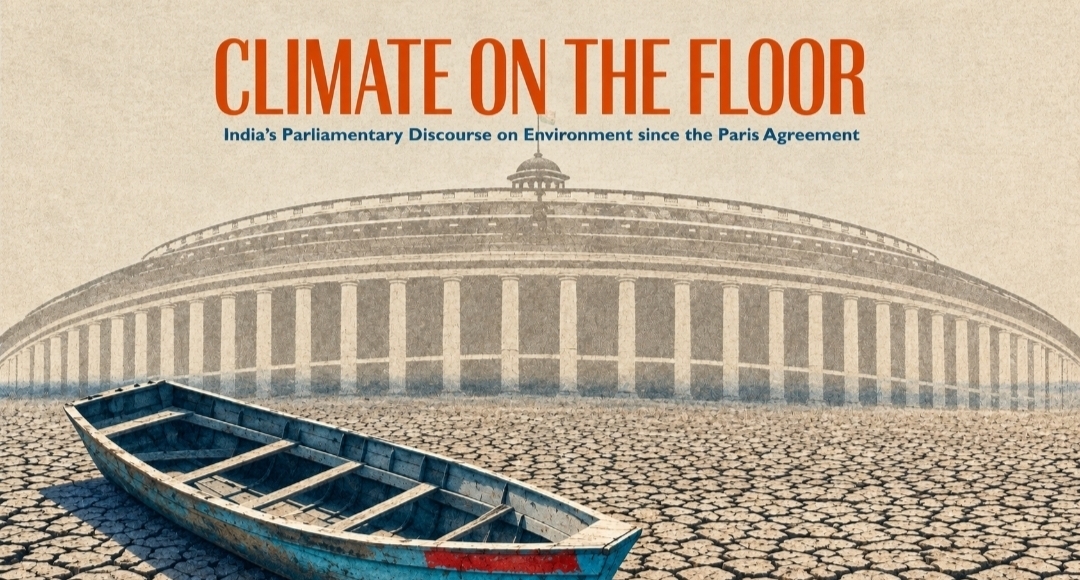
Ten years after the Paris Agreement, climate change accounts for just 3.3% of all questions asked in Parliament, according to a new report released in New Delhi on October 1. The report, Climate on the Floor: India’s Parliamentary Discourse on Environment since the Paris Agreement, was authored by Hajira Puthige and published by the Centre for Financial Accountability. It was released by Congress MP and former Environment and Forest Minister Jairam Ramesh, in the presence of climate expert Soumya Dutta, environmental lawyer Ritwick Dutta and Maansi Verma of Maadhyam.
The study examines 8,702 climate-related questions raised in the Lok Sabha and Rajya Sabha between December 2015 and December 2025, grouped into eight themes. It asks whether parliamentary scrutiny is keeping pace with India’s growing climate vulnerability.
Its answer is that it is not. Interest is concentrated on clean energy and decarbonisation, which draw 37.7% of the questions and align with India’s international targets. Climate finance receives only 0.3% and global climate governance 1.3%, which the report calls blind spots. Attention, it says, tends to be reactionary: questions on glaciers spiked after the February 2021 Uttarakhand glacier burst, and heatwaves drew substantial focus only after the record heat of 2022.
The report also finds a split between the two sides of the House. Members of the ruling NDA mostly ask status-oriented questions, which let the government showcase programmes such as PM-KUSUM and Green Hydrogen. Opposition members focus on implementation gaps, funding shortfalls and policy effectiveness. In reply, the report says, the Union government often points to the “state subject” status of disaster relief, urban flooding and forest management. It also says it does not centrally maintain data on climate-induced migration, heatwave deaths among informal workers, or forest area lost to wildfires. The government has rejected proposals for a separate Climate Change Act, saying the Environment (Protection) Act is sufficient.
The National Adaptation Fund for Climate Change, once a flagship for vulnerable sectors such as agriculture, was reclassified as a “non-scheme” expense from 2023-24, with no new projects to be started, the report says.
The findings come as extreme weather takes a growing toll. The Centre for Science and Environment and Down To Earth’s Climate India 2025 report recorded 4,064 deaths from extreme weather in the first nine months of 2025, a 48% rise over four years. It also found that 9.47 million hectares of crops were affected, 99,533 houses were destroyed, and at least 18 states and Union Territories saw their highest number of extreme-weather days since 2022.
Releasing the report, Ramesh said concern over the environment and climate is much greater than a decade ago, but that Parliament has not seen much debate. “Today’s climate champions were yesterday’s climate skeptics and deniers,” he said.
The report argues that parliamentary debate must move beyond individual disasters and technology-led responses towards adaptation, climate finance, implementation and accountability.