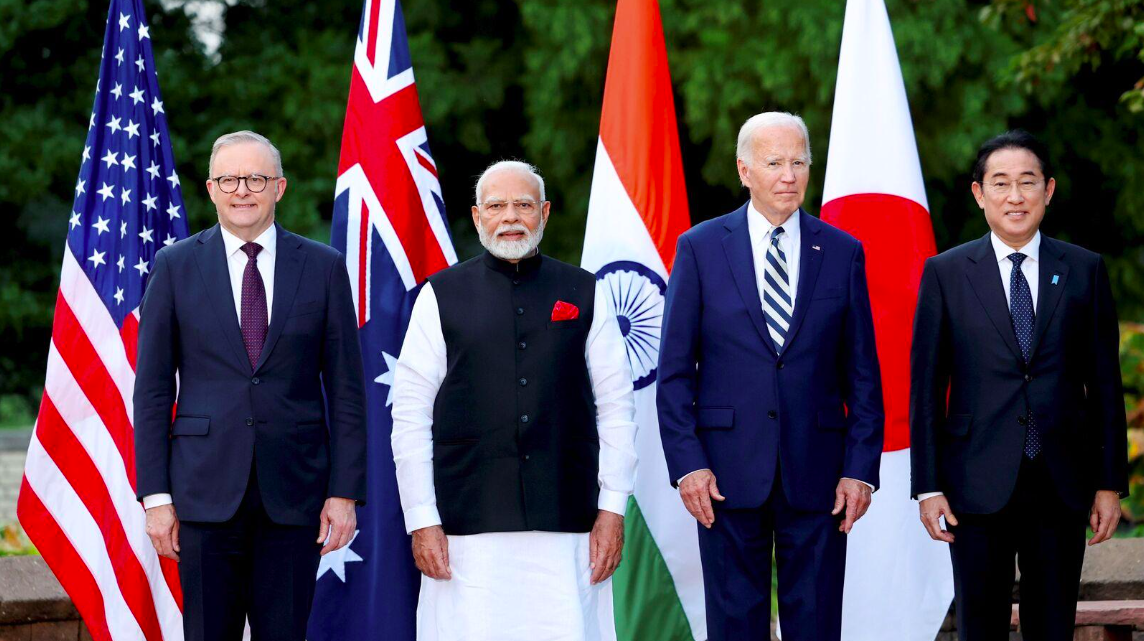
Prime Minister Narendra Modi joined US, Japanese and Australian leaders at the Quad Summit 2026 in Manila on November 17, 2026, to strengthen Indo-Pacific security and economic cooperation. The summit announced new maritime, technology and counterterrorism initiatives
The Quad Leaders’ Summit 2026 in Manila has given fresh momentum to India’s strategic engagement with the United States, Japan and Australia, with new commitments covering maritime security, artificial intelligence, cybersecurity and economic cooperation. Prime Minister Narendra Modi joined US President Donald Trump, Australian Prime Minister Anthony Albanese and Japanese Prime Minister Sanae Takaichi on November 17, as the four countries sought to strengthen regional stability and economic resilience in the Indo-Pacific.
One of the most significant announcements for India was the decision to host the inaugural Quad Business Leaders’ Forum in Mumbai in early 2027. However, while the summit expanded cooperation across several strategic sectors, questions remain over implementation, regional tensions and the ability of the four countries to maintain common priorities.
Quad Summit 2026: Major outcomes for India
The announcement of the Mumbai Business Leaders’ Forum represents an effort to take the Quad beyond diplomatic and security cooperation. The proposed forum will bring together business leaders, government officials and policy experts from the four member countries to encourage commercial partnerships and investment.
For India, the initiative offers an opportunity to attract investment, strengthen manufacturing partnerships and diversify supply chains. It also supports New Delhi’s ambition to become a more significant player in regional economic networks. However, actual economic benefits will depend on whether the forum produces concrete business agreements and long-term investments.
Maritime security was another major priority. The leaders announced the Indo-Pacific Maritime Surveillance Collaboration to improve information sharing and maritime domain awareness. Under the initiative, P-8 and P-3C patrol aircraft are scheduled to participate in a maritime exercise in 2027 for the first time in a Quad context.
The development is particularly relevant to India because of its strategic position in the Indian Ocean. Important shipping routes connecting the Middle East, Africa and Southeast Asia pass through these waters. Improved maritime surveillance can help monitor suspicious activities, illegal fishing and potential disruptions to commercial shipping.
India’s existing P-8I maritime patrol aircraft capabilities also make it an important participant in this cooperation. However, the initiative does not establish a joint Quad naval force or a collective military command.
Cybersecurity, AI and undersea connectivity
The Quad Summit also placed growing emphasis on digital and technological security. The four leaders announced enhanced Quad Cybersecurity Cooperation, recognising the increasing number and scale of cyber incidents across the region.
For India, cybersecurity is essential to protecting digital payments, financial services, telecommunications and government infrastructure. Greater cooperation could strengthen information sharing and regional resilience against cyber threats.
The leaders also reaffirmed support for the Super Intelligence Accelerator, an initiative intended to coordinate and fund access to, deployment of and technical assistance for trusted artificial intelligence technologies across the Indo-Pacific. In this context, Australia, India and Japan use the term Super Intelligence to refer to artificial intelligence.
Undersea infrastructure was another important part of the discussions. The leaders welcomed progress under the Quad Partnership for Cable Connectivity and Resilience, including upcoming undersea cable projects in the Indian Ocean. They also welcomed Australia’s expanded contribution, with a focus on electricity cables.
These initiatives matter because international internet connectivity, financial transactions and communications depend heavily on reliable undersea infrastructure. For India’s growing digital economy, stronger regional connectivity could reduce vulnerabilities and support economic security.
Cross-border terrorism and India’s security concerns
Counterterrorism featured explicitly in the Quad leaders’ joint statement, which condemned terrorism and violent extremism in all forms, including cross-border terrorism. The four countries also committed to strengthening their existing cooperation on counterterrorism.
The reference is significant for India, which has repeatedly raised concerns about cross-border terrorism and its impact on regional security. The statement came against the backdrop of the 2025 Pahalgam terror attack, although it did not mention the attack or identify any country as responsible. For New Delhi, the inclusion of this language provides diplomatic support for its longstanding position that terrorism remains a shared international security concern. However, the summit did not announce a new India-specific counterterrorism mechanism or directly accuse any country of sponsoring terrorism.
China remains a strategic concern
Although China was not named in the Quad’s joint statement, the leaders opposed unilateral or destabilising actions aimed at changing the regional status quo through force or coercion. They also expressed concern about economic coercion, including arbitrary export restrictions, and reaffirmed their commitment to protecting freedom of navigation and maintaining secure maritime routes.
These concerns have particular relevance to the Indo-Pacific, where China’s growing military and maritime presence has become an important consideration for regional powers, including India. The planned 2027 maritime exercise involving patrol aircraft from all four Quad countries is intended to strengthen maritime surveillance and information-sharing. For India, which has significant strategic and economic interests in the Indian Ocean, stronger maritime cooperation is an important development.
However, the Quad has not described itself as an alliance directed against China. Its approach continues to emphasise regional stability, cooperation and a free and open Indo-Pacific, while leaving individual members room to manage their own relationships with Beijing.
What remains unresolved after the Quad Summit?
Despite the announcements, the Quad Summit 2026 has left several important questions unanswered.
First, the proposed Mumbai business forum has yet to produce investment commitments or commercial agreements. Its economic value will depend on actual participation and follow-through.
Second, maritime cooperation will need sustained operational coordination. The planned 2027 aircraft exercise is an important step, but its long-term impact will depend on information sharing and continued collaboration.
Third, differences in national priorities could affect the group’s ability to respond collectively to regional disputes. India, in particular, continues to maintain independent relationships with countries outside the Quad, including Russia and Iran.
Finally, the proposed infrastructure and technology initiatives require investment, technical cooperation and clear implementation mechanisms. Announcements alone cannot guarantee stronger connectivity or greater technological access.
India’s strategic autonomy remains central
India’s participation in the Quad reflects its approach of building strategic partnerships without entering a formal military alliance. New Delhi continues to engage with multiple international groupings, including BRICS and the Shanghai Cooperation Organisation, while maintaining relations with major powers across different geopolitical blocs.
The Manila summit has expanded opportunities for India in maritime security, business, technology and regional diplomacy. Hosting the first Quad Business Leaders’ Forum in Mumbai is a visible diplomatic development, while the new surveillance and counterterrorism initiatives address important Indian security priorities.
However, the success of the Quad will ultimately depend on whether its members deliver concrete results through diplomatic commitments. For India, the challenge is to convert strategic cooperation into economic opportunities and regional stability while preserving its freedom to make independent foreign policy decisions.