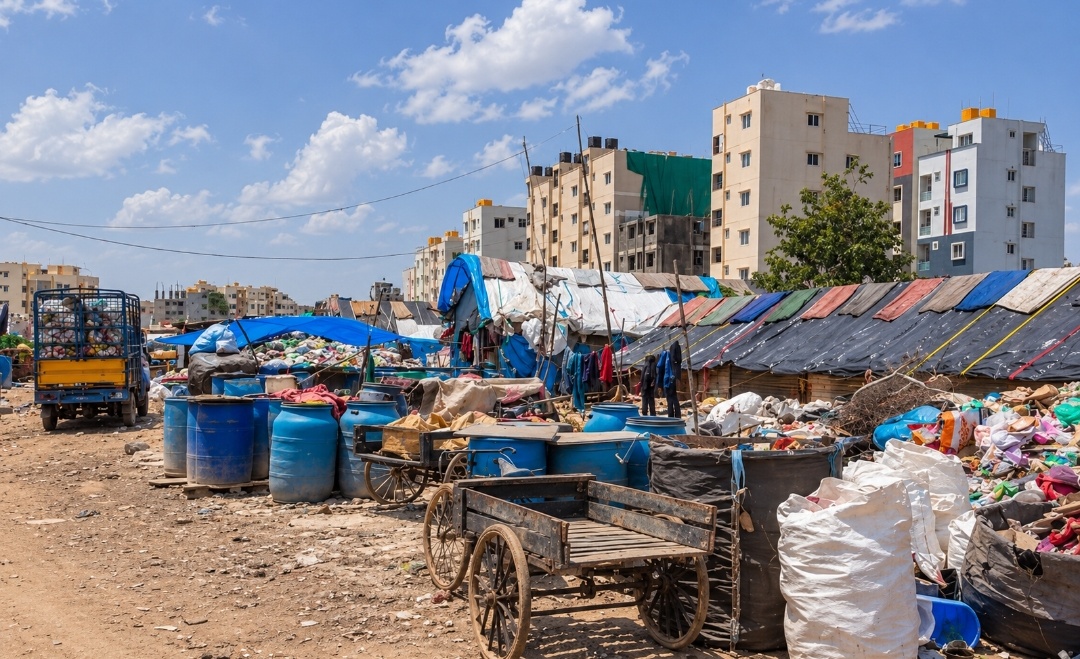
In Whitefield this October, officials inspected two migrant settlements and found mixed waste, open burning, stagnant water and too few toilets. The clearest undertaking was a landowner’s promise to clean up. Bangalore Mirror’s report, republished by Urban Acres on 17 October, said the work had not been verified. Workers asked for garbage drums that the civic department would empty a clean-up, ASHA visits, first-aid kits and mosquito control. They offered to keep the premises clean afterwards.
These sheds are not an exception. The last decennial Census to enumerate migration was conducted in 2011. The PLFS for 2020–21 estimated India’s migration rate at 28.9 per cent, but the Centre has proposed a fresh survey for July 2026 to June 2027 to obtain comprehensive, up-to-date information on migration patterns. India still lacks a recent comprehensive enumeration of its migrant workforce. Police reporting on other Whitefield settlements identified construction, domestic work, driving and delivery among residents’ occupations. Scroll has documented Bengali migrant families nearby sorting garbage by hand. These are jobs that keep a growing city habitable. Residents will do the daily labour of sanitation. They ask the city for what tenants cannot provide: a collection round and a working drain.
The state does reach such settlements, usually in the wrong uniform. In August, more than 500 police personnel conducted verification drives at over 30 Whitefield locations, checking identity and citizenship documents.³ Policing does not depend on a settlement being recognised in a welfare register. Access to some housing and infrastructure schemes does. A Bengaluru study found that programmes including JNNURM and the Smart City Mission were tied to notified-slum status, and that no new slums had been notified in the city since 2011.⁵ This does not mean municipal bodies have no responsibilities in non-notified settlements. It means residents can remain outside the categories through which particular schemes are delivered.
The arrangement is familiar. Cities treat migrant labour as an input that arrives when construction sites, kitchens and delivery routes need workers. Housing and sanitation are left to workers and to whatever land an owner is willing to rent out. The cost of growth stays off the municipal ledger and lands on workers, who lose wages when illness keeps them away from work. A city that depends on their labour cannot treat the place where they sleep as somebody else’s problem.
Housing is where the national promise is thinnest. The Centre’s Affordable Rental Housing Complexes scheme was designed to provide decent rental accommodation near workplaces, particularly for urban migrants and the poor.⁶ By March 2025, 5,648 vacant government-funded houses had been converted under its first model. Under the second, 82,273 new rental units had been approved and 35,425 completed.⁷ By 9 August 2026, 13,046 units had been sanctioned under the Affordable Rental Housing component of PMAY-Urban 2.0.⁸ These are different measures: converted houses, approved units and completed homes. Even taken together, they indicate a limited rental-housing response to the workforce that keeps India’s cities running.
Labour law offers only a partial answer. The 1979 Inter-State Migrant Workmen Act required contractors to provide suitable residential accommodation during migrant workers’ employment.⁹ The Occupational Safety, Health and Working Conditions Code, in force since November 2025, sets out duties towards inter-State migrant workers, including suitable working conditions and journey allowances, but does not reproduce that general housing requirement.¹⁰ The Code separately provides for temporary accommodation for building workers at or near construction sites, including accommodation expenses where building work is done through a contractor. That is not a general housing guarantee for every migrant worker. A landowner who simply rents out sheds is not automatically an employer or contractor. The housing arrangement in settlements such as these therefore falls between employment-based protections and local-government responsibilities.
The fix is to attach the duty to the place, in every city. State municipal laws should make waste collection, drainage and access to toilets a local body’s obligation in every inhabited settlement, regardless of land tenure or tenants’ papers. Landlords renting sheds beyond a defined occupancy threshold should need a municipal licence specifying minimum toilets, water access and waste containers, with penalties when facilities fail. Rental-housing funds should favour cities that identify and upgrade existing worker settlements. The drums handed out near Whitefield’s Hatti Road did not solve the problem if no municipal vehicle came to empty them.¹ A licence can be inspected and suspended. A promise cannot.
Health outreach needs its own protection. After a verification drive, residents may hesitate to admit officials whose purpose they cannot distinguish. Health and sanitation staff should have no role in identity or citizenship checks, and state governments should say so in writing. Every inspection report should name the department responsible for follow-up and set a date for completion.