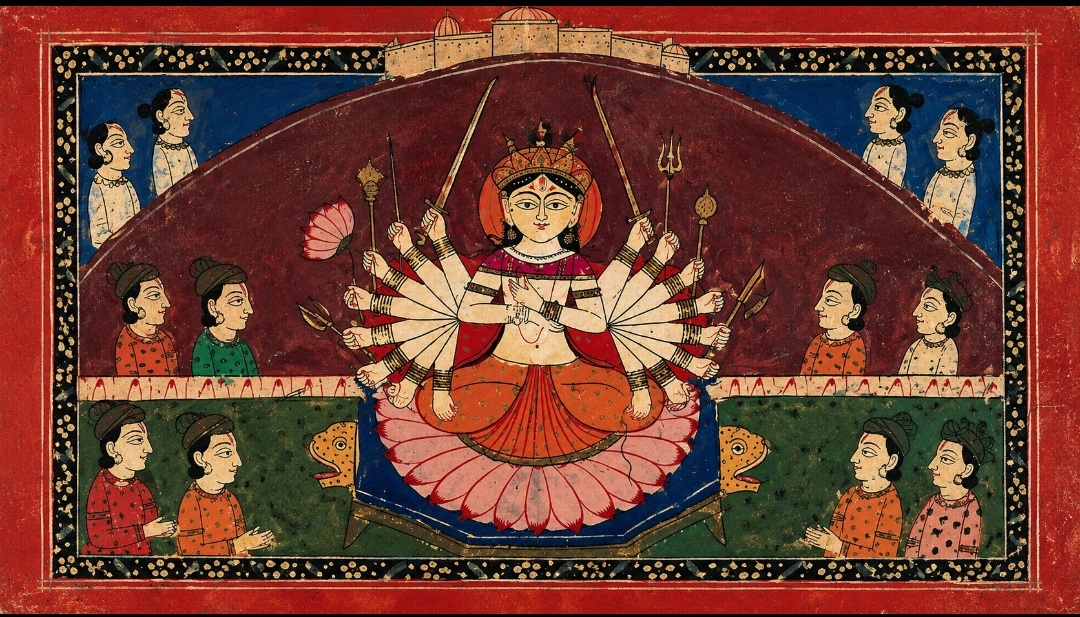
Look at the ancient West, and the heavens feel incredibly crowded by men. If you look up at the Greek, Roman, or Norse pantheons, the ultimate authority stops at a male throne: Zeus, Jupiter, or Odin. Yes, goddesses like Athena or Ishtar held real, terrifying power over warfare and wisdom, but they still operated under the shadow of a supreme cosmic patriarch.
Cross over into the Indian subcontinent, however, and that entire vertical hierarchy turns upside down.
Here, the absolute source of baseline existence, creation, and raw, unsettling destruction is unapologetically feminine. The Devi isn’t a secondary character.
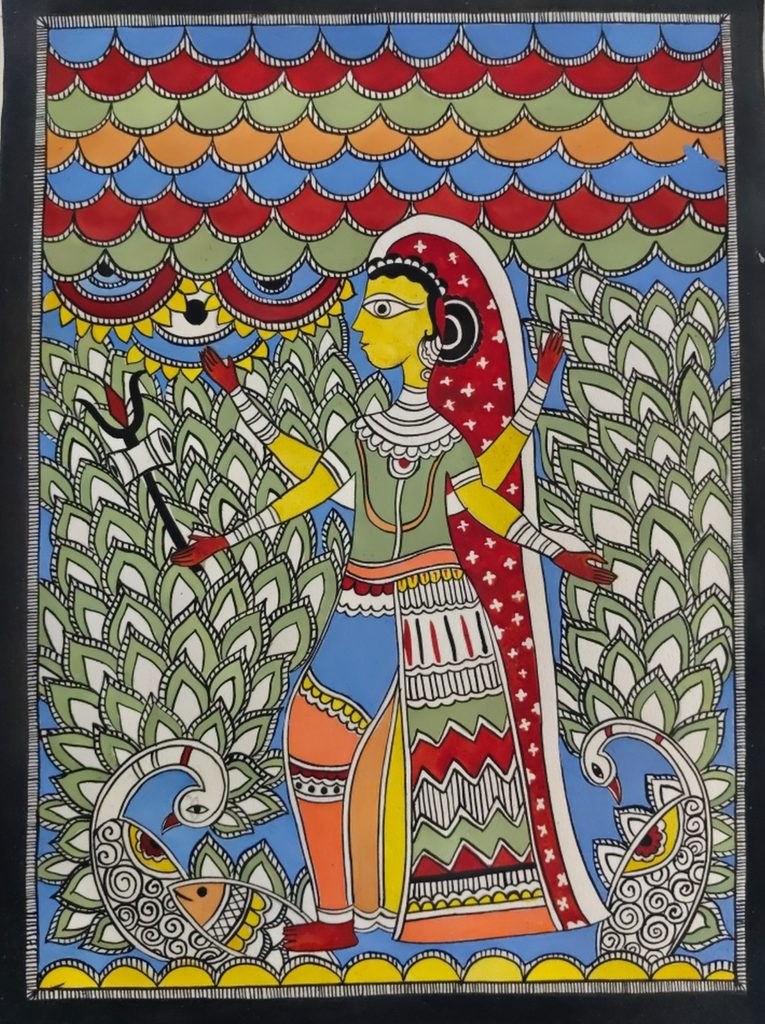
I was actually sitting with a canvas recently, working on a Madhubani painting of Aadishakti, when the weight of this hit me. This cosmic inversion isn’t just an abstract theological trick found in old books. Long before kings built stone forts or managed massive standing armies, the earliest tribal and forest communities across this land looked at the vastness of the universe and saw a mother.
That spiritual baseline gave historical Indian women a very real, tangible leverage point: a way to defend their personal autonomy and assert authority, from remote tribal councils all the way up to royal courts.
The Arrow of Intellect
If you want to see how deep this baseline runs, look past the physical battlefields and step into the Vedic court of King Janaka of Videha. It was a high-stakes intellectual arena where the most brilliant male scholars of the age gathered to dissect the nature of reality and the soul.
Among them stood Gargi Vachaknavi.
The text of the Brihadaranyaka Upanishad records that a legendary sage named Yajnavalkya had completely broken the room, systematically silencing every single man present. The men accepted defeat. Gargi didn’t.
She stood up in a heavily patriarchal court and cross-examined the undisputed champion without a hint of hesitation, demanding to know: “On what, then, is the world of Brahman woven, like warp and woof?”
When Yajnavalkya felt cornered by her intellect and explicitly threatened her, telling her that her head would literally fall off if she kept pushing, Gargi didn’t back down. She came right back into the next round of debates with a brilliant, combative metaphor:
“As a warrior of Kashi or Videha rises with a strung bow and two fierce arrows, I rise against you.”
Gargi’s defiance worked because she was tapping into a truth the court already accepted: the ultimate source of speech, cosmic intellect, and wisdom (Vāc) was personified as a powerful Goddess.
She wasn’t just a lone woman arguing against an intimidating man; she was channeling a recognised divine authority that sat at the absolute top of human thought.
The Light of Shakti
By the time you get to the 5th-century text of the Devi Mahatmya, this dynamic becomes even more radical. The story reads almost like a political manifesto.
A buffalo-demon named Mahishasura conquers the heavens, completely evicting the major male gods. Indra, Vishnu, and Shiva fight him head-on and fail miserably, left entirely helpless.
In absolute desperation, these male deities pool their inner light and energies together. Out of that collective cosmic force emerges a single woman: Durga.
It is a complete subversion of traditional power structures. The narrative makes it clear that supreme, raw capability doesn’t belong to individual male rulers; it belongs to the active, feminine current of the universe known as Shakti.
Durga doesn’t look around for a husband’s permission or guidance. She rides into the chaos alone, casually wields the weapons the men couldn’t use effectively, and eliminates the threat herself.
For historical women, this wasn’t just a neat piece of mythology to listen to; it was a powerful mirror. It reminded them that when male systems and leadership collapse, it is the birthright and the immediate responsibility of the woman to step forward and fix the balance.
Matriarchal Soil and Living Autonomy
Long before these ideas were captured in Sanskrit manuscripts, the foundation of Devi worship belonged entirely to indigenous and tribal Adivasi communities.
In a typical feudal kingdom, land is property: something owned, divided, and passed down by men. But in ancient agricultural and forest clans, the Earth was understood as a living womb.
Because women gave birth and sustained the tribe’s daily survival, they were viewed as the human extension of the very soil they stood on. Because of this, early tribal leaders were frequently women, and the central protectors were local clan mothers, or Gramadevatas.
You can still see the living reality of this today. In places like Meghalaya, the Khasi people remain distinctly matrilineal: property, wealth, and family lineage still pass directly through the youngest daughter.
The high social status of these women isn’t an accident; it is directly tied to the simple theological fact that the supreme deity they pray to looks exactly like them.
As patriarchal empires expanded over the centuries and tried to absorb these tribal territories, women constantly used the imagery of the Devi to mount a resistance.
When Rani Durgavati of the Gond tribe went to battle against Akbar’s Mughal army in the 16th century, she wasn’t fighting because a text permitted her to; she did it because her clan goddess demanded it of her.
Whether it was Gargi using razor-sharp philosophy or Queen Chennamma standing up to British colonisers, these women never justified their leadership through male lineages. They framed themselves directly as vessels of Shakti.
Even during the modern independence movement, the entire subcontinent was consciously reimagined as Bharat Mata. The entire call to revolution was built around children fighting to free their mother from foreign chains, proving that the deepest well of revolutionary energy in the Indian psyche has always been feminine.
The Living Legacy of Aadishakti
We look to the Devi because our ancestors knew that real power isn’t just about brutal physical conquest; it’s about resilience, fierce intellect, and protecting life at all costs.
That is exactly why, when I painted her, I chose to give her the Trishul and the Damru, framing her with the bold, traditional sun and moon lines of the Madhubani style.
She isn’t a quiet, submissive consort sitting in the background; she is Aadishakti, holding creation and destruction in her own hands.
From the high-stakes debates of Gargi to the ancient tribal forests, the worship of the Goddess has always been a foundational baseline of female resistance. It is a stark reminder that whenever women rise up to fight for their rights, they are simply channelling the original force that held the world together long before kings ever tried to claim it.