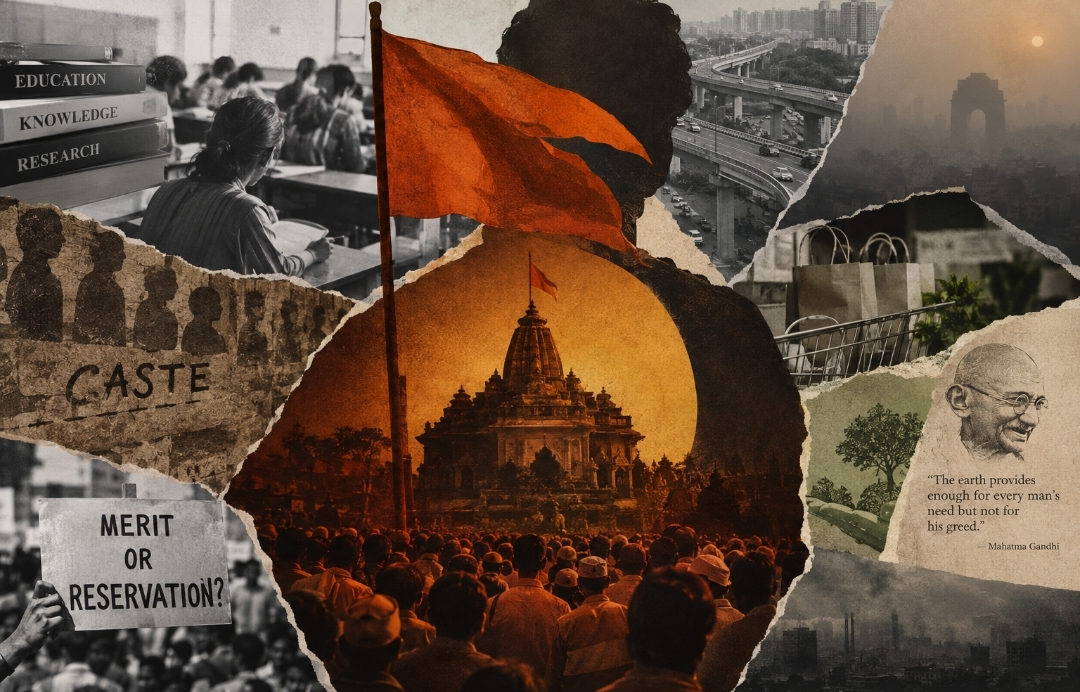
For the last twelve years, Hindutva has been the dominant discourse in Indian politics. Time and again, electoral victories have been trumpeted as victories for Hindutva, and Hindutva ideologues have propagated their vision as an inevitable consequence of India’s civilisational identity. But after twelve years in power, one fundamental question regarding Hindutva remains unanswered: What is its long-term vision beyond electoral victories?
Paradoxically, Hindutva has been highly successful in both its electoral achievements and its assertion of a hegemonic presence in the public sphere. However, as soon as one looks beyond electoralism to institutions, education, social coherence, governance and development, a series of contradictions emerge. An ideology, no matter how successful it may appear, must be judged not by the fears it mobilises but by the kind of future it attempts to build. In this sense, Hindutva’s vision for the future still appears indistinct.
The Politics of Demographic Anxiety
Among the more striking aspects of Hindutva discourse is its fascination with numbers. The centrality of demography in its imaginaries is evident in concerns about the relative numerical decline of Hindus, census data and the fear of demographic change. This insecurity is very often traced back to Partition, with the straightforward argument that wherever Hindus are numerically marginalised, the very fabric of national integrity is threatened.
This raises a simple question: How long can a political discourse sustain itself through demographic anxiety? Hindus have never constituted as large a proportion of the population as they do today. More than a billion Hindus inhabit the subcontinent, and many more are present globally. Yet, despite being demographically superior to an extent never before witnessed in their history, this anxiety shows no signs of subsiding. If numerical superiority does not assure security, then the source of insecurity lies elsewhere.
An ideology cannot perpetually define itself through the existence of an enemy. Sooner or later, it must positively articulate what it stands for.
The Crisis of Educational Vision and Merit
A deficiency in coherent positive vision is also apparent in the sphere of education. Recent debates over higher education have indicated an increasing concern that traditional universities should yield ground to skill-development education and that conventional academic courses will become obsolete. Such pronouncements reveal that, in addition to creating skills demanded by the market at present, the focus of the education system must move away from theoretical and scientific research, from developing intellect and the capacity for critical thought, and from philosophical contemplation.
However, not all societal progress can come through training. Were Socrates, Plato, Newton, Einstein or Ambedkar products of skill-development centres? Intellectuals, researchers, artists, philosophers and scientists are required for national growth, alongside engineers and technicians.
The situation is further aggravated by the National Education Policy (NEP) 2020 and its emphasis on early exit points into vocational courses. Critics argue that the education policy tends to discriminate against the education of the poor and reifies traditional occupations. The concern here is one of democratic access to higher education, and the policy may also recreate caste and social stratification. Are its proponents more interested in creating workers than in imparting knowledge?
A similar paradox of merit can be observed. For years, the reservation policy was criticised by proponents of the Hindu Right for damaging merit and efficiency (Subramanian 2019). However, despite the rhetoric surrounding meritocracy, recent debates over institutional autonomy, professional appointments, examination irregularities and concerns about selection processes have been pervasive. Merit must be applied impartially. It can no longer serve as a selective criterion for rejecting reservation policies while being disregarded in institutional selection processes.
Social Coherence and the Politics of Permanent Crisis
The inconsistencies are equally visible on the social front. Looking only at electoral results, it would seem that the present regime has brought about unprecedented social harmony among Hindus. However, caste divisions, regional animosities and social inequalities remain as entrenched as ever. The fact is that these inequalities were never really eliminated; they were only manipulated more effectively than before.
It is this strategic use of fault lines that has become the defining characteristic of the present brand of Hindutva politics. Its need to constantly regenerate itself means that it must constantly generate crises, whether concerning demographics, religious conversions, historical grievances, national security or cultural onslaughts. The politics of Hindutva currently rests upon the successful mobilisation and management of anxiety.
Ajay Gudavarthy, in his work Politics, Ethics and Emotions in New India, notes how “the systematic mobilization of social anxieties is emerging as a critical aspect of political mobilization in the contemporary India”. Crisis has become a permanent state of emergency, and only crisis leads to constant political mobilisation. The politics of mobilisation thus demands a continuous supply of threats to sustain itself.
This explains the political phenomenon of the last ten years. While Narendra Modi holds the office of Prime Minister, the narrative often presented to the public is not one in which Modi, as Prime Minister, is responsible for governing and delivering policy outcomes, but rather one in which he, as an outsider, will fix the problems arising from governance deficits. This is an astoundingly successful narrative in which the Prime Minister is simultaneously portrayed as the custodian of state power and an outsider to the system itself. This implies that failures lie with the government, while solutions are to be provided by the Prime Minister himself. While politically astute, this separation is illogical.
The Contradictions of Development
Development is another area that deserves examination. The government constantly displays images of highways, flyovers, expressways and mega infrastructure projects to demonstrate tangible evidence of growth. While infrastructural development is necessary, development cannot be measured solely in terms of brick-and-mortar realities. The quality of infrastructure matters much more than its scale.
Reports of bridge collapses, cracks and structural inadequacies cast doubts over design, oversight and the real nature of this “development”. Most importantly, development must also be reflected in people’s living conditions. If most of North India remains submerged in a toxic haze of air pollution for months each year, the country cannot simply talk about development. Should the measure of development be pictures and inaugurated structures alone, or should it also include a clean atmosphere, healthy bodies, informed minds and secure institutions?
Hindutva and the Paradox of Consumption
Another contradiction appears when examining the link between Hindutva and economic modernity. Hindutva is constantly projected as the political articulation of the Hindu civilisational past. Many of the values it seeks to reaffirm in classical Hindu philosophies appear, in fact, quite contradictory to the developmental agenda pursued by the present Hindutva polity.
Across virtually all streams of Hindu thought, from the Upanishads through to the Gandhian approach to Hindu ethics, restraint has been a central concern. The issue was not simply about wealth generation but rather about the control of desire and acquisition. As a well-known Gandhian adage points out: “The earth provides enough for every man’s need but not for his greed”, reflecting an overarching ethic that celebrated balance and equilibrium.
Material well-being, clearly, was not to be eschewed, but was to be pursued within specific moral and ecological boundaries. However, the logic of the present discourse on development appears starkly different. Success is measured through an increased standard of consumption, expanding markets, rising production and increasing GDP growth. The message to the citizen seems clear: consuming more, travelling more, buying more and aiming for ever more elaborate lifestyles is the pathway to happiness. The definition of development has become synonymous with an ever-greater multiplication of desires.
It is in the sphere of energy security and self-reliance that this paradox comes into sharp relief. Speaking at the time of the West Asian crisis, Prime Minister Narendra Modi stated that instability in the region reinforces the necessity of energy growth and self-reliance. This point is undoubtedly well taken.
Every state must protect itself from external shocks. But the question that emerges from this crisis is one that receives significantly less attention: Is it not equally a call for societies to curb unsustainable consumption that places excessive demands on nature?
If Hindutva truly holds itself up as the inheritor of civilisational values, then questions of ecological restraint and moderate consumption should occupy a prominent position in its developmental programme. Instead, its current approach seems largely aligned with the kind of consumption-driven modernity it criticises when addressing the West.
There is an undeniable conflict at work: a civilisational legacy based on renunciation and restraint now increasingly seeks validation through the multiplication of desire and rising consumption. The issue is not that development is unnecessary; it surely is. It is more about how the project of development is to be carried out without jettisoning the very ethical foundations that Hindutva purports to uphold.
The Crisis of Political Ethics
The contradictions of Hindutva are visible not only in policy matters but equally in the realm of political ethics. Among the more striking examples is the shifting political discourse surrounding Mulayam Singh Yadav.
For decades, the various units of the Hindutva combine lambasted Mulayam Singh Yadav for ordering the firing on kar sevaks during the Ayodhya movement in 1990. This event occupied a prominent position in the collective memory of Hindutva politics and served as a rallying point for mass mobilisation. Mulayam was frequently characterised as a quintessential proponent of appeasement, often derisively nicknamed “Maulana Mulayam”, a label indicating alleged overindulgence of Muslims at the expense of Hindu interests. The firing remained an indelible grievance that defined the politics of the Hindutva movement for a long time.
In 2023, however, the very same political leadership honoured Mulayam Singh Yadav with the Padma Vibhushan. Now, this is not primarily a commentary on Mulayam’s suitability for the award; arguments for conferring honours in recognition of long public service can certainly be made. Instead, this award tells us much about political morality.
If the events of 1990 were a historical wrong demanding decades of emotional mobilisation, then how are we to understand such a rapid departure from that position? Conversely, if reconciliation between political adversaries is desirable, why should ordinary citizens continue to be politically encouraged to nurse historical grudges?
There is clearly an asymmetry at work here: political leaders reserve for themselves the space for political negotiation and reconciliation, whereas public emotional involvement with history must continue for political consumption. This reflects a wider pattern in contemporary politics: collective memories become political tools to be wielded when expedient and laid aside when politically impractical. Historical wounds, kept alive for political agitation, may be set aside for political pacts.
Though a successful political strategy, this raises troubling questions about authenticity and political morality.
This practice can also be observed when dealing with corruption. Charges of corruption and disloyalty hurled at political opponents often find a quiet end once these individuals switch their loyalties and join the ruling political combine. Old complaints about moral corruption are then readily pushed aside to make room for political manoeuvring. The discourse on corruption, though earlier proclaimed as a national emergency, loses much of its force once the objective shifts from moral denunciation to political accommodation.
In doing so, contemporary Hindutva politics appears to be increasingly driven by pragmatism rather than principled idealism, taking inspiration from an archaic style of politics that prioritises political acquisition and state interests over ethical considerations.
Political realism has its due place in politics, and the state needs a certain degree of pragmatism, but to what end? When such pragmatism leads to the constant sacrifice of claimed principles, one must necessarily inquire about the extent to which any political project can genuinely be ideologically anchored while systematically disregarding its moral underpinnings.
Hindutva and the Political Majority
Another dimension in which the relationship between Hindutva and caste becomes complicated is that, while the discourse of Hindutva today is founded on the idea that Hindus constitute about 80 per cent of India’s population, the social reality on the ground is that Hindu social formations are fractured along caste, regional, linguistic and local divisions.
For the majority of people in India, caste continues to be the most real and tangible social reality, far more immediate and powerful than “Hinduism”. In this sense, the Hindu majority is not something that exists naturally in the political field but is instead a political project.
What Hindutva is aiming at is a complete overhaul of social formations fractured along lines of caste, region, language and so on, turning these social entities into a political one. Hindutva’s success does not rely on the abolition of caste but on its temporary subjugation and the overlaying of caste identities with a supra-caste religious political identity capable of coming together at critical political moments.
Thus, caste and Hindutva are not necessarily mutually exclusive. Both are simultaneously capable of occupying a single social space. Caste continues to influence matrimonial ties, interactions among individuals at the local level, hierarchy and resource allocation. However, at the time of elections and during certain kinds of political mobilisation, it might recede in favour of a broader Hindu identity that takes precedence over one’s caste identity. Thus, it is Hindutva’s ability to overlay caste rather than replace it that matters.
What we may be witnessing is the dominance of caste at the social level and its regression in the political sphere, temporarily, though. Elections increasingly suggest that caste calculations can be made submissive to the narratives of nationalism, civilisational identity or even external threat perception.
The Pulwama attack and the subsequent elections of 2019 seem to represent such a moment when national security and civilisational identity trumped the traditional lines of caste politics and made this broader religious consolidation possible.
In this sense, it can be argued that while caste remains the organising principle of “normal times” in India, Hindutva is about mobilisation during “extraordinary times”. These could be election periods, security crises, religious mobilisation or moments of acute shared vulnerability. During such times, caste’s political significance recedes even as its hold remains.
The formation of a cultural majority in this form remains an incomplete project. As long as caste remains the organising principle of social relations and Hindutva operates at the political level, it is difficult to assert that real social integration has taken place. Electoral unity may merely be concealing social divisions. And that question may ultimately provide the answer as to whether Hindutva succeeds as a project of civilisational resurgence or merely as an electoral strategy.
Beyond the Electoral Majorities
All told, the biggest contradiction of Hindutva is the disconnect between its massive political success and its unsettled intellectual, ethical and civilisational questions.
The ideology has managed to change public debate, forge a more inclusive Hindu political bloc and seize power on the political centre stage over the last decade or so. However, most of the deeper questions remain unaddressed.
It talks about unity among Hindus, while caste continues to govern social life; it invokes Hindu ethical norms, but often adopts a brand of politics driven by pragmatism that can appear dismissive of norms; it invokes the restraint and accord of its civilisational ideals while aggressively promoting a development model that encourages consumption and material expansion; and it continues to draw considerable energy from anxiety, crisis and the evocation of threats, despite unprecedented numerical strength and political power.
It is undeniably the champion of mobilisation, but mobilisation alone cannot replace a coherent vision for the future. An ideology that has held the heights of power for more than a decade can no longer be defined primarily in terms of what its rivals are or through the management of anxieties.
It must be able to articulate what kind of society it intends to build, what role education, equality, science, environmental harmony and social justice play in its ideal society, and whether it intends to build a secure civilisation or endlessly generate electoral majorities.
How its future unfolds will depend not on winning the next election but on its capacity to address these wider questions.