Surjit Patar, the renowned Punjabi poet, wrote these poignant verses in the aftermath of Operation Blue Star in 1984:
Laggi nazar Punjab nu, edhi nazar utaaro
Le ke mirchaan kaurriyan, ehde sir ton waaro
(Punjab has been struck by the evil eye; ward it off. Take some bitter chillies and wave them around its head.)
These words feel strikingly relevant today as Punjab grapples with a catastrophic problem that, while not manufactured within its borders, has thoroughly engulfed the state. Back in 2015, under the Shiromani Akali Dal-BJP alliance led by Parkash Singh Badal, the drug menace was already rampant. Congress leader Capt. Amarinder Singh famously took an oath on the Gutka Sahib, promising to eradicate drugs from Punjab within four weeks if elected. Congress subsequently won the election, and Amarinder took charge as Chief Minister. Nearly a decade has passed since that pledge, yet the drug problem has only grown more severe. This raises a fundamental question: why have successive governments’ campaign promises and anti-drug drives failed so completely while the ground reality has turned increasingly grave?
Over the past two decades, Punjab has been governed by multiple political parties, yet no administration has found a viable answer to this crisis. The murder of anti-drug activist Parvinder Singh, popularly known as Jhota, has brought renewed scrutiny to the current Aam Aadmi Party (AAP) government’s campaign, Yudh Nasheya Virudh, exposing a deep chasm between official rhetoric and grim realities on the ground. Jhota repeatedly used Facebook Live to expose what he alleged was the illegal sale of addictive substances and the complicity of local authorities. His killing has raised a question that extends far beyond one man’s death: what happens when ordinary citizens take it upon themselves to confront a criminal economy that the state claims to be dismantling?
A killing captured on camera
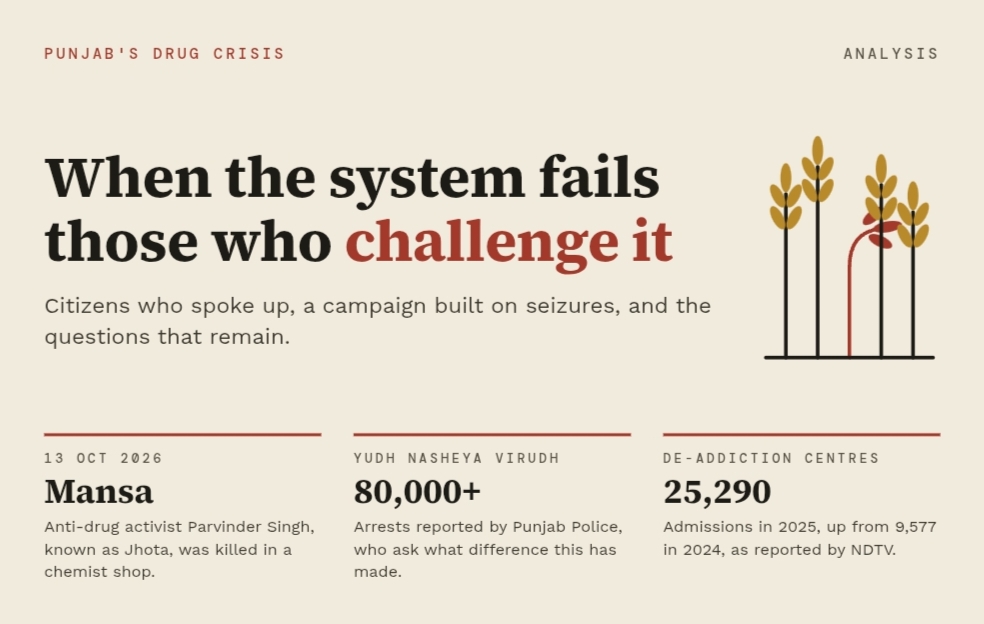
On October 13, 2026, Jhota was shot dead inside a chemist shop in Mansa town while confronting its owner over the alleged sale of addictive drugs. Four of his companions also sustained bullet injuries. According to The Tribune, Jhota was recording the confrontation on his mobile phone when the argument escalated into gunfire. A 5.48-minute Facebook Live video captured the incident, including Jhota warning that the shop owner had taken out a pistol before shots were fired. He was rushed to Mansa Civil Hospital, where he was declared dead. Doctors reported that he had sustained three bullet injuries, including one that pierced his liver.
The footage made the killing especially disturbing. This was not a murder concealed in a remote location or discovered days later. It unfolded in a crowded commercial area, during a confrontation over the very problem the government had promised to eliminate. The presence of a camera did not deter the alleged shooter. Instead, the footage became a record of how quickly a dispute over the drug trade could turn lethal. Source: The Tribune, October 13, 2026.
The killing also raised questions about the risks Jhota had faced before his death. His activism had brought him into confrontations with people he accused of facilitating access to addictive substances. His death must be investigated as an individual criminal case, but the wider circumstances cannot be ignored. If citizens believe that challenging suspected drug suppliers may expose them to violence, the state’s failure extends beyond the loss of one life. It undermines the possibility of community-led action against the drug trade.
The case has since become a test of whether Punjab’s institutions can command public confidence. The family’s demand for accountability has also gone beyond the arrest of the alleged shooter. Protesters have sought action against officials responsible for preventing the illegal sale of drugs and demanded resignations from senior political and police leadership. These demands reflect a lack of confidence in the institutions that are supposed to protect citizens. Whether or not every demand is legally or administratively justified, the anger behind them cannot be dismissed as mere political agitation.
When the protectors become part of the problem
The circumstances surrounding Jhota’s murder are particularly troubling because they come amid repeated allegations that the drug trade operates with the assistance, protection or indifference of people who should be preventing it.
Just two days after his killing, Punjab Police officer Karandeep Singh was arrested by the Narcotics Control Bureau (NCB) in connection with an alleged heroin trafficking network. Reports stated that he was posted in the anti-drone unit, a specialised wing intended to help detect and prevent cross-border smuggling. According to the allegations reported at the time, he had helped traffickers move contraband by providing information about safe delivery routes. The case also involved the arrest of a former AAP sarpanch.
The allegations must be tested through the legal process, and one officer’s arrest does not establish that the entire police force is compromised. Nevertheless, repeated cases involving alleged collusion between law enforcement and traffickers demand serious scrutiny. Drug networks do not survive merely because they are difficult to detect. They can also survive because information is leaked, investigations are obstructed, vulnerable officials are recruited or influential individuals are shielded from scrutiny.
How can supply lines be dismantled if the people responsible for detecting them are suspected of helping traffickers? How can villagers be expected to report drug suppliers if they fear that their identities or complaints will reach the very people they are accusing?
The government’s anti-drug campaign cannot be judged solely by the quantity of heroin seized or the number of arrests announced. Those figures matter, but they reveal only part of the picture. A credible assessment must also establish whether the availability of drugs has declined, whether treatment is reaching people who need it, whether major suppliers and financial networks have been disrupted, and whether officials implicated in corruption face independent investigation.
Without those measures, enforcement statistics risk becoming a substitute for examining the actual conditions in Punjab’s villages and towns.
Gulzar Singh and the price of speaking out
Jhota’s killing was not an isolated reminder of the dangers faced by people challenging Punjab’s drug networks. In September 2026, Gulzar Singh, a daily-wage worker from Toor Banjara village in Sangrur district, died after consuming poison, having publicly questioned Punjab Finance Minister Harpal Singh Cheema about the easy availability of heroin, commonly known as chitta.
Gulzar had spoken to the minister during a public programme, explaining that his son was addicted to drugs and had sold household belongings to sustain his addiction. Gulzar’s family alleged that he faced pressure from local panchayat members to apologise after raising the issue. Police subsequently registered a case against five people, including the village sarpanch, on allegations including abetment to suicide and caste-based offences. The accused must have an opportunity to answer these allegations, and the case requires an impartial investigation. Source: The Indian Express, September 10, 2026.
The significance of Gulzar’s death lies in the questions it raises about the relationship between citizens and those exercising local power. A person whose child is struggling with addiction should be able to approach an elected representative without fearing humiliation or retaliation. A Public meeting should not be just a PR exercise, It should be a way to reach the vulnerable section and understand the ground reality to create programmes and policies that can help the people.
Jhota and Gulzar faced different circumstances, and their deaths should not be treated as equivalent. One was killed by gunfire during a confrontation at a chemist shop; the other died after consuming poison following a public complaint about drugs. Yet both cases illustrate the human cost of a crisis that has penetrated family life, local governance and community relations. The question is whether the state can protect people who expose a problem, even when their complaints challenge the ruling party’s claims of success.
Another incident in September involved Jagseer Singh, also known as Jagga Singh, who reportedly attempted suicide outside the Sangrur mini-secretariat after accusing the police of failing to act on complaints against alleged drug suppliers. His allegations and personal circumstances require independent examination, but the incident added to the growing public anger over how drug-related grievances are handled.
These cases expose the danger of treating criticism of the anti-drug campaign as a political inconvenience. If people affected by addiction cannot speak openly about their experiences, the government loses access to the very information it needs to design effective interventions. Citizens are not merely beneficiaries of public policy. They are witnesses to the failures that official statistics may not capture.
Neha Shorie: A warning that was not heeded
The death of drug inspector Neha Shorie remains another disturbing chapter in Punjab’s history of violence surrounding drug enforcement. On March 29, 2019, Shorie was shot dead inside her government office in Kharar while serving under the Congress government led by Amarinder Singh.
According to the initial investigation, the accused shooter acted out of a personal grievance connected to the cancellation of a drug licence in 2009 and Shorie’s subsequent refusal to issue a new licence to his wife. Her father, retired Army officer Kailash Shorie, has since questioned whether the full circumstances and possible connections surrounding her killing were adequately investigated. On October 23, 2026, he again wrote to Union Home Minister Amit Shah seeking a CBI investigation, alleging that his daughter had been targeted because of her actions against the illegal diversion and black-marketing of government drug stocks. These are his allegations and require verification; they should not be presented as established findings. Source: The Tribune, October 23, 2026.
The similarities between Shorie’s case and the concerns raised after Jhota’s murder are not exact, but the underlying question is comparable: how effectively does the state protect those who challenge suspected wrongdoing connected to the drug trade?
Shorie was a government official performing her duties. Jhota was a citizen confronting alleged illegal sales. Their roles differed, but neither should have had to depend on personal courage alone to confront a potentially dangerous situation. A functioning system must provide effective safeguards, credible investigations and institutional accountability.
Shorie’s father returning to the authorities years later illustrates how unresolved doubts can become an additional burden for bereaved families. Families are entitled to answers, not simply assurances that a case has been dealt with. If investigators have established a clear motive and ruled out other possibilities, those findings should be transparently explained. If material questions remain, they deserve serious consideration rather than dismissal.
The limitations of a campaign built around enforcement
The AAP government’s Yudh Nasheya Virudh (War Against Drugs) campaign has reported substantial seizures and arrests. According to Punjab Police figures published in October 2026, the campaign had resulted in the seizure of thousands of kilograms of heroin and other narcotics, alongside tens of thousands of FIRs and more than 80,000 arrests. These are significant enforcement figures, but their scale also raises a question: what measurable difference have they made to the availability of drugs and the lives of people struggling with addiction?
A campaign can be operationally extensive and still fail to achieve its central purpose. Seizures may indicate effective policing, but they may also reflect the scale of the market being targeted. Arrests do not automatically translate into convictions, and the removal of low-level sellers does not necessarily dismantle the networks that’s sustain the trade. If arrested individuals are quickly replaced, the supply chain can continue operating despite repeated police action.
There is also a danger that visible enforcement becomes the principal measure of success because it produces numbers that can be announced at public events. Addiction is more difficult to address through statistics alone. It requires sustained treatment, psychological support, family assistance, social reintegration and employment opportunities for people who have recovered. Relying on quantitative data without the qualitative data can be misleading.
The available treatment figures are revealing. NDTV reported in September 2026 that admissions to government de-addiction centres rose from 9,577 in 2024 to 25,290 in 2025. More than 14,000 admissions had reportedly already been recorded by July 2026. These figures may reflect a combination of rising demand, improved access, changes in reporting or other factors, and should not automatically be interpreted as proof that drug consumption increased by the same proportion. Nevertheless, they demonstrate the scale of the treatment challenge confronting the state. Source: NDTV, September 7, 2026.
People struggling with addiction should not be treated as disposable or as a public-relations problem. Punitive approaches that drive them away from healthcare can make recovery more difficult. Treatment must be accessible, affordable and continuous, with trained staff, appropriate medicines, counselling and support for families. Rehabilitation cannot end when a patient leaves a facility. Without stable housing, employment and community support, people may return to the circumstances in which their addiction developed.
At the same time, a public-health approach must not become an excuse for failing to investigate organised trafficking. The distinction is straightforward: people who need treatment should receive it, while those who profit from exploiting addiction must face effective law enforcement. A government that concentrates on one side of this equation while neglecting the other cannot resolve the crisis.
The economic roots of addiction
Punjab’s drug problem cannot be understood without examining its economic and social conditions. Agrarian distress, indebtedness, unemployment and the shortage of secure opportunities have left many families struggling to imagine a future for their children. Migration has become an aspiration for many young people who believe that a livelihood abroad offers greater dignity and financial stability than the opportunities available at home.
These pressures do not mean that poverty inevitably leads to addiction, nor that every person who uses drugs does so because of unemployment. Addiction has multiple causes, including social circumstances, mental health, trauma, family environments and the availability of substances. But economic insecurity can intensify vulnerability and make recovery harder, particularly when families lack the resources to access treatment or sustain a relative through rehabilitation.
A serious response must therefore extend beyond raids. Punjab needs credible employment pathways, stronger public education, investment in sports and community facilities, and accessible mental-health services. Schools and colleges should have trained counsellors who can identify problems early and connect young people with support. Rural healthcare facilities must be equipped to provide treatment without forcing families to travel long distances or incur unaffordable costs.
Agricultural policy matters in this wider context. Farmers and agricultural labourers need sustainable livelihoods, reliable access to public services and meaningful opportunities beyond precarious work. The central government must address long-standing agrarian concerns, while the Punjab government must demonstrate that it can create viable local employment and strengthen rural institutions.
The answer cannot be to wait until another election and announce a new deadline. A credible strategy requires public targets that can be independently assessed: access to treatment, rates of treatment completion, prevention of fatal overdoses, reductions in the availability of illicit drugs, successful prosecution of major traffickers and protection for people who report wrongdoing.
Political promises and institutional accountability
Against this backdrop, political promises demand critical scrutiny. During his October 2026 visit to Punjab, Union Home Minister Amit Shah met families affected by the drug crisis and promised to make Punjab chitta-free by December 31, 2029. The BJP has presented the deadline as a commitment to action, but the announcement also invites a basic question: what will be done differently from the approaches pursued by previous governments?
The BJP cannot separate itself entirely from the history of the drug crisis. The party governed Punjab in alliance with the Shiromani Akali Dal during a period when allegations of widespread drug trafficking became a major political issue. Congress subsequently made its own promises, including Amarinder Singh’s four-week pledge. AAP came to power promising change and launched its own anti-drug campaign. The failure to establish lasting solutions across successive administrations suggests a problem deeper than the identity of the party in office.
Shah’s visit also drew attention to the demands of Neha Shorie’s parents, who reportedly sought an audience with him but were turned away by police. Their experience raises questions about whose grievances receive political attention and why families with longstanding concerns must repeatedly seek access to senior officials. If the government is serious about confronting the drug trade, it should welcome credible evidence and ensure that complaints receive impartial examination, regardless of the political consequences.
The Punjab government, meanwhile, cannot rely on transferring a high-profile case to the CBI to settle questions about its own performance. Director General of Police Gaurav Yadav must be judged against the performance of the force under his leadership. That assessment should include the prevention and investigation of serious crimes, action against corrupt personnel, the protection of witnesses, the handling of complaints and the prosecution of organised criminal networks. Demands for his resignation and that of Chief Minister Bhagwant Mann reflect the depth of public anger, although the legal and administrative consequences of particular failures must be assessed on the evidence.
Accountability should not be reduced to demanding resignations whenever a serious crime occurs. It must also involve transparent reviews, independent scrutiny, disciplinary proceedings where warranted, and clear explanations of what went wrong. But neither should administrative leadership be insulated from responsibility simply because individual perpetrators are prosecuted.
Protecting those who speak out
The most immediate lesson from Jhota’s death is that community members cannot be expected to confront potentially dangerous drug networks without meaningful protection. People who report suspected trafficking need confidential complaint mechanisms, credible follow-up and protection against intimidation. Where allegations involve police officers or local political representatives, complaints should be examined by bodies capable of operating independently of those implicated.
Whistleblowers should not have to make themselves vulnerable by broadcasting confrontations online to secure public attention. Social media can expose wrongdoing, but it is no substitute for an effective complaints system. Punjab’s people have been let down by successive political administrations. Their high-decibel promises stand in stark contrast to the experiences of families who have lost children to addiction, citizens who fear retaliation for raising concerns and communities that continue to witness shootings and organised crime.
A state that endured Partition, the violence of 1984, extrajudicial killings and the targeting of human rights defenders now faces another devastating challenge. The forms of violence differ, and they must not be collapsed into a single narrative. But each episode tests the same fundamental promise of the government: that citizens can live, work, seek help and speak out without being abandoned to those who wield power or violence.
Surjit Patar’s verses asked Punjab to ward off an evil eye. Today, no ritual or slogan can protect the state from the consequences of institutional failure. What Punjab needs is a government willing to confront the people who profit from addiction, investigate its own failures, protect those who challenge wrongdoing and invest in the lives of the people it serves.
Until that happens, every new campaign will risk becoming another announcement, every new deadline another political promise, and every death another reminder that the burden of a failed system continues to fall on ordinary people.