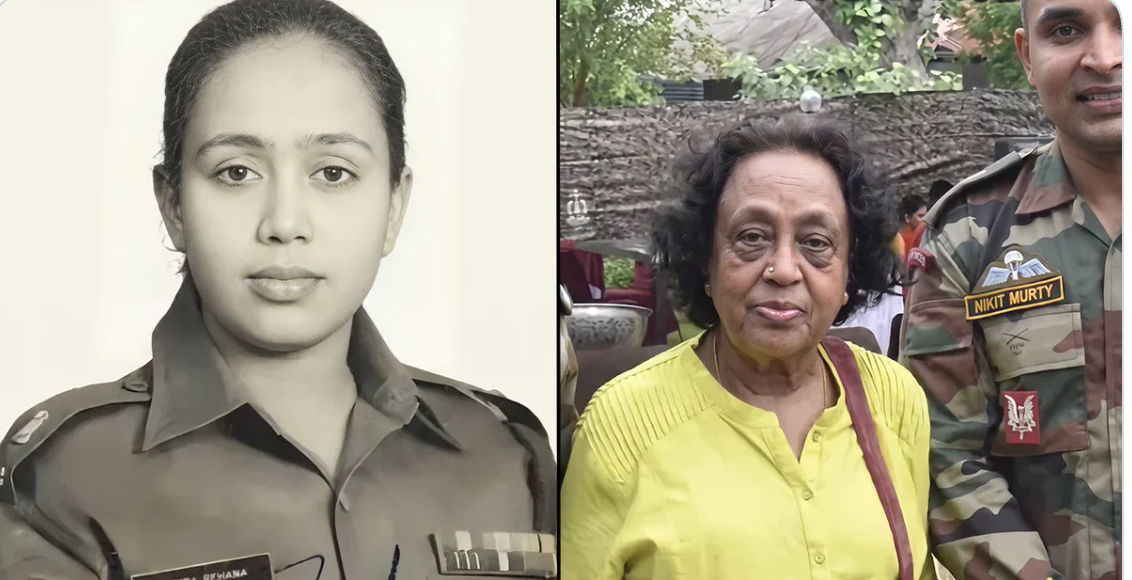
Some barriers fall to force. Others fall to sheer persistence, and Lt Col (Retd.) Josyula Farida Rehana’s story belongs firmly to the second kind.
She was born in Mysore in 1940 and trained as a doctor, graduating from Mysore Medical College with an MBBS and a gold medal in surgery, a record that would have been enough on its own to mark out a promising civilian career. The 1962 war with China changed the course of her life. India’s poor showing against Chinese forces exposed how thin its medical corps had become, and the Army put out a call for doctors willing to put on a uniform. Rehana answered it, joining the Army Medical Corps in 1964.
Treating patients from behind the lines was never going to hold her interest for long. She wanted a posting with the Parachute Regiment’s medical wing, one of the most demanding assignments the force had to offer, and the answer she got back was blunt. She has recalled being told plainly that she would not be allowed to join because she was a woman. Her application was turned down twice by her own account, and by some tellings a third time. She kept submitting it anyway.
The refusal eventually gave way. Rehana was posted to 60 Parachute Field Hospital, and on 19 September 1966 she completed parachute training, becoming the first woman Army officer to earn her paratrooper wings and the first woman in any service to join an operational airborne unit. Flight Lieutenant Gita Chanda of the Air Force had already won her wings back in 1959, but it was Rehana’s posting that put a woman inside a fighting airborne formation for the first time, expected to jump with the unit rather than simply hold a qualification.
What followed was twenty-one years of service, twelve of them with the para unit, and by most accounts close to a thousand jumps, including at least one free-fall descent that makes her the first woman free-fall paratrooper the Army has produced. Combat roles stayed closed to women throughout her career, so her job remained medical, but a field hospital built to move with the Parachute Brigade came with its own demands. She had to be ready to jump into wherever the brigade landed, set up surgical facilities under field conditions, and keep working once she got there.
That readiness was tested for real in 1971. Rehana served with 60 Parachute Field Hospital on both fronts of the war with Pakistan, carrying out surgery under wartime conditions rather than training exercises. She came home with the Poorvi Star and the Paschimi Star, campaign medals awarded for service on the eastern and western fronts, and later became the first woman to win the Gen Choudhary’s Trophy at the Medical Officers Senior Course, a mark of standing among her peers rather than a ceremonial honour. In January 2018, President Ram Nath Kovind presented her with the Women Achievers Award, one of 112 recipients recognised that year for work across fields as different as mountaineering and merchant shipping.
What stays with you is not the list of firsts but what she has said about it since. Meeting today’s servicewomen, she has said simply that she feels good seeing them get facilities and support she never had. It reads less like nostalgia and more like someone quietly satisfied that the door she forced open all those decades ago has stayed open, and that the women walking through it now no longer have to fight the same battle twice just to get inside.
About The Author
