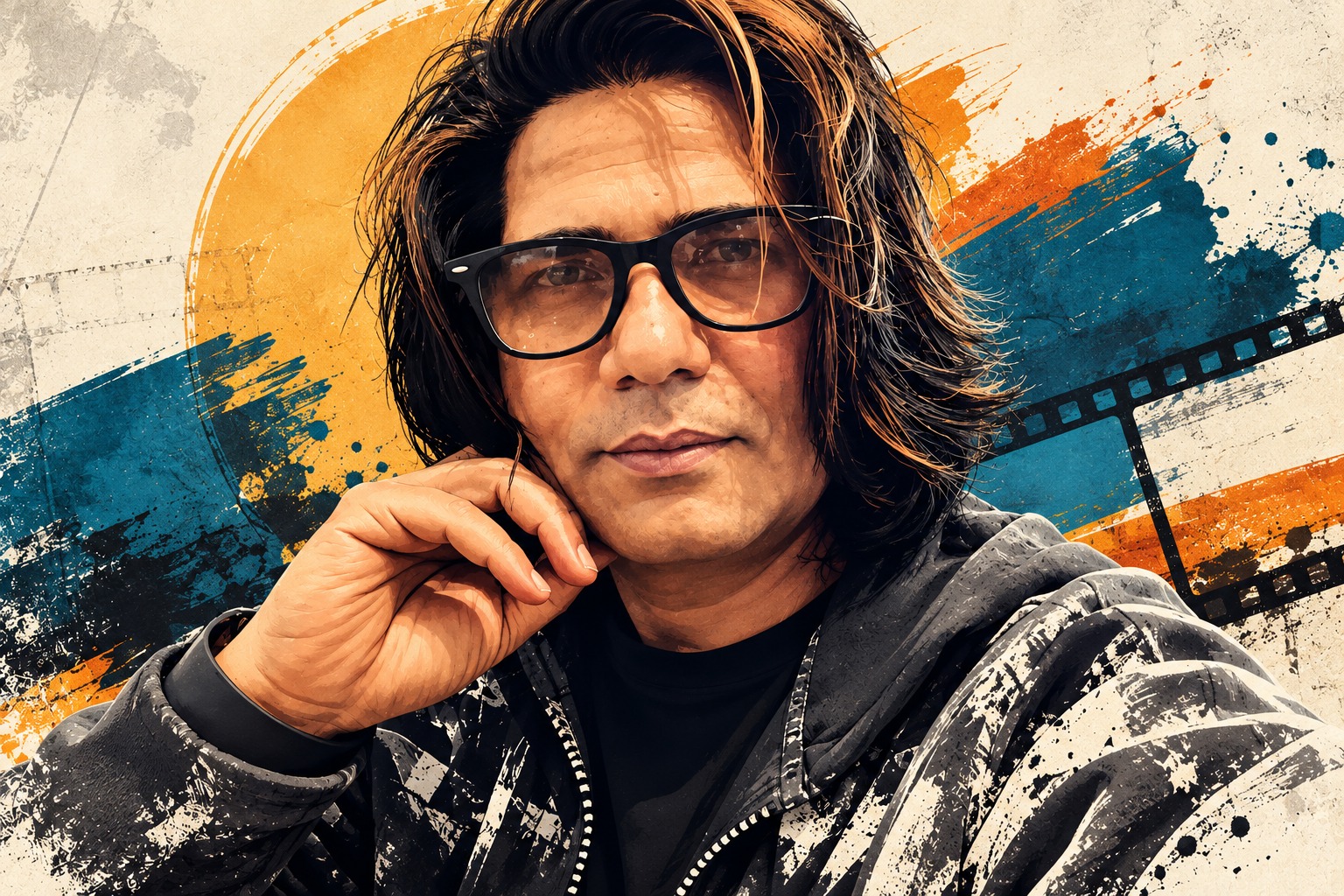
For poet and lyricist A. M. Turaz, the journey to Hindi cinema began far from Mumbai, in the quiet village of Sambalhera, Muzaffarnagar. He grew up in a farming family with no connection to the world he would eventually enter. At 19, he left home for Mumbai with little more than a belief in his writing and the willingness to live with uncertainty. What followed was a long apprenticeship in survival as much as in cinema. There were years of writing for television, a first film with Kudiyon Ka Hai Zamana, and then another difficult stretch before Guzaarish and his association with Sanjay Leela Bhansali opened a new chapter.
The songs that followed, from Aayat and Ghoomar to Binte Dil and Ek Dil Ek Jaan, brought recognition, but Turaz has never seen a career as a collection of credits. In this conversation, Turaz reflects on the making of that identity, the cost of leaving home, the loneliness of being an outsider, the changing language of Hindi cinema, the importance of giving writers their due, and the responsibility that comes with being entrusted with the gift of creation.
A. M. Turaz on growing up in a farming family
You grew up in Sambalhera, in a farming family with no connection to the film industry. When you look back, where does the writer in you come from?
I have always felt that I am, at heart, a very ordinary person. If there is one identity I recognise in myself, it is that of a writer.
I feel I was born to write. Whether it is poetry, ghazal, songs or scripts, writing has been the constant thread through my life. That is really who I am.
I was born in Sambalhera, a small village in Muzaffarnagar. My father is a farmer and my younger brother is also a farmer. There was no film background in my family, and we had very little exposure to the industry.
Even today, when I return to the village, people meet me exactly as they always have. They do not treat me differently because I have written films or songs. I do not go there announcing what I have done, either. In many ways, life there remains exactly as ordinary as it was when I left.
If cinema was not part of your world growing up, when did the idea of becoming a writer begin to take shape?
I honestly cannot say where it came from. It was simply something I felt within myself. At some point, I recognised that instinct and decided to take it seriously.
I began learning poetry and Urdu and worked at improving my craft. Gradually, I realised that I did not want to remain confined to poetry gatherings. I wanted my writing to reach a much larger audience.
That was when the film industry became a possibility in my mind. It was not a dream I had from childhood. The dream developed over time. I began imagining what it would be like to write for cinema, and once I started believing it could happen, I wanted to pursue it.
Leaving Sambalhera for Mumbai
Leaving home at 19 must have been a difficult decision, particularly when your father wanted you to remain close to the family and its traditional livelihood.
It was difficult, especially because nobody from our village had gone to Mumbai. Very few people had travelled beyond Delhi. My father wanted me to complete my studies, stay at home and eventually take up farming.
From his point of view, he was absolutely right. A parent naturally worries about sending a young person to an unfamiliar city where he knows nobody. At the time, our image of Mumbai was largely shaped by films and magazines. We imagined it as a dangerous place, full of uncertainty.
My father was worried about where I would live, what I would eat, how I would survive and whether I would find work. He knew I had not even completed my studies and did not have any particular professional skill apart from writing.
I understand his concerns much better today. Parents do not always express their fears directly. Behind their resistance is often a simple question: how will my child survive in a place I know nothing about?
Your grandmother eventually became the person who helped you take that leap. What do you remember about that moment?
My grandmother was alive then, and surprisingly, she was in my favour. One day she asked me whether I truly believed I could make it in Mumbai.
I told her I was certain I could. She believed my belief. She spoke to my father and told him that if I wanted to go to Mumbai with my writing, I should be allowed to go. My father eventually agreed and asked how much money I needed.
I remember getting a reservation on the Dehradun Express. I did not come to Mumbai without a ticket or by simply running away. I came with a proper reservation, sitting among the crowd. The journey took nearly 40 hours. Then I arrived in Mumbai, and the real struggle began.
What did those early years in Mumbai teach you that you could never have learned at home?
The struggle is extremely important. Not simply because you face difficulties, but because it prepares you for a larger platform.
You do not arrive in Mumbai prepared for everything. You learn here. You learn how to write to a tune, how to deal with people, how to communicate, whom to meet and whom not to meet. There are countless things you understand only after you enter the industry.
When I came here, I worried about everything. Where would I live? What would I eat? How would I travel? How would I survive?
As the struggle increased, I realised that I had to become independent. That was perhaps the most important lesson.
At one point, you even stopped accepting money from home. Was that the moment you realised you had to take complete responsibility for your life?
For the first year and a half, I took money from home. Then I realised that I had become too comfortable.
I was not working as hard as I should have been because I knew that money for food and living expenses was coming from home. I could sleep, wake up, eat and continue living without confronting the urgency of my situation.
Then I realised that Mumbai is a difficult city and the film industry is an even more difficult place. If I wanted to survive here, I had to become independent.
I had grown up in a village where parents took care of almost everything. That is how life works in many families there. I decided I had to break that habit.
So I told my father that my work had started and that I was earning money. He did not completely believe me and sent money again the following month.
When it arrived, I returned it. I wanted him to believe that I was genuinely managing on my own. After that, he stopped sending money.
You have also been candid about not romanticising your struggle. You never describe yourself as someone who slept on pavements or went hungry.
I believe in telling the truth about my struggle. I never slept hungry, and I never slept on the footpath.
Yes, I walked a lot. There were times when I travelled without a ticket because I did not have the money. But I do not want to exaggerate my story simply because a more dramatic version sounds better.
Eventually, I found television work. I began writing screenplays, dialogues and stories. That gave me some income and allowed me to survive.
I came to Mumbai in 2002. I did not have work initially. Around 2003, I started getting television assignments, and I continued with that work until 2005.
Your first film, ‘Kudiyon Ka Hai Zamana’, came in 2005. Did you think that was the breakthrough you had been waiting for?
I thought it would be. It was my first film, and it was a multi-starrer with actors such as Rekha ji and Mahima Chaudhry.
I thought that once I had written one film, more films would follow. But after that film, there was no immediate line of work.
I had already left television because I believed films would become my future. Instead, I found myself struggling again.
At the end of 2007, I was introduced to Sanjay Leela Bhansali. For various reasons, that opportunity did not work out immediately. I continued struggling, and because I had left television, I was now dependent entirely on song writing.
There was very little money and not enough work. It was a difficult period, but it taught me a great deal.
Then came ‘Guzaarish’, which changed the course of your career. What did that film mean to you?
At the end of 2009, Sanjay called me again and gave me ‘Guzaarish’, starring Aishwarya Rai and Hrithik Roshan.
That film changed my life. The songs reached a much larger audience, and my work suddenly had visibility. I began receiving more films, the financial struggle gradually eased, and opportunities also began coming from outside India.
But I would not separate Guzaarish from the years that preceded it. The struggle prepared me for that opportunity.
More than two decades after you arrived in Mumbai, how do you see the Hindi film industry today?
The industry has changed a great deal, and it should. Every era reflects the way people see the world.
The narration and storytelling have changed. The kind of artificiality that existed earlier has reduced in certain areas, although it has not disappeared. It has simply taken different forms.
Today, for instance, action and spectacle have become much larger. Cars are flying around and fights have become increasingly exaggerated. Earlier, the artificiality appeared in different ways.
At the same time, realistic and parallel cinema has also grown. When I first came here, you would sometimes see a hero singing in a manner that had little connection with reality. Things are different now.
There is still a great deal of artificiality, particularly in action, and sometimes it becomes excessive. In my view, when artificiality takes over completely, genuine art gets pushed aside.
Does that concern extend to writing as well?
I do not think writers themselves are necessarily artificial. They are writing stories and creating the material cinema needs.
Cinema has to attract an audience, so some exaggeration is inevitable. But I believe the art should remain as close to reality as possible.
Even poetry uses exaggeration. We speak about the moon and stars, for example. There is an element of imagination in that.
But I try to put something real into my writing, something that connects people with their own lives.
For me, art is the journey from darkness towards light. There should be truth in that journey. There should be a sense that darkness is ending and light is arriving.
Why writers still fight for recognition
You have spoken strongly about the rights and recognition of writers. Why do you think writers still have to fight for their place in the industry?
Recognition is the right of every writer. And it is not only writers. Other technicians and artists who contribute to a film should also receive proper credit.
The fight for those rights never really ends. There will always be people whose rights are overlooked, and there will always be people who have to raise their voices.
Writing is still not taken as seriously as it should be by many producers and decision-makers.
People want a good song, so they hire a lyricist. They want good dialogue, so they hire a dialogue writer. But they do not always think about the amount of thought, time and skill that goes into producing good writing.
A writer also needs to be given the right environment. If the people making the film do not understand writing, they cannot expect the writer to produce his best work.
Sahir Ludhianvi had once fought for writers and lyricists to receive proper recognition. Do you think that fight remains relevant?
Absolutely. It is the right of all writers to be recognised. And this fight is not going to end. There will always be people who overlook rights, and there will always be people who ask for them.
I believe writers have to continue raising their voices when their rights are ignored. I also have a responsibility to speak up.
How important is a lyricist to the making of a film, especially when a song can acquire a life of its own beyond the film?
A lyricist is extremely important. Songs are created for films, but a song can also develop an identity of its own. A film may not work, or people may not watch it, but a song can travel independently across hundreds of platforms.
That is something the industry should recognise. I think a song is almost like a message. The songs that become popular and touch millions of people can sometimes show people a direction or express something they themselves could not articulate.
If something has the power to reach that many people, it should be written with honesty and responsibility.
You have written songs in very different linguistic and cultural registers, from “Binte Dil” to “Ghoomar”. How do you decide what language a song needs?
It is always situational. When I wrote “Binte Dil”, I was thinking about the character and where he came from. He was not from that world, so I felt his language should sound different.
I researched Urdu, Persian and Arabic words and selected those that suited the character and the situation.
Similarly, when I wrote “Ghoomar”, I tried to move towards Rajasthan and its cultural and linguistic flavour, even though it is not my own language.
So, I do not begin by deciding, “I am going to write in this particular language.” I look at the character, the situation and the emotion, and then I search for the words that belong there.
That brings us to Urdu. You have often spoken about its fluidity and musicality. What does Urdu mean to you as a writer?
Urdu is not as distant or intimidating as people sometimes make it out to be. Every language has difficult words. English has difficult words. Hindi has difficult words. Urdu has them too.
But Urdu is already part of everyday Indian speech. We use words every day without stopping to ask whether they are Urdu, Hindi or something else.
The language itself has absorbed influences from many sources. There are Hindi words, Persian words, Arabic words, Marathi words, Gujarati words and English words in the language we use.
What I particularly love about Urdu is its ‘ravani’, its flow. There is a rhythm in it. That quality makes it particularly effective for dialogue, poetry and music.
I do not think we should treat Urdu as something separate from us. It is an Indian language and part of our cultural history.
When you write for yourself, how different is that process from writing a song for cinema?
It is completely different. When I write a film song, I am writing for a situation, a character and the requirements of the story.
But when I write poetry, I write for myself. There are poems I write simply because they give me happiness and satisfaction. There is no composer waiting for them, no producer, no character and no scene. I write because I feel that I want to write that particular thing.
Interestingly, some of the songs people have loved began as poetry I had written for myself.
“Ek Dil Ek Jaan” was like that. There was also a song in ‘Gangubai Kathiawadi’ that I had written earlier for myself. It was eventually used in the film.
When you write without a brief, you have complete freedom. You are not thinking about whether somebody else will like it. You are simply trying to satisfy yourself as a writer.
What is the one thing you still want to achieve as a writer?
I still feel much the same way I did when I started. I want a good opportunity to do good work. I want a good film, a good tune and the chance to write something meaningful for it.
The difference is that I am more comfortable now. I do not have to make endless calls looking for work, and I no longer have the same worries about where I will live or what I will eat. But the desire to do good work has not changed.
What writing still asks of him
After everything you have achieved, what does A. M. Turaz still want from writing?
I believe certain people are chosen to create something that remains after they are gone. If you have been given that ability, you have a responsibility towards it.
Sometimes I wonder whether I have written the work I truly wanted to write. I do not know. Sometimes you create something and only understand its meaning much later.
My effort is to leave behind something that strengthens the work I believe in, which is writing.
So, ultimately, it is not really about what I want for myself. I came from writing, and I have reached writing. That is the simplest way I can describe my journey.
What I am trying to understand now is not what I want from writing, but what writing wants from me. And I want to give myself completely to that.