di sheikh ba chiragh hami gasht gird-e-shahr
kaz dev-o-dad maloolam, insaanam arzoost”
(Yesterday the Master with a lantern was roaming about the city
Crying ‘I am tired of devil and beast, I desire a man)
“zin hamrahan-e-sust anasir dilam girift
sher-e-khuda o rustam-e-dastanam arzoost”
(My heart is weary of these weak spirited companions
I desire Lion of God, and Rustam, son of Zal-Dastan.)
~Rumi
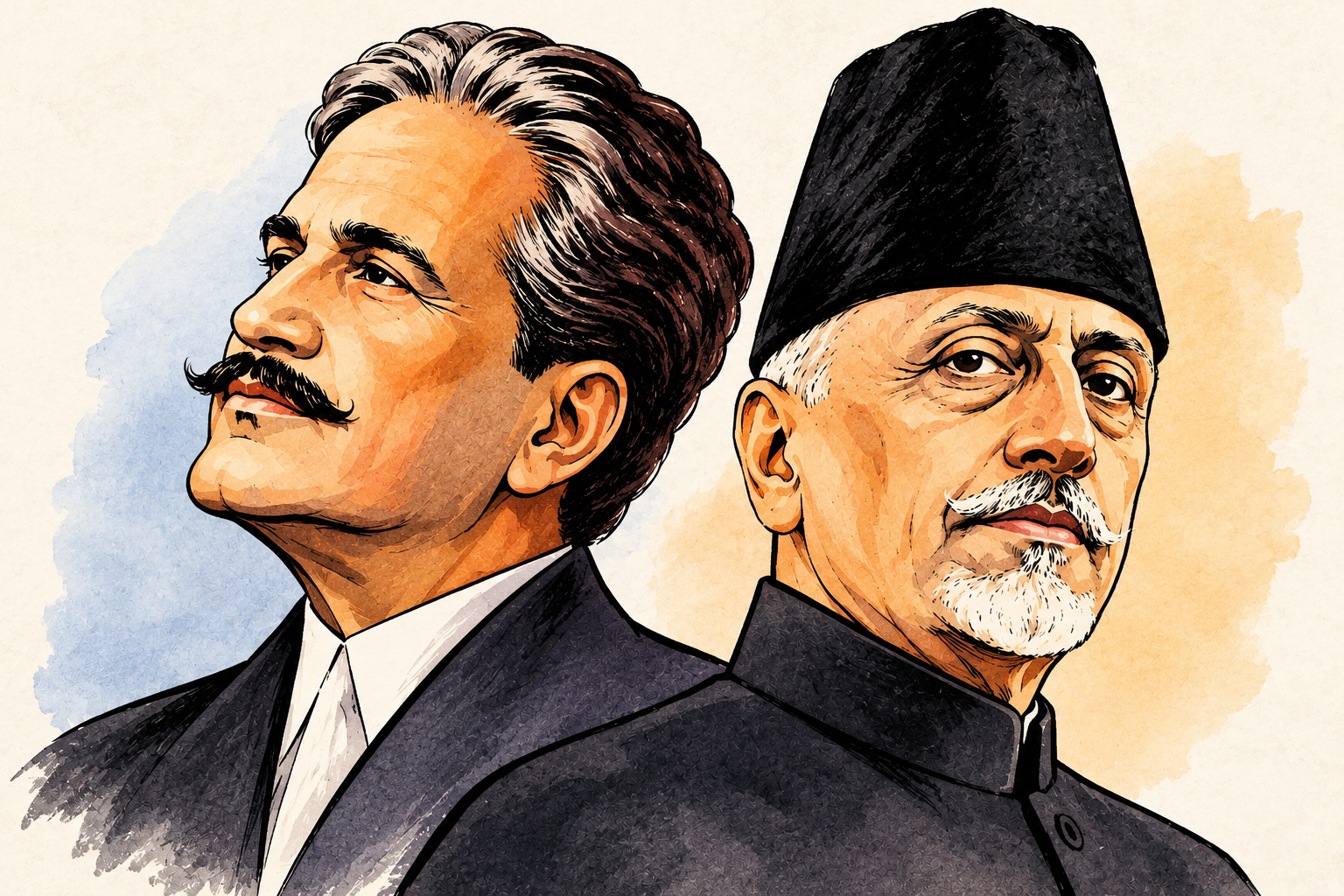
Allama Iqbal and Maulana Abul Kalam Azad, two men who fit beautifully into the description offered in Rumi’s verses above, have inspired and influenced generations of Muslims in South Asia for nearly a century. History has assigned them two very different pedestals: one as the spiritual father of Pakistan and the other as one of the foremost proponents of Muslim nationalism in India. Yet both appear to occupy a similar place in the collective imagination of succeeding generations of Muslims, particularly in India.
Both were exceptional writers, politicians and public intellectuals, deeply rooted in the Indo-Islamic ethos and well-versed in Western thought. They remained connected to global Muslim intellectual currents and were men of action who left behind formidable literary works and ideological legacies. Who were these two men? Where did they come from? What shaped them into the figures they became? What made them different, and yet allowed them to emerge as competing, and sometimes coexisting, role models?
Iqbal was born in Sialkot, Punjab, in 1877, in British India, to a Kashmiri father and a Punjabi mother. Azad, eleven years younger than Iqbal, was born in Mecca, then part of the Ottoman Empire. His father’s family hailed from Delhi, while his mother belonged to the Hijaz region of Arabia. He grew up in Calcutta, where his family moved when he was two. Iqbal’s ancestors were Kashmiri Pandits who had converted to Islam a few generations earlier. Azad, meanwhile, came from a family of scholars who had enjoyed prominence since the reign of Mughal Emperor Akbar.
Iqbal received his early education at Scotch Mission School in Sialkot before moving to Government College, Lahore. He subsequently travelled to England, obtained his degree in philosophy from Cambridge and qualified as a barrister at Middle Temple. He later received his doctorate from the University of Munich. Azad, by contrast, was largely home-schooled by private tutors appointed by his father. A voracious reader, he educated himself in several disciplines. He later visited Al-Azhar in Egypt, although he did not obtain a formal degree from the institution.
Professionally, Iqbal taught philosophy at Government College, Lahore, and briefly practised law. He eventually devoted himself primarily to writing, with financial support from princely states such as Bhopal. Azad entered journalism, taking up editorial responsibilities at several newspapers in Lucknow and Amritsar before launching his own publications in Calcutta. He eventually moved into full-time politics and the freedom struggle.
Despite their different backgrounds and political trajectories, several common influences and themes run through their careers and intellectual work.
Both were influenced by their travels abroad during the first decade of the twentieth century. Iqbal’s journey to Europe gave him a deeper understanding of Eastern and Western thought and helped him rediscover Islam as a civilisational force capable of binding a global community. Azad’s travels to Egypt and Iraq exposed him to nationalism and revolutionary movements. There, he encountered individuals engaged in struggles for the independence of their respective countries.
Both were fierce critics of the intellectual inertia that had taken hold among sections of the Muslim masses, which they associated with a distorted understanding of mysticism. They believed this had contributed to a lack of initiative and action, impeding Muslim intellectual and political development.
In the decade that followed, Iqbal published his celebrated Persian works, Asrar-e-Khudi (The Secrets of the Self) and Rumuz-e-Bekhudi (The Secrets of Selflessness), in which he challenged popular forms of mysticism that, in his view, encouraged passivity. Instead, he advocated a more nuanced understanding of spirituality, rooted in the Quranic spirit and centred on action, struggle and the cultivation of individual character. He envisioned a community formed through the transformation of individuals.
Around the same time, Azad was publishing his weekly Urdu newspaper, Al-Hilal. After the British authorities banned it, he launched another publication, Al-Balagh. These weeklies were forthright in their political positions and called upon Muslims to participate actively in the freedom struggle, presenting it as a religious duty. His editorials drew upon the history of the early Muslim community and the struggles of the Prophet’s companions against oppression. He invoked Islam’s historical legacy while urging people towards political action, communal harmony and national unity.
Both were essentially modern in their outlook and deeply admired figures such as Jamaluddin Afghani, the influential reformist whose ideas travelled across the Muslim world and Europe. Both wrote passionately about Afghani. In Iqbal’s Javid Nama, the poet-protagonist Zinda Rud, guided by Rumi, encounters Afghani in one of the celestial spheres. When the time for prayer arrives, Afghani leads the congregation, with Iqbal and Rumi praying behind him.
Azad, too, discusses Afghani at considerable length, particularly his travels and his influence on reformers such as Muhammad Abduh of Egypt. He also credited himself with introducing Afghani’s ideas to Indian audiences through Al-Hilal. Azad’s own travels through Afghanistan, Iraq, Syria, Egypt and Turkey were, in some ways, inspired by the routes Afghani had taken nearly four decades earlier.
Iqbal and Azad were both conscious of the composite culture that had developed through a thousand years of Islamic presence in India. For Azad, this understanding found expression primarily in his politics; for Iqbal, it was reflected in his poetry.
Azad emerged as one of the strongest proponents of political unity from the very beginning of his political career. He was among the first prominent Muslim voices to call upon Muslims to shed their reservations and join a full-fledged struggle for independence alongside their fellow countrymen. As events unfolded and the prospect of independence became intertwined with the possibility of Partition, Azad stood firmly against the proponents of the Two-Nation Theory. He foresaw the dangers of defining nationhood through religion and repeatedly warned of the consequences for future generations.
Despite his efforts, when Partition became a reality, Azad sought to calm the anxieties of the large Muslim population that chose to remain in India. He urged them not to lose heart or courage. Instead, he asked them to draw upon their rich cultural heritage and become equal partners in the project of nation-building.
Iqbal’s poetry reflects the composite culture of India in all its richness. Poems such as Hindustani Bachchon Ka Qaumi Geet, Himala, Naya Shivala, Ram, Tarjuma-e-Gayatri and Nanak, among others, are distinctly Indian in their scope and themes.
The popular claim that Iqbal gradually moved away from Indian themes in his later works is an oversimplification. His later compositions, including Bal-e-Jibril and Javid Nama, are profound explorations of the human ego, its potential and its relationship with the universe and the Ultimate Ego. Yet, throughout these works, one encounters references to people, places and intellectual traditions that contribute to this larger philosophical project.
Kashi, an ancient centre of learning associated with Hinduism, Buddhism and other intellectual traditions, appears alongside Rum (Anatolia), Sham (Syria) and Samarqand, all celebrated centres of Islamic learning. In his journey across the celestial spheres in Javid Nama, the poet first encounters Vishwamitra, the ancient Indian sage whom Iqbal calls Jahandost, and engages him in a conversation about the deeper meanings of life. As he ascends, he encounters the Tasins of Gautam alongside those associated with Jesus, Zoroaster and Muhammad. Such figures and imagery recur throughout Iqbal’s poetry.
Their eagerness to learn from and engage with diverse intellectual traditions marks another common feature of their personalities. Iqbal was conversant with major contributors to both Western and Eastern philosophy. He could engage with Einstein, Bergson and Hegel as comfortably as he could with Ibn Rushd, Ghazali and Maimonides. Azad, too, displayed an extraordinary intellectual curiosity. He quoted Western sources while discussing the Crusades, explored Indian, Arab and Western musical traditions, and discussed the origins and history of tea drinking. His writings reflected the curiosity of a lifelong learner.
Perhaps the most critical element running through both their literary works and their lives was the primacy of the Quran as the cornerstone of their ideological foundations and actions. Across their poetry and prose, Quranic ideas and verses recur in carefully considered ways. Their speeches and lectures are similarly rich in Quranic references and interpretations. Their lives and work suggest an enduring commitment to personal spiritual development and the pursuit of a value-based civilisation grounded in Quranic teachings.
Both men, in different ways, left behind an unfinished agenda for future generations.
Iqbal did not live to see an independent India or Pakistan. He passed away in 1938, nearly a decade before independence. Yet he envisioned a community of free individuals who would organise themselves through collective public action to create a better society. In much of his work, he directly addressed the youth, urging them to assume the responsibilities he believed awaited them. Politically, he advocated a federal arrangement for India, with provinces enjoying a degree of autonomy. At the time, the eventual consequences of Partition and the emergence of rival nation-states were still difficult to foresee in their entirety.
Azad lived to witness the aftermath of Partition and its devastating consequences. He did what he could to provide reassurance and direction to those who remained in India. As the country’s first Education Minister, he also played a crucial role in establishing and nurturing institutions of higher learning. Until the end of his life, he continued to speak about the ideals he had upheld, and he did not hesitate to criticise even close colleagues when he believed they were departing from those principles. His memoir, India Wins Freedom, offers a testament to this intellectual and political conviction.
These two men lived through extraordinarily turbulent times, yet left behind intellectual and political legacies that remain relevant. Their lives and works offer much to reflect upon and provide a sense of direction at a time when we appear to be standing on uncertain intellectual ground, struggling to translate ideas into organised public action.