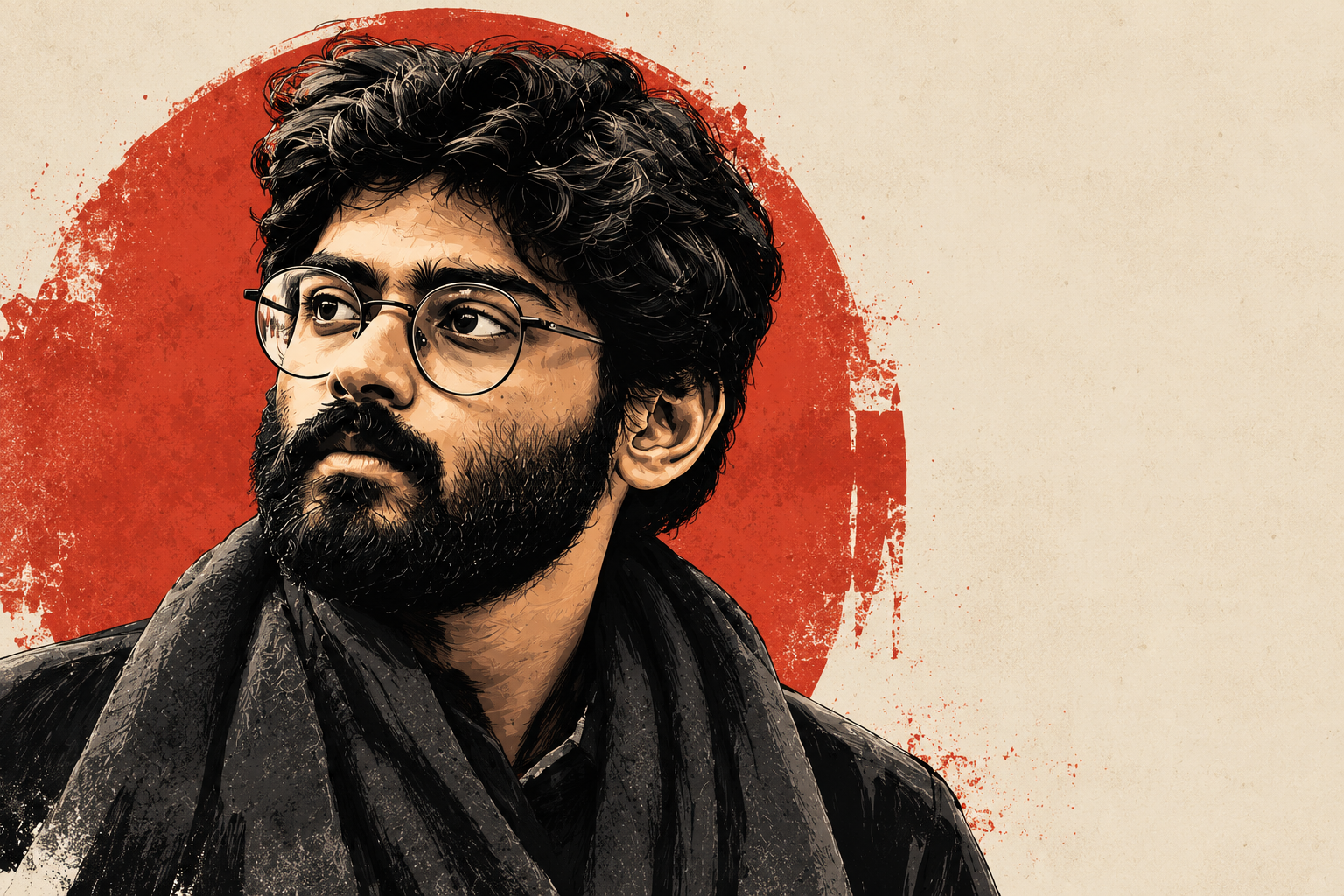
“I disapprove of what you say, but I will defend to the death your right to say it”
Evelyn Beatrice Hall wrote this line in The Friends of Voltaire (1903) to capture Voltaire’s fierce defence of freedom of speech.
My Approach Towards Sharjeel Imam
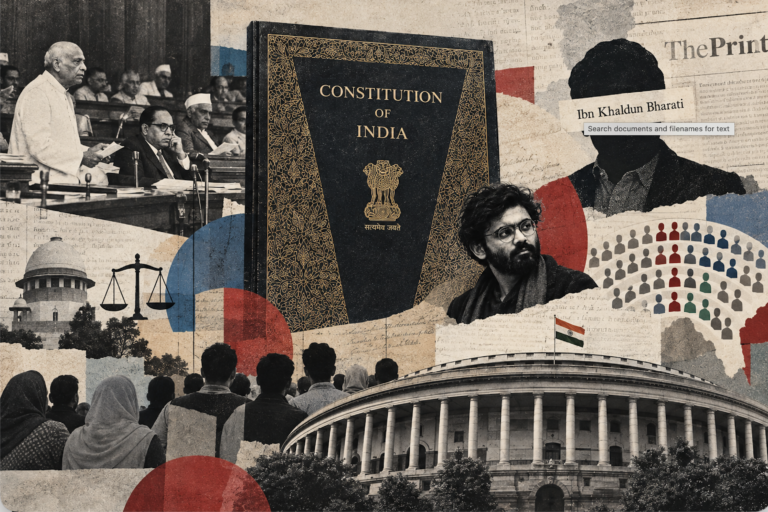
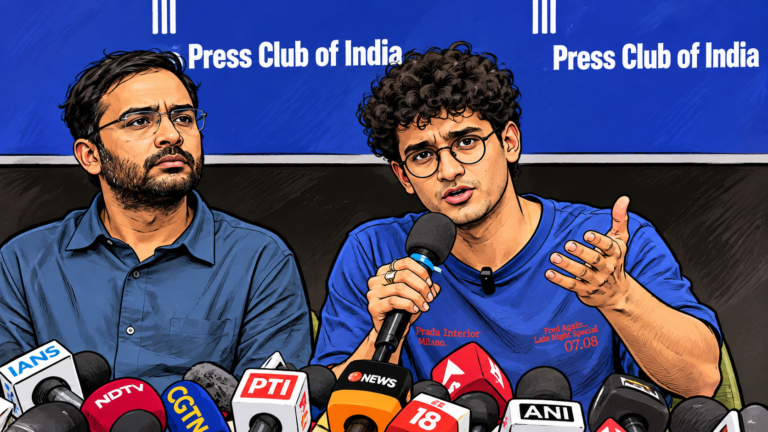
This article offers no point-by-point rebuttal of Sharjeel Imam’s interview with The Quint on 29 September 2026, since Md Zeeshan Ahmad has already attempted that at the same portal on 23 October. My concerns run deeper, towards the political imaginations Imam holds and the formulations he believes to be emancipatory for Muslims and for other marginalised sections of India.
I treat the political imaginations Imam holds as a distinct philosophy curated for India and its longstanding secular-majoritarian dilemma. His repeated quotations of Muhammad Iqbal, together with his deep reverence for Muhammad Ali Jinnah, Ali Shariati (the principal ideologue of the 1979 Iranian Revolution) and Jamaluddin Afghani, make it clear that his ideological premise rests on Islamic modernism. This current fused Quranic values, Islamic rationality (ijma) and reasoning (ijtihad) with Newtonian physics. It found its birthplace in the Indian subcontinent in the nineteenth century, and Sir Syed Ahmad Khan and later Hasrat Mohani carried its torch during the anticolonial struggle.
My agreements and disagreements with Imam’s arguments bear on the pertinent historical and political debates of multicultural and postcolonial societies, and so they also concern constitutionalism, secularism and minority rights. I will assess his understanding of the anticolonial struggle and partition politics, along with his conceptualisation of a “just” and “desirable” political order, and I will offer a critique of it. Sharjeel Imam has been incarcerated for nearly six years without a trial. My disagreements with him imply no support for his incarceration, and I want a fair trial for him, which the establishment has unjustly denied.
The Two Camps
The interview has drawn very divergent responses online to Imam’s proposed course of action, and the spectres of Shaheen Bagh still haunt India’s political imaginations. A section of the intellectual class has defended his arguments by invoking the long history of oppression against Muslims in India, some of it state-sponsored, and their epistemological isolation from national discourse. From this perspective, his philosophical and political trajectory cannot be understood apart from the historical conditions that produced it. Aakar Patel’s Our Hindu Rashtra offers a similar diagnosis. Patel argues that India has functioned in practice as a de facto Hindu state since independence, because Hindu interests have repeatedly subordinated competing minority interests, a tendency that in his account has only accelerated since 2014.
The opposing camp has rebranded Imam as an “Islamist radical” and has read his political philosophy and proposed course of action as little more than an “Islamic manifesto”. Such denunciations have often proceeded from a very narrow understanding of how power structures operate within a secular-majoritarian state such as India. A Foucauldian lens would ask who possesses the discursive power to define secularism in the first place, before asking whether Imam’s politics conform to an ostensibly neutral standard. What counts as secular, which political expressions earn recognition as legitimate, and how the doctrine is expected to be performed have all been produced and regulated within a dominant epistemic order. In a majoritarian formation, the vocabulary and imaginaries of “secular politics” can come to mirror the assumptions of the majority.
The Rightful Call for Reforms in the Electoral System
Sharjeel Imam’s advocacy of Proportional Representation (PR) in place of the First-Past-The-Post (FPTP) system has, in essence, exorcised a ghost that haunted the Constituent Assembly debates themselves. He rightfully invokes Perry Anderson’s critique of FPTP in a diverse country such as India in The Indian Ideology (2012), which argues that the system monopolises political power towards the majority and treats the subservient votes as the “defeated ones”. Imam gives the example of the Mayawati-led Bahujan Samaj Party in the 2014 General Elections, when it emerged as the third largest party by vote share and still won no seats. He calls this an injustice to BSP voters.
Some sporadic voices in the Constituent Assembly debates shared Imam’s apprehensions, even though an overarching consensus favoured FPTP, primarily because, as Dr B.R. Ambedkar argued, PR requires an electorally literate population that India lacked in the 1950s. K.T. Shah was the strongest voice for PR through the Single Transferable Vote (STV), and he argued that FPTP cannot accommodate the diverse voices of India’s highly heterogeneous population and would eventually leave out peripheral aspirations. On 4 January 1949, Shah opined to the Constituent Assembly, chaired by H.C. Mukherjee, “I feel, Sir, that if you make representation of very large numbers of voters to be concentrated on a single member, so to say, you may not have a correct verdict of the people on a multiplicity of issues that are usually placed before the electorate at a general election.”
Eventually the Assembly dropped PR in favour of FPTP for those reasons. A literacy rate of a mere 18 per cent (Census 1951) would indeed have made a complicated PR system hard to navigate in a first democratic exercise. The same logic may not hold for twenty-first century India, though. The literacy rate has risen to 72 per cent (Census 2011), and it may approach 80 per cent in 2026, while the channels of electoral literacy have developed and diversified. Teaching the current population about PR through STV would therefore be much easier and more feasible than it was in the 1950s. Besides Imam, former Election Commissioner S.Y. Quraishi has led the call for this electoral reform, arguing that “the time has come” for India to move to a PR system.
A move towards PR could also diminish the possibilities of electoral manipulation and mitigate the consequences of disenfranchisement, concerns that have resurfaced in the context of the recent Special Intensive Revision (SIR) exercise. PR could therefore secure more representative outcomes for India’s diverse communities and strengthen fairness at the ballot box in the longer run. The case for PR may transcend a technical adjustment to the country’s electoral system, since it demands a philosophical reconsideration of what democratic representation ought to mean. Accommodating divergent opinions, identities and social backgrounds would be an imperative and a philosophical requirement for any heterogeneous nation that aspires to call itself democratic. For Imam, a move to PR would allow a structural secularism in place of a symbolic and nominal one.
A Distorted Understanding of Partition Politics
Appreciable as his advocacy of PR may be, Imam goes wrong in how he understands the anticolonial movement and partition politics. Md Zeeshan Ahmad has already devoted a section of his rebuttal to this, titled “A Reductive Reading of India’s Freedom Struggle”, and he rightly argues that Imam collapses partition politics into a debate between the Hindu Congress and the Muslim League. Imam’s arguments, Ahmad says, merely rehabilitate Jinnah and Iqbal and grant the former the rank of a lone warrior against Congress dominance. Ahmad also points out that Imam treats the ummah as a homogeneous community and turns a blind eye to peripheral Muslim communities such as the Pasmandas and Dalit Muslims.
Imam’s uncritical advocacy of the Cabinet Mission Plan of 1946 poses an even bigger problem, since he treats it as something that could have given Muslims the political space Congress denied them. This is a genuine flaw in his understanding of partition politics. The Plan proposed a federated united India in which the centre would hold only defence, foreign affairs, international trade and communications, and the provinces would handle everything else. It recommended three groups. Group A consisted of the Hindu-majority areas, Group B of Muslim-majority areas such as the North-West Frontier Province, Punjab, Sindh and Balochistan, and Group C of Bengal and Assam. These groups were to serve as intermediaries between the centre and the provinces, an arrangement Jawaharlal Nehru and much of the Congress elite vehemently opposed.
In A History of India (1998), Hermann Kulke and Dietmar Rothermund argue that the controversy went beyond administration. For the League, compulsory grouping was the core of the Cabinet Mission Plan. Although the Mission rejected Jinnah’s demand for a sovereign Pakistan, Groups B and C would have brought most Muslim-majority provinces together in two powerful regional blocs, with substantial autonomy inside a formally united India. The arrangement therefore offered the League something approaching the substance of Pakistan without immediately conceding territorial sovereignty. Congress feared that it would eventually hollow out the Indian Union and reduce the centre to a mere coordinating authority.
Imam frequently invokes the Cabinet Mission Plan in support of decentralised governance, autonomous political structures and stronger safeguards for minority communities throughout the subcontinent, and this raises questions about his reading of the constitutional crisis that preceded Partition. His tendency to frame partition politics primarily through the binary of Congress and the Muslim League relegates colonial power to the background and renders other political actors and forms of mobilisation largely invisible. His suggestion that the League had already secured an overwhelming political consensus among the subcontinent’s Muslims is equally problematic. The franchise in the 1946 provincial elections remained highly restricted, and the League’s remarkable performance in Muslim constituencies cannot straightforwardly be extrapolated into a plebiscitary endorsement by the whole Muslim population. Regional variations complicate such a conclusion further, particularly in the North-West Frontier Province, where Congress remained a formidable force.
Reducing the politics of the 1940s to a Congress-League binary also hides mobilisations that conformed to neither camp. Bengal provides perhaps the clearest example. Communist and peasant organisations had developed substantial influence among sections of the rural poor, Muslim peasants included, and the Tebhaga movement of 1946-47 mobilised sharecroppers around material questions of land, rent and agrarian exploitation. Such a binary may most significantly obscure the third and structurally decisive actor, the British colonial state, whose constitutional arrangements, management of communal representation, negotiations over the transfer of power and eventual withdrawal fundamentally conditioned the political terrain on which both Congress and the League operated.
Reigniting Debates on Indian Secularism
Sharjeel Imam openly proclaims that he does not belong to the “Save the Constitution” club and treats Indian secularism as a “trap” in which Indian Muslims have always been victims. A casual reading might suggest that he denounces secularism as a principle, but he does not. His criticism targets the form secularism has historically taken in India, a secular-majoritarian order that incorporates minorities formally as equal citizens while leaving them structurally disadvantaged in the distribution of political power. By calling it a “trap”, he argues that constitutional language has confined Muslim politics within an intellectual horizon that permits demands for equality and brands collective representation, or power-sharing, as “communal”.
Underlying this critique is Imam’s more fundamental characterisation of the Constitution as a status-quoist instrument. In Multiculturalism and the Politics of Recognition (1992), Charles Taylor argued that modern democratic politics cannot be reduced to the equal treatment of detached individuals, since identities are constructed through social recognition. In one sphere, Taylor’s conceptualisation might support Imam’s position. Constitutional equality may not bring structural equality. Perry Anderson, writing on the lower castes of the subcontinent, argued that casteism has enabled Indian democracy. Parallel conclusions could be drawn for Muslims in India too.
Taylor also challenges Imam’s linear conceptualisation, however. Muslims, as stated earlier, do not form a homogeneous community, and class, ethnic and linguistic lines divide them. Imam’s repeated use of “we”, “our”, quam and ummah projects a monolithic Muslim community. The Indian Muslim community has been dominated by Ashrafs and Pathans, while lower ranks such as Pasmandas have been treated as inferior. Even Dalit Muslims are sometimes treated as unequal to other Muslims. A politician seeking a stronger collective response may therefore suppress differences within their own community.
Many lessons can be drawn from anti-imperialist Islamic movements in Africa and the Middle East in the mid-twentieth century. Despite a similar goal of ousting a colonial regime, the Islamists could not reconcile their internal differences. The Islamic Republic of Iran, for another instance, suppressed and outlawed nearly all of its revolutionary allies after 1979. The communists, socialists, Kurdish groups and minor anarchist groups, who had seen Ayatollah Khomeini as a progressive anti-imperialist force, were betrayed.
When Imam hails the Indian communists for doing a better job than Congress in giving Muslims political agency, the Indian Left should keep in mind the history of political Islam. It must extend solidarity in the face of current Hindutva violence against Muslims, and it should never adopt the vocabulary or imaginaries of that tradition.
Religion and the Left
Imam, knowingly or otherwise, has pointed to the reason behind the crisis of the Left in India. The Left’s relationship with religion has been a major impediment, cutting it off from the greater population. While hailing certain Marxist principles such as dialectical reasoning and an emancipatory vocabulary, he rejects dogmatic materialism and a historicist view of society. When he says, “… the larger issue with them (Marxists) is their disavowal of religion as a positive force among Muslims, their reduction of religion as a part of an oppressive superstructure, their rejection of every invocation of religion as petty-bourgeois illusion, or elite manipulation, or grand imperial plans, or identity politics – all of them amounting to denial of agency to Muslims as Muslims”, he points to a facet the Indian Left has conveniently avoided.
Engaging with religion in politics can be challenging. The influence of religion in Indian society has never allowed the imposition of Marxist atheism, as the Marxist rule in West Bengal and Kerala shows, where religion was accepted as an Indian reality to be left alone and was relegated to a passive entity. Here lies probably the greatest mistake the Left has made. Extended beyond Muslims to other religious communities in India, Hindus included, Imam’s argument carries immense weight once the positive role of religion is sociologically analysed. In The Protestant Ethic and the Spirit of Capitalism, Max Weber argued that capitalism flourished in Europe because the Protestant population played a positive role during the Reformation. The Protestant ideal of accumulating wealth for investment directly helped lay the foundations of capitalism in modern Europe. Marx found in capitalism a logic of historical progression, whereas Weber credited it to the religious ethics prevalent in Europe.
Weber’s analysis may not be self-sufficient and may invite criticism, but a logical conclusion follows from it. Religion can operate as an active force that constructs emancipatory vocabularies and political imaginations, in addition to offering the temporary relief from daily subjugation that Marx called the “opium of the people”. Here Imam invokes Islam as a positive force and refuses to treat it as a reactionary subordinate to be done away with.
A Distinct Ideologue of Political Islam
In the end, Imam is an ideologue of political Islam with Indian characteristics. Indian nationalists have condemned Jinnah for very good reasons, as the chief architect of Partition and of the communalism he fostered during the freedom struggle alongside the Hindu Mahasabha and the RSS. Imam does something that discomforts the entire liberal academy, myself included, by engaging with Jinnah from the opposite perspective. This perspective is probably blasphemous for anyone claiming to be a nationalist.
I have routinely engaged with Muhammad Iqbal and Sir Syed Ahmad Khan as pioneers of Islamic modernism, while Jinnah has always been a condemnable character in Indian historical and political disciplines, although the philosophical world knows him as a Muslim modernist and a democrat. Strangely, after Partition was complete and Pakistan was proclaimed an independent sovereign nation-state, Jinnah did not turn Pakistan into an “Islamic state”, as many would have expected. He claimed it instead as a “Muslim-majority democratic and civic state, rather than a theocratic or fundamentalist Islamic state governed by the ulema”. The Islamification of Pakistan began only with the regime of General Zia-ul-Haq, which was extremely unpopular and fiercely resisted.
Throughout the interview, Imam invokes Islamic vocabulary to draw his imagination of an emancipatory politics. He grounds political concepts such as justice (adl), equality and emancipation in tawhid (the unity of God), and he treats shirk as a conceptual source of oppression in the form of despotism, casteism and chauvinism. He also stresses independent reasoning (ijtihad) and rationality (ijma). Imam implicitly rejects universal citizenship as a detached concept and upholds the communitarian argument that citizenship derives from its relation to community. In Liberalism and the Limits of Justice (1982), Michael Sandel states that persons are partly constituted by social relationships, histories, communities and moral commitments. Political theory therefore cannot always treat citizens as individuals stripped of these constitutive attachments.
Imam’s invocation of this communitarian citizenship departs from the liberal conceptualisation, which he explicitly denounces. His politics does not reduce Muslim politics to minority rights activism, secular anti-majoritarianism or even a convenient alliance with anti-Hindutva forces. Although he states that the BJP-RSS is much more dangerous than Congress, he accuses the latter of enabling structural discrimination and overt centralisation that paralysed the Muslim population, and of upholding a symbolic constitutional secularism that disallowed Muslims, Dalits, Adivasis and other oppressed sections from forging alternative political possibilities. Until the oppressed can forge a meaningful political alternative of their own, Imam lends his support to a “third front” of communists, Lohiaites, Dravidianists and Ambedkarites, who he believes can better represent their political agencies.
Imam therefore forges a distinct kind of political Islam that differs from the revolutionary Islam of Khomeini, the political programme of the Muslim Brotherhood and any salafi jihadist politics. His resentment of the Muslim clergy and elites, together with his critique of the Waqf Board, lends his beliefs their distinct character. His advocacy of decentralisation extends beyond politics. He accuses Muslim elites of compromising with the Indian state, since Waqf Board office holders are centrally appointed, and he proposes a decentralised model of appointment for the Waqf Board too. This distinguishes him from the much larger Indian ulema, whose lavishness and compromises with the majoritarian order he implicitly rejects.
Unlike many Islamists, Imam does not envision an order equivalent to a caliphate, and he wants neither a ruling khalifa nor shariat as the only guiding rulebook for his political imagination. He adopts Islamic values that he thinks harmonise with modernism and rejects taqlid (superstition and blind faith). He envisions history as a struggle for liberation from shirk, meaning despotism, chauvinism and casteism or racism, and he dreams of an order in which community rights and emancipation from majoritarian epistemological constructs replace the majoritarian conceptualisation of secularism. Sharjeel Imam’s political Islam may therefore be read as an autonomous and emancipatory expression of an alternative political possibility, one that would be fairer and more just to all the oppressed classes in the subcontinent.