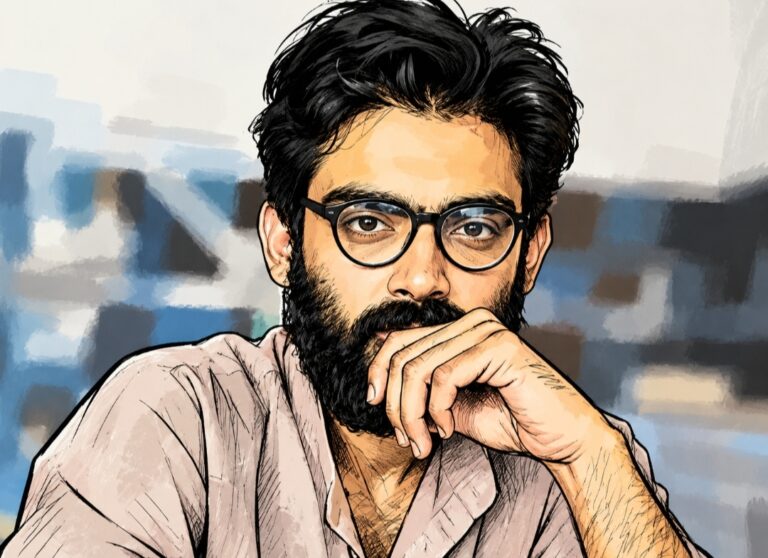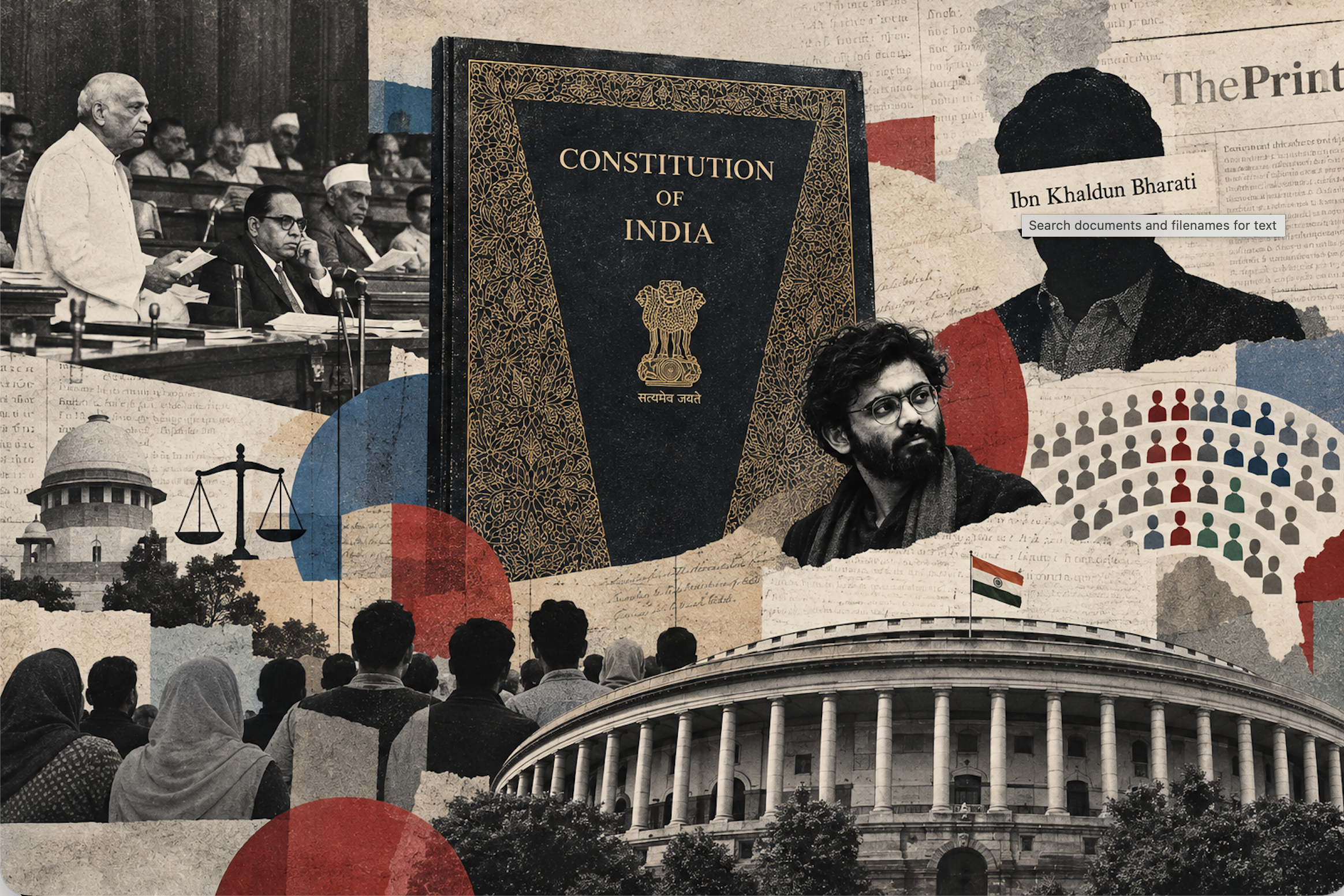
The controversy surrounding Sharjeel Imam’s recent writings says as much about the state of India’s political discourse as it does about the arguments he has put forward. Here is a political prisoner questioning the limitations of Indian democracy, the inadequacy of minority safeguards and the concentration of political power. His critic, writing under the pseudonym Ibn Khaldun Bharati in ThePrint, nevertheless presents this thinking as an Islamist manifesto that threatens the Indian Republic.
Bharati’s article responds to Imam’s interview with The Quint and offers an elaborate ideological indictment. Imam’s subsequent writing in Karvaan India sets out proposals for electoral reform, decentralisation and minority representation that deserve closer scrutiny.
The debate turns on a question that has troubled democracies for generations. Can a political system claim to represent all its citizens when its institutions leave substantial sections of the population persistently underrepresented? India’s Constitution-makers confronted this very question more than seven decades ago.
What the Constitution-makers actually debated
On 27 August 1947, the Constituent Assembly accepted recommendations providing reserved legislative seats for religious minorities under joint electorates. The Assembly abandoned these provisions on 26 May 1949, after accepting the view that religious reservations could perpetuate communal divisions in the aftermath of Partition.
This history carries weight. Guaranteed minority representation was seriously considered, initially accepted and later rejected by those entrusted with drafting the Constitution, so it can hardly be called an alien idea introduced by contemporary Muslim activists. Sardar Patel was not advocating religious separatism when he presented the original recommendations, and the members of the Constituent Assembly were not promoting an Islamist political order when they debated minority safeguards.
Imam’s proposals differ from those considered in 1947. He advocates proportional representation as an electoral system and institutional reservations for religious minorities in the judiciary, the executive and universities. A related concern lies beneath them, namely whether formal political equality can ensure meaningful participation by communities that face persistent disadvantage.
B.R. Ambedkar understood the danger of permanent numerical dominance. Speaking in the Constituent Assembly on 4 November 1948, he separated a political majority from a communal majority and recognised the vulnerability of minorities when the latter becomes the basis of political power. The framers eventually chose a different constitutional settlement, but their debates establish that minority safeguards were a legitimate subject of disagreement and cannot be dismissed as inherently anti-democratic.
What Indian schoolchildren are taught about power-sharing
Bharati’s ideological alarm contrasts with what Indian students meet in their political science textbooks. In Democratic Politics-II, the National Council of Educational Research and Training (NCERT) explains power-sharing through the contrasting experiences of Belgium and Sri Lanka. Sri Lanka’s majoritarian policies alienated its Tamil minority, while Belgium adopted constitutional arrangements to accommodate differences between its linguistic communities. Those arrangements include equal numbers of Dutch-speaking and French-speaking ministers in the central government, regional autonomy and institutions representing linguistic communities. The textbook presents them as a means of managing diversity and preventing political alienation.
The comparison is relevant because it challenges the assumption that institutional recognition of community differences necessarily weakens national unity, and Belgium may offer no ready-made solution for India. Considerable distance separates recognising the democratic value of power-sharing from endorsing any particular demand made in its name, and that distinction should inform the debate over Imam’s proposals.
Representation is not religious supremacy
Bharati’s main objection is that Imam’s political vision cannot be separated from an Islamist conception of Muslim nationhood. The concern deserves scrutiny, particularly because Imam makes no secret of the religious influences on his thinking. It remains necessary, however, to distinguish the philosophical foundations of a political argument from the constitutional arrangements it proposes.
Proportional representation operates in democracies around the world, and decentralisation is a recognised feature of federal governance. India itself provides reserved legislative representation for Scheduled Castes and Scheduled Tribes and protects the cultural and educational rights of religious and linguistic minorities. None of these arrangements establishes a claim to political supremacy by its mere existence.
Imam’s proposals nevertheless raise difficult questions. Would institutional reservations based on religion reinforce communal identities? How would greater autonomy for religious institutions affect women, dissenters and disadvantaged groups within those communities? Would proportional representation strengthen accountability or encourage political fragmentation? These concerns are far from peripheral, since they bear directly on whether the reforms Imam advocates would strengthen democratic citizenship.
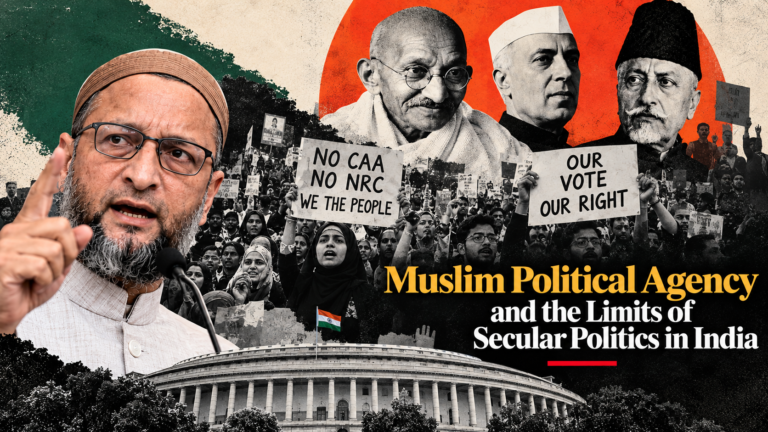
Bharati’s critique would have persuaded more readers had it devoted greater attention to these institutional questions instead of treating Imam’s ideological outlook as sufficient evidence of the political consequences of his proposals. His sweeping assertion that Muslim elites and ordinary Muslims have historically shared essentially the same political ideology because of their religion is especially difficult to sustain, and the differences between Maulana Abul Kalam Azad and Muhammad Ali Jinnah over Indian nationhood, minority safeguards and the constitutional future of Muslims demonstrate the inadequacy of such generalisations.
Faith is not a constitutional programme
Bharati also challenges Imam’s religious understanding of liberation, particularly his references to tawhid (monotheism) and shirk (polytheism), and he draws parallels with the revolutionary Islamic thought of Ali Shariati. Scrutinising the religious foundations of Imam’s politics is reasonable, and his ideas should be tested for their implications for pluralism, individual liberty and equal citizenship. Religious inspiration and the establishment of a religious state are nonetheless different things. Political movements from many ideological traditions have drawn upon religious ideas without seeking to make religious doctrine the basis of state authority, although religiously inspired politics can become exclusionary when it denies equal standing to those outside its faith.
The distinction carries weight in Imam’s case. The proper test of his proposals is whether they would guarantee equal rights to non-Muslims, protect freedom of conscience and allow individuals within Muslim communities to reject the authority of religious institutions. These tests are demanding, and Imam’s political framework must answer them. Bharati’s interpretation of his religious language cannot substitute for a demonstration that the proposed reforms would necessarily fail them.
Partition and the argument over a lost alternative
Imam’s interpretation of Partition is among the more contentious aspects of his writing. He places considerable responsibility on Congress’s approach to decentralised constitutional arrangements and on the collapse of the Cabinet Mission Plan. That reading is open to serious challenge, although it has precedent in historical scholarship. Maulana Azad, Ayesha Jalal and H.M. Seervai, among others, have questioned aspects of the conventional narrative, even as their interpretations and conclusions differ significantly.
The Cabinet Mission Plan of 1946 attempted to preserve Indian unity through a constitutional structure of provincial groupings and a Centre with limited powers. Its failure involved conflicting political ambitions, disagreements over the plan’s interpretation, British decisions and escalating communal tensions, so any account that places responsibility exclusively on one party risks oversimplifying a complicated historical process.
Bharati questions Imam’s interpretation by asking why Pakistan did not later adopt a similar arrangement, given that the proposed Groups B and C roughly corresponded to its western and eastern wings. The question bears on the contradictions in the Muslim League’s political programme. Pakistan’s later constitutional choices, however, cannot conclusively determine whether the Cabinet Mission Plan could have offered a viable alternative to Partition in 1946, and they cannot settle the intentions of every participant in those negotiations. Imam’s historical interpretation should be challenged where the evidence warrants it, and the same applies to Bharati’s counterarguments. Neither gains authority merely from being presented as the more nationalist account.
The curious obsession with liberal silence
Perhaps the most curious feature of Bharati’s essay is the prominence he gives to the alleged silence of India’s liberal intelligentsia. His headline declares that Imam’s Islamist manifesto will be forgotten but the silence of liberals will not. That framing moves the focus from the merits of Imam’s arguments to the conduct of those who have supposedly failed to condemn him. Why should the absence of a liberal chorus of disapproval measure the seriousness of Imam’s political ideas? Intellectuals are entitled to disagree, remain unconvinced or decline to enter every public controversy, and their silence neither validates Imam’s proposals nor renders them objectionable.
More troubling is the wider implication of repeatedly interpreting demands for Muslim political agency through the language of Islamist ambition. Such framing resembles aspects of contemporary Hindutva discourse, in which assertions of Muslim political identity are often treated with suspicion. That resemblance does not establish Bharati’s political affiliation or personal motives, but it does make the assumptions behind his argument worth scrutinising.
Behind the borrowed name
There is a certain irony in invoking Ibn Khaldun, the celebrated historian and thinker who studied the relationship between political authority, social organisation and the rise and decline of states, only to produce an argument that so readily reduces complex political questions to ideological categories. One might have expected a little more historical curiosity from someone choosing that intellectual association.
Writing under a pseudonym is unobjectionable, and some of the most influential political writings in history have appeared under assumed names. A pen name nevertheless confers no intellectual authority and does not exempt its bearer from criticism. ThePrint says it knows the identity of the author, but whether the wider public knows who stands behind the pseudonym is less important than the arguments he has put into circulation. A pseudonym may keep a name out of public view, but it cannot disguise the political assumptions or inconsistencies of the writing itself. Readers are perfectly entitled to form their own judgements on those questions.
Democracy beyond the ballot box
Imam’s main concern is whether equal voting rights necessarily translate into equitable political representation. The question extends beyond Muslims to a wider debate about electoral systems, federalism, group rights and the limitations of majoritarian democracy. Political scientist Arend Lijphart’s work on consensus democracy and power-sharing in divided societies offers one framework for weighing these issues, and Will Kymlicka’s writings on multicultural citizenship similarly explore the relationship between minority protections and liberal democratic principles. Neither offers an automatic justification for Imam’s proposals. Their relevance lies in demonstrating that collective representation and individual citizenship need not always compete.
The real challenge is to design institutions that accommodate social diversity without entrenching communal divisions or weakening individual rights. That challenge carries particular weight in India, where religious identity intersects with caste, class, language and regional differences. No community, Muslim or otherwise, can be treated as a politically uniform bloc, and any meaningful programme of reform must account for these internal differences as carefully as it addresses relations between communities.
The questions that refuse to disappear
The constitutional questions Imam raises have survived far greater political upheavals than the controversy surrounding his latest writings. The Constituent Assembly debated minority safeguards before the Republic came into existence, political theorists continue to scrutinise the limitations of majoritarian democracy, and Indian schoolchildren are taught that sharing power can strengthen national unity rather than diminish it. Imam is neither the originator of these questions nor their final authority, and his historical claims and political proposals deserve the same rigorous scrutiny as any programme of constitutional reform. His critics, however, cannot evade the substance of those questions by concentrating on the ideological identity of the person raising them.
The issue is whether Indian democracy is willing to scrutinise its own arrangements for political representation without treating every challenge to the existing order as an assault on the Republic. Imam plainly need not be right about everything. Bharati has every right to challenge Imam’s political philosophy, but the specific democratic reforms Imam advocates remain without an answer to why they should be rejected on constitutional grounds. That is the argument worth having, long after the outrage has subsided.