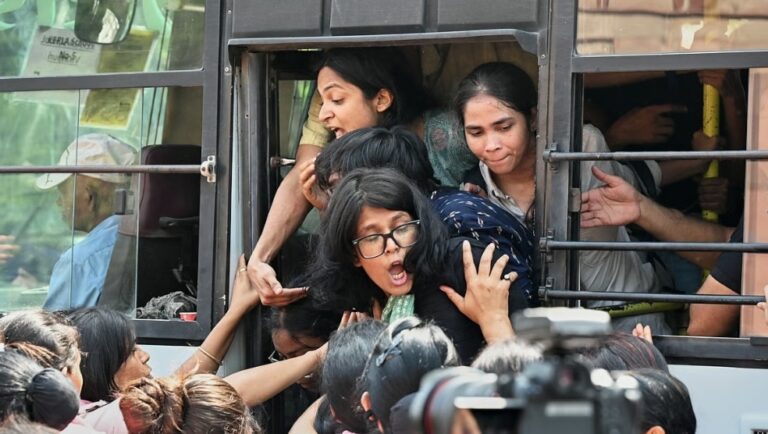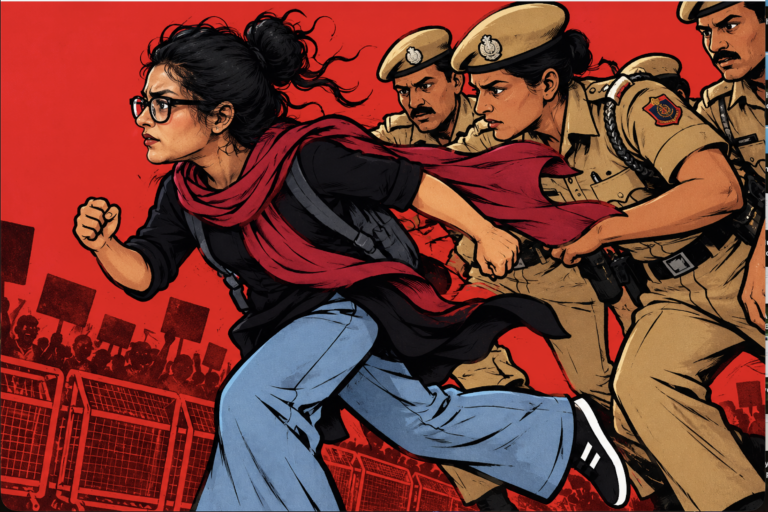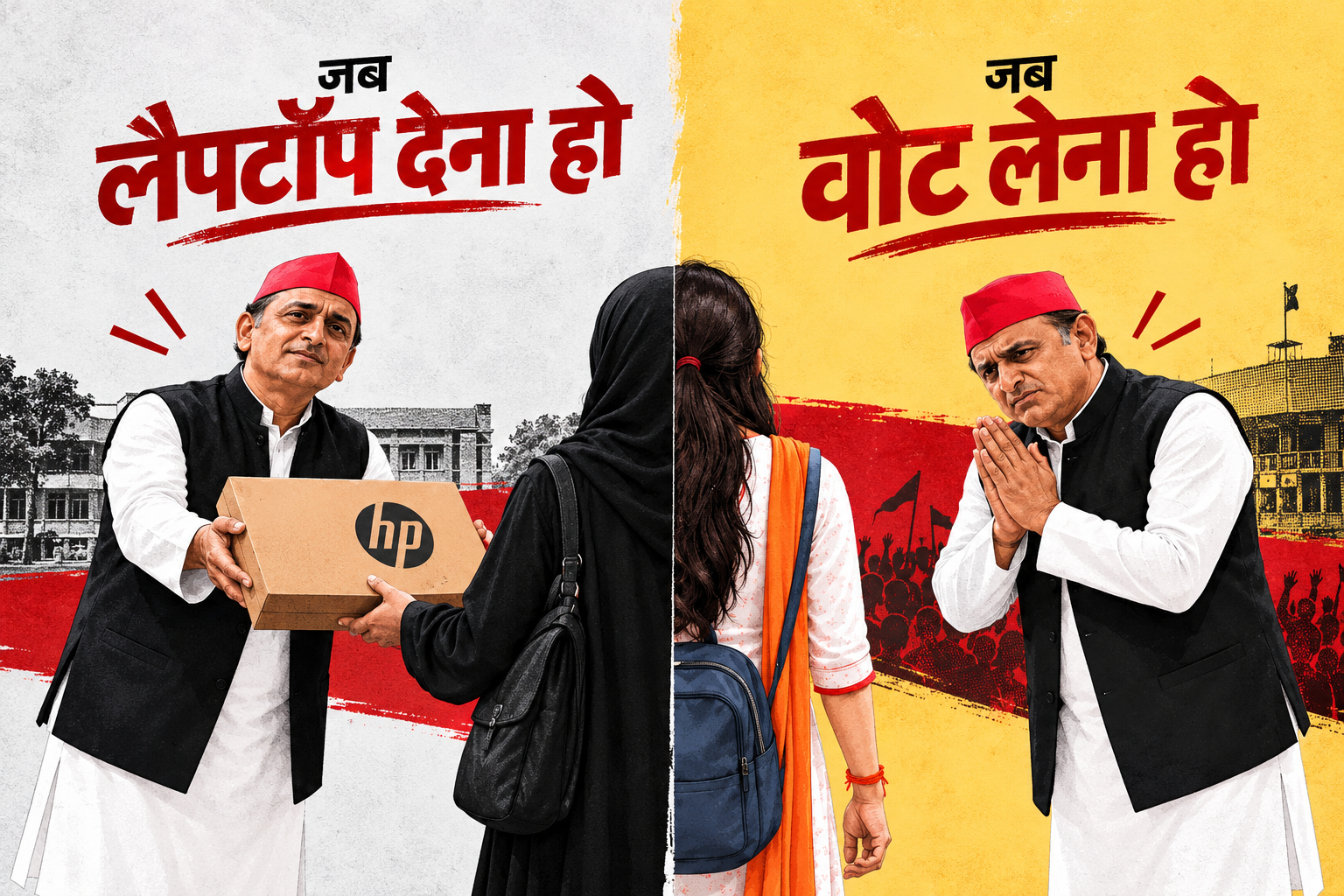
A two-panel image attributed to Uttar Pradesh BJP social media accounts has asked viewers to read a politician’s welfare record through the clothing of two young women. On the left the figure presented as Akhilesh Yadav hands a boxed HP laptop to a girl in a black burqa, under the line “When it is time to give a laptop”. On the right the same figure stands with folded hands before a girl in a white kurta and an orange dupatta, under “When it is time to take a vote”. The image appears to have been generated digitally and carries no caption, which may be deliberate, because a post that says nothing leaves viewers to supply the accusation and leaves the account with nothing to defend.
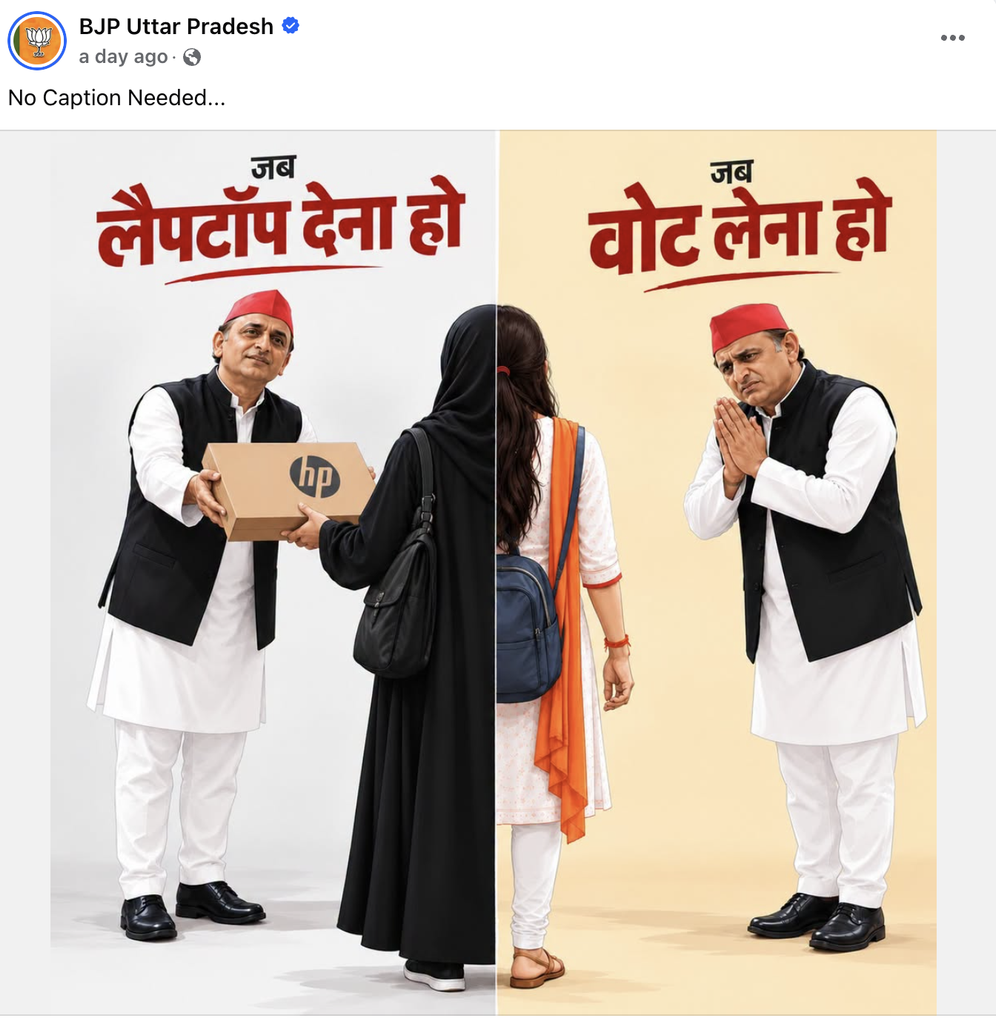
The claim packed into the frame is that benefits went to one community while another received only a politician’s supplication at election time. Nothing in the picture supports it. The laptop scheme launched by the Samajwadi Party government in 2012 was tied to examination results, and the published criteria made no mention of religion. A scheme that distributed devices by marks cannot easily become a communal ledger without somebody inventing the ledger first, and the image has done that with two costumes.
The costumes have been chosen with care. Neither girl faces the viewer, so each can stand for any daughter in any household, and the viewer must fill the gap with a community. That anonymity may also protect the poster, since no actual student can object and none appears to have consented to being used as a prop. The template itself is old in Indian politics, where the charge of appeasement has long been levelled at opposition parties, and a meme can carry that charge in a few seconds to people who would never read a speech.
The image has surfaced in a week when both halves of its message were already in circulation. In an ANI report of 15 October, a BJP leader called him “Maulana” Akhilesh Yadav and accused the Samajwadi Party of promising reservations on the basis of religion, while Uttar Pradesh minister Om Prakash Rajbhar spoke of a “laptop scam” under his government. A meme that pairs a laptop with a burqa would therefore find an audience already primed to read the scheme as a communal favour, and that may explain why it has been put out now.
An official party handle carries obligations that an anonymous meme page does not. Such accounts speak with the authority of an organisation that governs the most populous state, and their output may be read as campaign material. Section 123(3A) of the Representation of the People Act, 1951 treats the promotion of enmity between classes of citizens on grounds of religion, in service of an election campaign, as a corrupt practice, and Section 196 of the Bharatiya Nyaya Sanhita deals with promoting enmity between groups more generally. Whether this single post crosses either line would be for the Election Commission or a court to decide, but the question can fairly be put to the party.
No response from the Samajwadi Party to this image had been reported at the time of writing. The nearest reaction from the party concerned a different set of posters in Lucknow, which had drawn Akhilesh Yadav, Rahul Gandhi and Elon Musk as the heads of Ravana. Samajwadi Party MP Awadhesh Prasad said the BJP was worried about Akhilesh’s growing popularity ahead of the 2027 elections, and his remark may indicate the line the SP leadership would take, although it cannot be treated as a reply to the laptop image.
The same logic would collapse if it were turned on the party’s own record. The free tablet and smartphone scheme announced ahead of the 2022 election would look absurd if drawn as a chief minister handing a device to a Hindu girl while a Muslim girl waited outside the frame. Students in Uttar Pradesh who received laptops came from every faith and caste, and many of them will remember the queue and the marksheet far better than any politician’s hands.