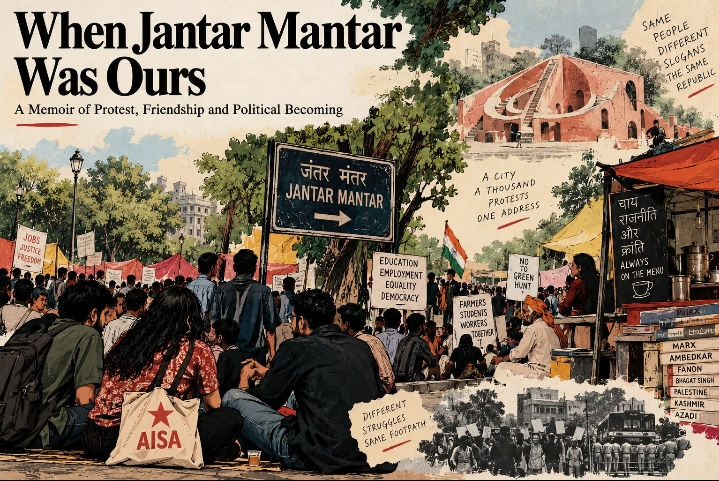
When Jantar Mantar Was Ours
A Memoir of Protest, Friendship and Political Becoming
My encounter with Jantar Mantar began when I was around twenty-one or twenty-two years old, a student at Jamia Millia Islamia and the General Secretary of the All India Students’ Association (AISA) at Jamia. I was young enough to believe that the world could be changed by the sheer force of conviction, and old enough to have discovered that the world rarely changed without a fight. In those days, Jantar Mantar was almost a second campus for us.
How Jantar Mantar Became a Protest Site
Jantar Mantar was not always the capital’s principal address for dissent. For decades after Independence, protesters gathered at the Boat Club lawns, close to Parliament and the central government’s offices. The lawns became a powerful symbol of public mobilisation, not least during the farmers’ agitation led by Mahendra Singh Tikait in October 1988, when hundreds of thousands of farmers converged on central Delhi. The scale of that demonstration, and the political pressure it generated, became part of the argument over who could occupy the capital’s most visible public spaces.
In 1993, as restrictions were imposed on gatherings at the Boat Club, Jantar Mantar emerged as the principal designated location for demonstrations. It was close enough to Parliament and government offices to give protesters visibility, but its narrower stretch of road made gatherings easier for the authorities to contain. There was no single founding declaration that transformed it into a protest site. Instead, years of demonstrations, hunger strikes and sit-ins gradually gave the place its political identity. For many activists, the move from the Boat Club lawns to Jantar Mantar also meant being shifted away from a larger and more prominent public space into a more confined one.
Its status was never entirely secure. In October 2017, the National Green Tribunal ordered a halt to protests at Jantar Mantar, citing concerns including noise, waste and the residential character of the area. The order was challenged, and in July 2018 the Supreme Court rejected a blanket prohibition on peaceful protests at Jantar Mantar and the Boat Club area, while allowing reasonable regulation of demonstrations. The judgment captured a tension that has followed the site for years: how to manage public order without making the right to assemble ineffective.
That tension has returned in a new form. In October 2026, Delhi Police removed Jantar Mantar from its list of designated protest sites and named Ramlila Ground, Burari Ground and CBD Ground as alternatives. The change has renewed questions about the distance between a protest and the institutions it seeks to address. For people who have little access to ministers, officials or national newsrooms, location is not a minor logistical detail. It can determine whether a grievance is visible at all. This history is part of what makes Jantar Mantar more than a familiar stretch of pavement: it has become a contested space in which the right to dissent is repeatedly negotiated.
My Second Campus
We would travel from Jamia to central Delhi at least twice a week, carrying placards, pamphlets, slogans and the kind of political certainty that belongs to youth. We went there to protest against what we called the neoliberal policies of the Congress government, against Operation Salwa Judum in Chhattisgarh, against P. Chidambaram’s counter-insurgency campaign known as Operation Green Hunt, and against a variety of injustices that seemed to multiply faster than we could organise ourselves to oppose them. We were not always successful, and we were certainly not always heard, but we went because the act of showing up had become inseparable from our understanding of politics.
Jamia had given us the vocabulary with which to understand the world, but Jantar Mantar taught us what that vocabulary meant when it encountered the world outside a classroom. At Jamia, we discussed capitalism, imperialism, state violence, communalism and the contradictions of Indian democracy. We read Marx, debated revolutionary movements, argued over the nature of the Indian state and tried to understand the relationship between class, caste, religion and power.
At Jantar Mantar, these abstractions arrived in the form of people who had lost their homes, workers who had not been paid, farmers who had been pushed into debt, women who had spent years demanding pensions, and families who had exhausted every official channel available to them. They did not always speak the language of political theory, but they understood power with an intimacy that no book could have given us. Their lives were the evidence behind the arguments we made in our meetings, and their persistence was a reminder that politics was not merely something to be discussed. It was something people were forced to practise every day in order to survive.
I remember the journey from Jamia as much as I remember the destination. There was a particular excitement in assembling a group of friends, arranging transport, checking whether the banners had been packed and wondering how many people would turn up. Sometimes the numbers were disappointing, and sometimes we arrived at Jantar Mantar to find ourselves among a handful of protesters facing a much larger police contingent.
Yet the smallness of our gatherings rarely discouraged us for long. We had the conviction that even a small protest could disturb the comfortable silence surrounding an injustice. We also had the uncomplicated vanity of young activists who wanted to believe that they were on the right side of history. We could be argumentative, self-righteous and occasionally insufferable, especially to those who did not share our politics.
Our friends called us jholawalas, sometimes affectionately and sometimes with genuine irritation. We had acquired the habit of turning almost every conversation into a discussion about the state, the ruling class or the latest political crisis. Even a casual meeting over tea could end in a heated argument about the revolution and the many reasons it had not yet arrived.
I remember one such afternoon when we had gathered around a tea stall after a protest that had attracted fewer people than we had expected. Someone complained that the movement was going nowhere, another blamed the weakness of our organisation, and a third began explaining why the problem was actually the absence of class consciousness among the masses. The tea had gone cold by the time we finished diagnosing the political condition of the country.
The tea seller, who had been listening to us without any visible interest, eventually asked whether we wanted another round. We ordered more tea, paid for it reluctantly and continued our argument. I cannot remember what the original disagreement was about, but I can imagine that the tea seller had heard the same discussion many times before. Perhaps he knew better than any of us that the revolution could take a while.
Over time, Jantar Mantar became familiar in the way that places become familiar when we return to them repeatedly during the formative years of our lives. We began to recognise the tea stalls, the faces of fellow protesters, the policemen who appeared at particular demonstrations and the people who seemed to have made the pavement their permanent political address.
There were those who came for a day, delivered their speeches and left, and there were those who returned week after week, year after year, carrying the same demands and the same battered files. Some had been protesting for so long that the original cause had become almost inseparable from their identity. They had learned to read the mood of the police, the temperament of the government and the indifference of the media.
They knew that a demonstration might attract cameras for an afternoon and disappear from public memory by the following morning. They also knew that the absence of cameras did not make their demands any less urgent.
The People Who Taught Me Politics
One of my enduring memories is of an elderly Muslim woman, around seventy-two years old, who had spent a substantial part of her life fighting for her pension. I remember being struck by the exhaustion in her words and, at the same time, by the stubbornness with which she continued to return to the streets. She explained that nearly half her life had gone into demanding what was rightfully hers.
I had arrived at Jantar Mantar with the impatience of someone who wanted the political system to be transformed, and here was a woman who had been fighting simply to obtain the money she needed to live with some measure of security. Her struggle seemed almost unbearably ordinary beside the grand language of revolution that we used so freely.
Yet she understood something that we were still learning: a pension was not merely money deposited into a bank account. It was recognition, independence and dignity. It was the difference between having to ask someone for every small necessity and being able to make decisions about one’s own life.
I often think about her when I remember those years, because she brought me closer to the meaning of politics than many of the speeches I heard from the stage. I sometimes imagine her returning to the same stretch of pavement years later, carrying the same file, perhaps with a few more papers tucked inside it. The faces around her would have changed, the slogans would have acquired new targets, and the government might have changed too. Her file, however, would still have been there, holding the history of a struggle that had outlived several political seasons.
Mentors, Poets and the Education of Dissent
Jantar Mantar was also where I encountered people who would become mentors, influences and, in some cases, friends whose memories I continue to carry. Mukulk Dubey, a chronicler of protests, belonged to that world of people who seemed to possess an extraordinary memory for movements, faces and political moments. He understood that a protest was never merely an event confined to a particular date. It belonged to a longer history of resistance, and the task of documenting it was itself a form of political work.
There were others whose presence gave the place an intellectual and moral depth that was not always visible to the casual observer. Swami Agnivesh was among those figures whose commitment to public causes brought him repeatedly into the orbit of protest politics. His appearance could command attention, but it was also a reminder that the people who gathered at Jantar Mantar came from different ideological traditions, religious backgrounds and experiences of political struggle.
We did not always agree with one another, and agreement was never a prerequisite for occupying the same space. That, perhaps, was one of the things I valued most about the place. People arrived with different understandings of justice, different political vocabularies and different ideas about how the country should be changed. Sometimes they argued bitterly, but they were still there, occupying a shared space in which disagreement was possible.
Then there was Kavi Vidrohi, whose poetry left a particularly lasting impression on me. He had a way of making language feel dangerous, as though a poem could unsettle the arrangements through which society made injustice appear natural. His poems about women, God and the established order stayed with me long after the demonstrations ended.
I did not agree with everything he said, and I doubt that he would have expected everyone who listened to him to do so. But disagreement was part of the education Jantar Mantar offered. It was a place where people encountered ideas that did not fit neatly into their existing beliefs, where a conversation could continue long after the crowd had dispersed and where a poem might provoke questions that a political speech could not answer.
Vidrohi reminded me that resistance did not always have to speak in the language of resolutions and slogans. Sometimes it could emerge from a strange, unsettling line of poetry that refused to leave you alone. I can imagine a small gathering around him after a demonstration, a few people sitting on the pavement while others stood nearby, waiting for him to finish speaking. Someone would inevitably disagree with him, and the argument would continue long after the original audience had begun to drift away.
That was the peculiar generosity of Jantar Mantar. You could arrive with a placard and leave with a question that had nothing to do with the slogan you had carried.
The Small Pleasures of Political Life
The place had its own small economy of survival, and I remember it with the affection one reserves for the unremarkable details that eventually become the substance of nostalgia. There were tea stalls where activists gathered to discuss the demonstration after the microphones had been switched off, inexpensive eateries where we could sit for a long time without being forced to order much, and a South Indian dosa counter that offered a welcome break from the otherwise austere routine of political activism.
There was also a second-hand clothes market, where one could search through piles of jackets, shirts and trousers and occasionally discover something that seemed to have been waiting for you. I once bought a jacket there, only to have a friend tell me that it looked like something Che Guevara might have worn.
I cannot remember whether the comparison was meant as a compliment or a joke, but I remember being sufficiently pleased with the jacket to keep wearing it. Eventually, I gifted it to Sandeep Singh, who was then the president of AISA. Perhaps the jacket was never particularly revolutionary, but in my memory it belongs to a time when even an inexpensive piece of clothing could acquire a political meaning simply because of the people who wore it and the places where they were seen.
The second-hand market had its own small theatre of bargaining. I imagine us standing before a heap of clothes, turning jackets inside out, inspecting their pockets and trying to negotiate a price that was already beyond our limited budgets. Someone would inevitably claim that a particular shirt had the unmistakable look of a revolutionary, while another would argue that no genuine revolutionary should care so much about his appearance.
We were young enough to take both positions seriously. We could spend an afternoon arguing about the politics of global capitalism and then devote another twenty minutes to deciding whether a jacket made us look sufficiently intellectual. Looking back, the contradiction seems less absurd than it once might have. We were trying to build political identities with whatever we had available, including cheap clothes, borrowed books and the opinions of our friends.
Jantar Mantar was also an affordable place to spend time with friends, and that mattered more than we perhaps acknowledged at the time. We met there to discuss politics, to plan demonstrations and sometimes simply to sit together because none of us had anywhere else we wanted to be. There were occasions when I arranged to meet someone for a date, although the distinction between a personal meeting and a political conversation was often difficult to maintain.
It was hard to spend an evening with a person without eventually discussing the government, a protest or some injustice that had made its way into the news. Our idea of romance was probably shaped by the same habits that shaped our politics: long conversations, arguments over ideology and the belief that a person’s understanding of the world revealed something essential about who they were.
I can still imagine the awkwardness of arriving for a meeting with the intention of having an ordinary conversation, only to find a protest unfolding nearby. One person would be trying to explain something personal while the other kept glancing towards a gathering where slogans were being raised. Eventually, the conversation would turn towards the demonstration, and the original purpose of the meeting would quietly disappear beneath an argument about politics.
Jantar Mantar offered us a place where we could talk without worrying too much about the bill, where a cup of tea could sustain an afternoon and where the city seemed, for a few hours, to belong to those who had very little money but an abundance of things to say.
Bruises, Detentions and Student Solidarity
Not every memory of the place is tender. Some are marked by fear, anger and the humiliation of discovering how quickly the language of democratic rights could give way to the physical power of the state. I remember an early protest with a Kashmiri friend against the death penalty for Afzal Guru. Our opposition to capital punishment was rooted in a broader belief that the state should not possess the power to take a human life as punishment.
The protest did not remain peaceful for long. A group of right-wing demonstrators, who had gathered around an event associated with Rajnath Singh, turned hostile towards us, and we found ourselves being chased away. The experience left me with a lasting impression of the unevenness of public space.
We were all citizens, theoretically entitled to express our views, yet the ability to exercise that right could depend on how many people stood behind you, which political cause you represented and whether the police considered your presence inconvenient. It was an early lesson in how the idea of free speech could be celebrated in principle and contested violently in practice.
I remember the peculiar feeling of looking over my shoulder as we moved away from the confrontation, trying to appear less frightened than I actually was. My friend and I were angry, but we were also conscious of how vulnerable two young men could be when a gathering turned hostile. We had arrived believing that our position was morally defensible and that the right to express it should be enough to protect us. We left with a more complicated understanding of what those rights meant on the ground.
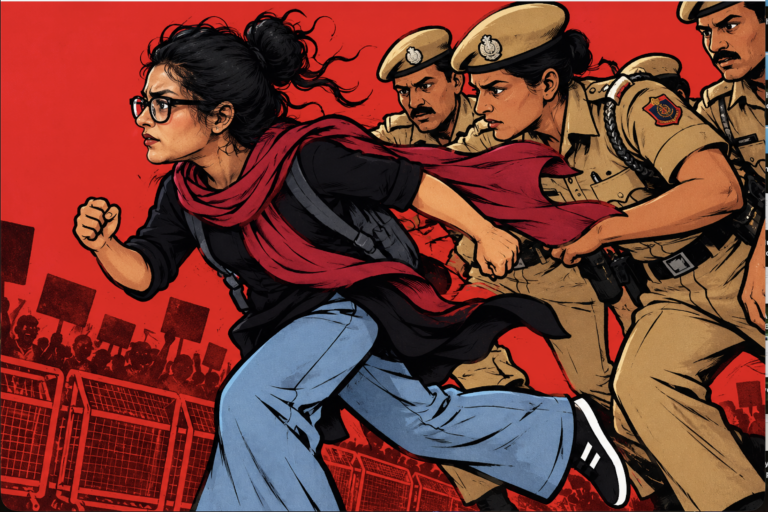
There were other demonstrations where the police charged at protesters who attempted to cross barricades. I remember the suddenness with which a gathering could turn chaotic, the confusion of people trying to work out which way to move, the sound of shouted instructions and the sight of friends trying to pull one another out of the crush. We sometimes returned to college with bruises, aching arms or stories of being pushed and beaten, and our friends would tease us about our latest adventures.
There was a peculiar bravado attached to these experiences. We wanted to believe that we had been punished because we had challenged power, and sometimes that was indeed the case. But there was also a tendency among young activists to turn suffering into a badge of honour, as though the number of times one had been lathi-charged or detained could serve as a measure of political commitment.
Looking back, I can see both the sincerity and the vanity in that attitude. We were learning to confront authority, but we were also learning how easily a political identity could become something one performed for one’s friends.
I can imagine returning to Jamia after one particularly exhausting demonstration, trying to hide a bruise beneath my sleeve while a friend demanded to know how many barricades I had attempted to cross. The questions would be half serious and half teasing. Someone would recount the incident with increasingly dramatic details, another would accuse him of exaggerating, and eventually the conversation would turn into a competition over who had been the bravest.
The laughter helped us put the experience behind us, but it also made it easier to overlook the fear that had accompanied it. We were young, and we had not yet learned that courage did not require us to pretend that nothing frightened us.
I was detained several times, and those experiences became part of the informal mythology of our student politics. The first detention I remember clearly was during a protest outside the Australian High Commission against racial attacks on students of Indian origin in Australia. We were taken away in a police bus, and the journey into detention quickly acquired the atmosphere of an impromptu gathering.
We sang revolutionary songs, argued, joked and tried to make the best of a situation over which we had little control. The bus became a temporary extension of the protest, a space where the police could confine our bodies but could not entirely determine what we did with our voices. There was something absurd about singing songs of freedom while being transported under police custody, and perhaps that absurdity made the experience memorable.
At the time, detention could feel almost like a rite of passage. We returned to campus with stories to tell, and the stories became part of the shared culture through which we recognised one another as activists.
I imagine someone on that bus beginning a revolutionary song in a voice that was slightly too loud, only to lose the rhythm when another protester started singing a different one. For a few moments, we would be arguing about which song deserved to be sung first, as though the order of the songs mattered more than the fact that we were sitting in a police vehicle.
Eventually, we would find a common tune. Someone would tap the seat in front of him to keep time, and a few of us would join in. It was a small, improvised act of defiance, but it also reflected the ridiculousness of our youth. We had been detained, and we were still trying to organise the proceedings.
We had even created our own version of Lal Chowk at Jamia, a familiar meeting point where we gathered to plan demonstrations, exchange information and decide which cause required our attention next. It was never an official headquarters, and it had none of the grandeur suggested by the name, but it served a similar purpose in our small political universe.
News travelled through conversations, rumours, telephone calls and messages passed between friends. We debated the wording of slogans, argued over organisational decisions and tried to persuade one another that the next demonstration would be larger, more effective or more consequential than the last.
We were constantly negotiating the relationship between the immediate demands of a protest and the larger ideological questions that divided political groups. We disagreed about strategy, about alliances and about the compromises that activism might require. Yet there was a shared sense that we were participating in something larger than ourselves, even when the crowd was small and the outcome uncertain.
Those meetings had a rhythm of their own. Someone would arrive with an urgent update, another would insist that the information was incomplete, and a third would announce that he had already spoken to someone who knew what was really happening. Plans were made, revised and occasionally abandoned before anyone had even left the campus.
I sometimes wonder how much of our political history was held together by such conversations, how many demonstrations began with a hurried meeting among students who had more conviction than resources. We had little money, limited influence and an imperfect understanding of the country we hoped to change. But we had a place to meet, and for a while that was enough.
As the Muzaffarnagar riots unfolded and the country moved towards the 2014 general election, the mood around us began to change. The communal violence in western Uttar Pradesh had exposed the vulnerability of ordinary people to political mobilisation built around religious identity, while the national political conversation increasingly revolved around Narendra Modi and the possibility of a decisive shift in power.
We watched the campaign gather momentum with a mixture of alarm, disbelief and helplessness. Our meetings and protests were animated by the feeling that an outcome we feared was becoming increasingly difficult to prevent. We went to Jantar Mantar because we wanted to resist the political direction in which the country appeared to be moving, but we were also confronting the limits of our own influence.
The crowds we could assemble were not necessarily the crowds that would decide the election. The language we spoke with conviction did not always travel beyond the circles in which we spoke it. There were moments when the gap between our political imagination and the political mood of the country felt almost impossible to bridge.
I remember the unease of conversations in which we tried to work out what the coming election would mean for the country. We would discuss speeches, campaign strategies and the growing appeal of a politics that seemed to promise a decisive break with the past. Each of us had a theory about what was happening, and each theory carried the reassuring implication that we had understood something the rest of the country had missed.
Yet there was a growing sense that our certainty was not enough. We could organise meetings, distribute pamphlets and make our arguments to anyone willing to listen, but we could not control the political imagination of millions of people. The realisation was painful because it forced us to confront the possibility that history was moving in a direction we had spent years trying to prevent.
The Street and the Newsroom
When the 2014 election arrived, I was already beginning to move away from student politics and towards journalism. The transition was not as clean as it might sound in retrospect. I did not suddenly abandon one world and enter another. The instincts that had taken me to demonstrations continued to shape the stories I wanted to report, and the people I met at Jantar Mantar remained among the most important sources of my understanding of public life.
What changed was my position in relation to the events. I was no longer primarily responsible for organising a protest or preparing a speech. I was learning how to observe, ask questions, verify claims and explain to readers why an event mattered. Journalism offered a different way of engaging with the world, although I was not yet fully aware of the tensions that would emerge between my own political commitments and the demands of the profession.
My first journalistic association with a hyperlocal portal at Zee Media involved covering Delhi and its many local concerns. Jantar Mantar soon became a familiar reporting destination, and I sometimes felt that I had simply exchanged one identity for another without changing the place where I spent my time.
I had arrived there as a student activist carrying a placard, and now I returned with a notebook, a recorder and questions for people who were often still standing where I had left them. I met students, farmers, workers, trade unionists and families whose struggles had continued long after the headlines that had briefly brought them public attention. Many of them had become familiar faces, and some remembered me from my activist days.
The difference was that I now had to listen carefully, establish what had happened and make their stories intelligible to people who might never visit the place. I was learning that journalism required a kind of discipline that activism did not always encourage. It was possible to sympathise with a person’s cause and still have to ask difficult questions about the facts, the claims and the people speaking on their behalf.
Sometimes I would recognise someone in a crowd before I could remember where we had first met. We would exchange greetings, and one of us would make a joke about the change in my appearance or occupation. The person who had once seen me carrying a banner would now find me asking for a quote, while I would be trying to remember the details of a conversation we had had years earlier.
There was an intimacy in these encounters that made reporting at Jantar Mantar different from covering an unfamiliar event. I knew something about the lives of the people I was interviewing, even when I did not know their complete stories. I understood the patience required to remain at a protest long after the cameras had left, because I had once done the same thing myself.
In some ways, the transition was liberating. Reporting allowed me to encounter people and movements beyond the ideological boundaries of my student politics. I began to understand that the world was more complicated than the categories through which we had learned to interpret it, and that even people who shared a cause could disagree sharply about its meaning or the means by which it should be pursued.
But journalism also brought its own frustrations. I joined Tehelka and continued to cover protests, finding myself drawn to the stories that unfolded at the margins of official politics. As my career progressed and I moved into larger corporate media organisations, however, I began to notice that Jantar Mantar did not command the same attention from editorial desks that it once commanded from my student activist self.
The demonstrations were often treated as small events unless they produced dramatic images, involved prominent political figures or threatened to disrupt the normal functioning of the capital. The long, slow struggles of ordinary people rarely fitted the rhythm of a newsroom that wanted a clear headline and an immediate consequence.
I gradually visited Jantar Mantar less often, although I never entirely stopped thinking of it as a place to which I belonged. The newsroom had introduced me to another kind of barricade, one that was less visible but could be just as effective.
There were stories I wanted to pursue that struggled to find space, people whose grievances appeared too familiar to merit sustained attention and movements whose importance was difficult to explain within the narrow boundaries of a daily news cycle. The distance between the journalist I wanted to be and the journalist the industry often required me to be became another part of my education.
I had once believed that journalism would allow me to carry the concerns of the street into the public sphere. I learned that the public sphere had its own hierarchies, and that not every story was considered equally worthy of being heard. Sometimes the protest was happening outside the newsroom, and sometimes the struggle was over whether the newsroom would pay attention to it at all.
I can imagine sitting at a newsroom desk late in the evening, watching a story from Jantar Mantar compete with the day’s political headlines. A reporter’s voice would come through the telephone, describing a group of people who had travelled a considerable distance to demand something that had been denied to them for years. I would know why their story mattered, but I would also know how difficult it might be to persuade an editor that it deserved space.
Perhaps this is one of the quiet ironies of becoming a journalist after being an activist. You spend your youth trying to get people to notice an injustice, and then you spend part of your professional life trying to persuade an institution to recognise that the injustice is newsworthy.
The protests around the demolition of the Babri Masjid and its continuing political consequences formed another part of the landscape I encountered through my reporting. For many people, the demolition had not remained a historical event that could be confined to a date in a textbook. It had altered their understanding of Indian politics, citizenship and the relationship between the state and religious minorities.
At Jantar Mantar, I met people whose faith in the political system had weakened over the years, people who had watched promises of justice recede into the distance and who continued to protest because they could not imagine another way to register their grievances. Their presence reminded me that the history of a place is often inseparable from the unfinished history of the people who return to it.
Jantar Mantar accumulated these histories without resolving them. One group would leave after a demonstration, another would arrive with a different demand, and the pavement would continue to hold the memory of arguments that the country had never fully settled.
Mass Movements and the Limits of Protest
The Anna Hazare movement of 2011 had introduced a different kind of political energy into the public imagination. I watched the movement from a distance, with interest but also with reservations about the political assumptions underlying its appeal. The demand for action against corruption had enormous resonance, and the crowds revealed how deeply people had grown frustrated with the political establishment.
Yet I was uneasy about the tendency to present complicated democratic problems as though they could be solved by the moral authority of a single movement or the creation of a powerful institutional mechanism. I was also conscious of the different political traditions being brought together under the broad language of anti-corruption.
Nevertheless, the movement demonstrated the capacity of public protest to occupy the national conversation and compel political leaders to respond. It showed that a gathering in central Delhi could become a spectacle watched across the country, although it also raised questions about who was represented in such moments of collective anger and whose grievances continued to remain outside the frame.
I remember watching the images of crowds and trying to understand the extraordinary emotional force that had gathered around the movement. There was something compelling about seeing so many people believe that their collective presence could compel the political establishment to act. At the same time, I wondered whether the excitement of a mass mobilisation could conceal the difficult work required to sustain democratic accountability once the crowds dispersed.
The question stayed with me because I had seen smaller protests continue long after their causes had disappeared from public attention. The people at Jantar Mantar rarely had the luxury of believing that one large gathering could resolve their problems. For them, the struggle often continued after the cameras had gone home.
The Nirbhaya protests in December 2012 brought another kind of anger into the streets of Delhi. The brutal sexual assault of a young woman had shaken the city and generated an extraordinary public response. People who had never considered themselves activists joined demonstrations, and the boundaries between political organisations, students, ordinary citizens and spontaneous crowds became less distinct.
The protests spread across central Delhi, including the areas around India Gate and the wider protest landscape in which Jantar Mantar had acquired its place. I remember the intensity of those days, the sense that something fundamental had been exposed about the city and the country, and the feeling that the ordinary language of public life was inadequate to describe the scale of the outrage.
During one protest, I was caught in a crush that nearly broke my hand. Even now, the memory brings back the physical vulnerability of being part of a crowd whose movements could change in an instant. The demonstrations made visible the anger of people who had been told for too long that violence against women was an unfortunate fact of life.
They also showed that the state could be forced to confront a public demand that it might otherwise have preferred to contain or ignore. I remember the crowds as a mixture of grief, fury and bewilderment, with people who had never stood together politically finding themselves shoulder to shoulder in the streets.
There were moments when the anger seemed to travel faster than anyone could organise it. People arrived carrying candles, handwritten signs and expressions of disbelief. Others came simply because they could no longer bear to remain at home. The city felt unfamiliar in those days, as though a terrible crime had forced people to look directly at the violence and indifference they had learned to live around.
What stays with me about that period is the difference between the possibilities of protest then and the restrictions that have increasingly come to define public assembly in Delhi. There were confrontations, barricades, detentions and police violence, and it would be wrong to romanticise the freedom available to demonstrators.
Yet there was still a sense that the streets could be claimed by people who wished to challenge the government, that an assembly could grow beyond the expectations of the authorities and that a protest might force its way into the national conversation. The right to dissent was never guaranteed, but its exercise remained visible enough to remind the country that democracy depended on more than the act of voting.
Public protest was one of the ways in which people without access to power could make themselves heard, even if the response was indifference, hostility or repression.
A Changing Geography of Dissent
Over the years, I have come to think of Jantar Mantar as a place where the many contradictions of Indian democracy have been staged in miniature. It is located in the heart of the capital, within reach of Parliament, government offices and the institutions that shape public life, yet the people who assemble there often struggle to get even a brief hearing from those institutions.
The observatory from which the place takes its name was built to study the movements of celestial bodies, to measure time and understand the heavens. Centuries later, the same urban landscape became associated with people trying to make sense of the political world below. The comparison may be sentimental, but I have often wondered whether there is something fitting about it.
The people who come to Jantar Mantar arrive with their own measurements of time, their own calendars of suffering and their own calculations of how long they can wait for justice. Some have been waiting for weeks, others for years, and some for so long that the waiting itself has become the defining feature of their lives.
I sometimes imagine a protester arriving early in the morning, before the television crews and the police vans have fully settled into place. He puts his bag down, removes a folded placard and begins arranging his papers on the pavement. The city is still waking up around him, and for a little while he has the place almost to himself.
By the afternoon, he will be surrounded by noise, arguments, cameras and people who have come to make demands of the state. By evening, the crowd will have thinned, the placard will be folded again and he will begin the journey home. Tomorrow, or next week, he may return to do the same thing. The routine might seem uneventful to someone passing through, but it contains a kind of determination that is difficult to measure from the outside.
Returning to Jantar Mantar
In recent years, I found myself returning to Jantar Mantar through my reporting on the Cockroach Janta Party, whose protests and subsequent encounters with the police brought the place back into my immediate field of vision. It was a strange experience to return to a space that had been so central to my youth and find myself observing it through the eyes of a journalist once again.
The names, the demands and the political language had changed, but the underlying questions were familiar. Who had the right to occupy public space? What happened when the state decided that a protest had become inconvenient? How far could the police go in controlling a demonstration before the right to dissent became little more than a promise on paper?
The arrests of CJP leaders, including Saurav Das and Ashutosh Ranka, and the events surrounding the attempts to protest at Jantar Mantar brought these questions into sharp focus.