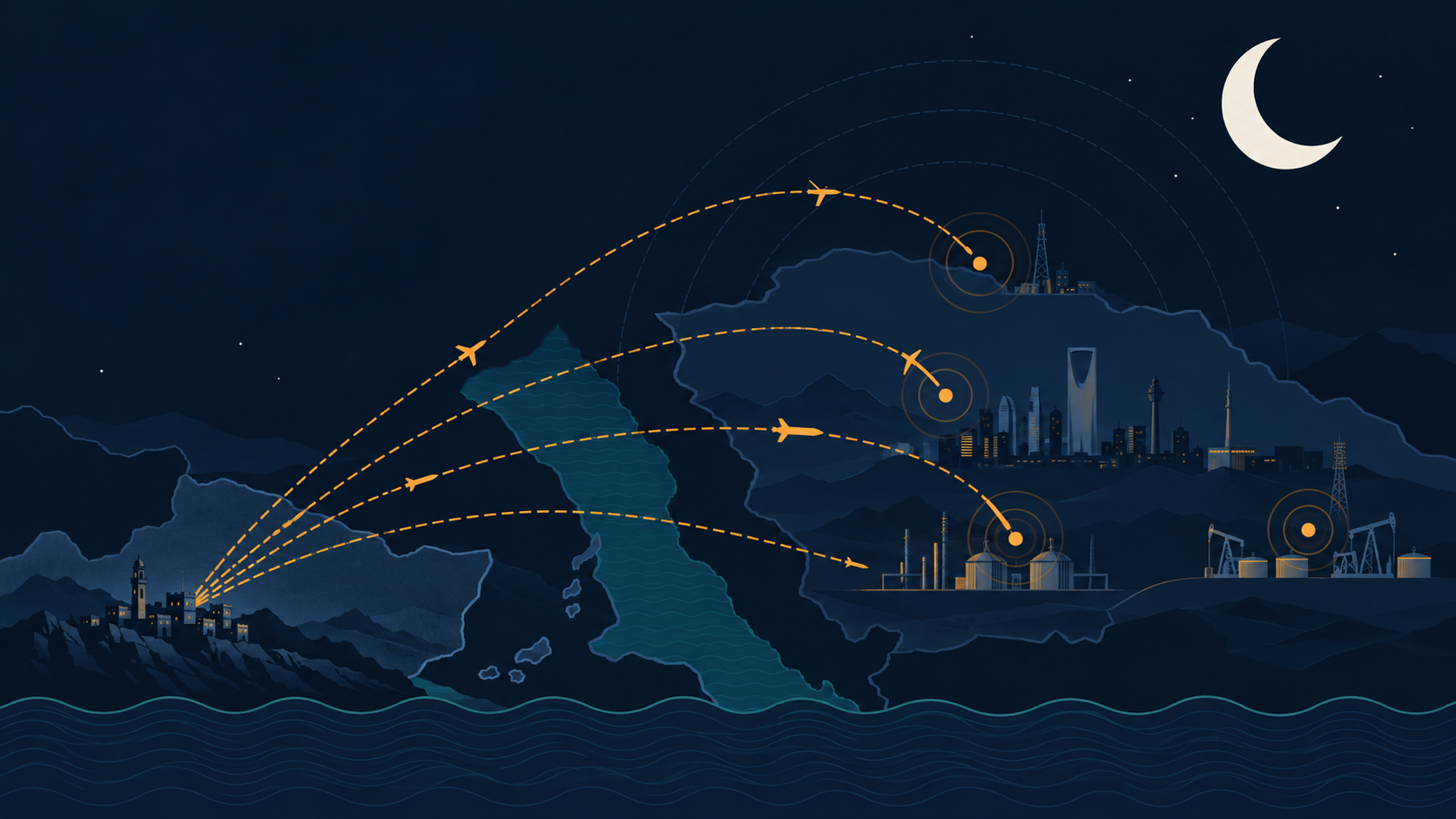
An attack hit King Khalid International Airport, roughly 22 miles north of Riyadh, on Saturday 10 October, leaving 13 people dead and more than 300 wounded according to Al Jazeera. Saudi aviation authorities gave a slightly lower count of 12 deaths against 309 injuries. A second strike on Sunday killed one person while injuring nearly a dozen others, and the Houthis also claimed an attack on Dammam, the industrial port city on the Gulf coast. Riyadh’s airport has now been struck four times in five days, with a pilot among the dead on 8 October. Three southern airports, Abha, Jazan and Najran, had been hit earlier in the week, leaving two dead at the first. The Guardian places these strikes within a campaign of recent weeks that has also reached oil facilities and tankers, including a refinery south of Riyadh that was seen smoking after a suspected attack on 3 October.
The Houthis have held Sanaa and parts of the north-west since 2014, and a United Nations brokered ceasefire that had largely held since 2022 has now collapsed. They stayed out of the war that the United States and Israel launched against Iran earlier this year. Last month their fighters seized key territory along the Red Sea coast, which the Guardian says gave them virtual control of the Bab al-Mandab strait. The Observer Research Foundation dates the fall of Mocha to 10 September, although Al Jazeera still reports battles around that city and nearby Dhubab. Yemeni government forces with local allies launched a major counteroffensive last week to drive the Houthis back. Saudi Arabia supports that government, which has made the kingdom the most visible target within their reach.
Houthi statements carried by the al-Masirah television channel have framed the attacks as reciprocity for Saudi strikes on territory the group controls, among them a raid on a Sanaa factory on 9 October. The same statements have promised worse unless Riyadh ends its interference in Yemen. Hisham al-Omeisy of the European Institute of Peace has argued that airport strikes draw a strong public response, which could encourage attacks on oil pipelines and energy facilities. He told Al Jazeera that the group would do whatever it took to extract more concessions from the Saudis. Farea al-Muslimi of Chatham House has said the Houthis have been underestimated for years and now feel confident of repositioning themselves within the region, although he has warned that any sense of control over the escalation may be an “illusion”.
Iran has long supported the Houthis as part of its axis of resistance, so control of the Red Sea gives Tehran added leverage over global oil and gas supplies at a time of American pressure, in the Guardian’s reading. Al Jazeera reported that Iran’s foreign minister urged Saudi Arabia to pursue diplomacy in a call with his counterpart in Riyadh. Yemeni government forces have struck airports in Houthi territory too. Sanaa’s airport, the only one offering international flights to Houthi-held areas where most Yemenis live, was hit on 13 July by at least five munitions, three of which landed on its sole working runway. Houthi-run media reported further Saudi strikes in two Sanaa districts on Sunday and attacks on Hodeidah’s airport on Thursday, with no word on the damage. Yemeni representatives at the UN have claimed that Houthi delegations use these airports for flights to and from Iran, and the government says its strikes aim to stop Iranian aircraft from landing.
Saudi Arabia ranks as the world’s eighth biggest spender on weapons, but Thomas Juneau of the University of Ottawa has said the kingdom is simply too large for air defences to protect consistently, even when some missiles and drones are intercepted. Even Israel’s air defence systems failed to stop a ballistic missile that narrowly missed Ben Gurion international airport last year, and the American bombardment of 2025 showed how hard the Houthis’ much-enhanced arsenal is to destroy. Better intelligence gathering and early warning may help guard specific high-value targets, although no way of blocking every incoming missile seems likely.
The disruption has been severe. Riyadh’s airport, the second busiest in the kingdom after Jeddah, has stayed closed, with authorities extending the suspension to 17 October. Cirium recorded a single departure from 354 scheduled flights on Sunday, while more than half of all flights in the kingdom were cancelled or did not operate. Lufthansa will stay away from Riyadh until 16 October, Air France-KLM until the end of the month, and Etihad has paused its Abu Dhabi service until 19 October. Qatar Airways has also suspended services to Riyadh and Dammam, while Britain, France and Germany have told their citizens to avoid the capital. Firms in Riyadh’s financial hub asked staff to work remotely, schools received a request to teach online this week, and the Guardian reports top energy executives dropped from the schedule of a high-profile conference. Al Jazeera, however, says organisers of the World Petroleum Congress intend to proceed as planned, and the Future Investment Initiative is still scheduled for 26 to 29 October. Energy Minister Prince Abdulaziz bin Salman told delegates that the kingdom’s resilience had been tested, adding that its response would be “equally serious”. Having marketed itself for years as a secure destination for tourism, major events and investment, the kingdom now faces attacks on that very image as it prepares to host the 2032 FIFA World Cup. Violence has rarely reached Saudi soil despite decades of indirect intervention elsewhere, so a frontline that its rulers long sought to avoid has now arrived at the capital.
Neither side has signalled any readiness to stop. Saudi counterstrikes seem unlikely to end, no early close to hostilities between Iran and the United States appears in prospect, and the Houthis, though a coalition of factions, seem unified behind hardline leaders for now. Fuel prices and international inflation may climb as a result, according to the Guardian.
Mohammed Yousuf Ali died in the 10 October attack, and 11 other Indian nationals were injured, according to the embassy. Eight remain in hospital, four of them in intensive care, while three have been discharged. His funeral took place in Riyadh on 12 October with the ambassador attending. India’s Ministry of External Affairs condemned the strike on 11 October, calling violence against civilian targets unacceptable and urging an immediate end to hostilities. The embassy issued a fresh advisory on 13 October telling nationals to stay calm and vigilant, shelter indoors during aerial attacks and follow instructions from local authorities. It opened a 24×7 control room, also asking people to refrain from circulating videos or news of the events. The email listed for the community in an earlier advisory is cw.rivadh@mea.gov.in.
About 2.75 million Indian nationals lived in Saudi Arabia in February 2025, according to figures given to Parliament, with roughly 2.57 million in work and about 182,000 as family members. Almost two fifths of the country’s bank remittances in 2023-24 came from Indians in the Gulf, according to a Reserve Bank of India survey, with Saudi Arabia supplying 6.7 per cent of a $118.7 billion total. A prolonged conflict could unsettle jobs, wages and remittances, although the reports gathered so far record no such effect.
An Air India flight from Delhi to Riyadh turned back mid-air on 8 October after Houthi missiles targeted the airport, and Indian carriers halted Riyadh operations that day. Air India extended its Riyadh suspension to 15 October. Air India Express cancelled Dammam, Jeddah and Riyadh services until 17 October. Akasa Air paused its Riyadh and Jeddah flights until the same day, and IndiGo grounded flights to four Saudi cities, Madinah among them, until then. Siasat counted at least 15 airlines, four of them Indian, that had cancelled or suspended Saudi services. Air India’s suspension will lapse two days before the airport is due to reopen, so it may need extending.
India has relied on imports for close to 90 per cent of its crude, according to the Observer Research Foundation, so fighting near sea lanes can reach fuel bills directly. Brent crude touched $102 a barrel on 8 October after the Houthi advance towards Bab el-Mandeb, having peaked at $126 earlier in the Hormuz crisis. Bab el-Mandeb carries far less oil than Hormuz, roughly a fifth of its volume according to American Energy Information Administration figures quoted by a tracker site. Its importance has grown because Saudi Arabia has turned to Yanbu as an export outlet while Hormuz remains disrupted. The same tracker puts Red Sea shipping traffic about 60 per cent below levels before late 2023 and says Saudi Red Sea crude exports fell from 3.8 to 2.2 million barrels a day by 12 September. The Observer Research Foundation argues that diversifying suppliers gives limited protection, since much alternative supply still passes through or near the Red Sea. Iraqi shipments to India more than doubled in September to 4.41 million tonnes, while Russian shipments fell 32.3 per cent. Insurers have raised war-risk premiums for Saudi-linked tankers at Yanbu to about three per cent of vessel value from below one in early July, against six to nine for Hormuz transits. One tracker site, citing Business Today, says India supplied about 60 per cent of the diesel moving through Bab el-Mandeb to Europe in August, roughly 200,000 barrels a day, which gives its refiners a direct stake in an open Red Sea.
No evacuation plan has been reported so far. The reopening of Riyadh’s airport on 17 October, any extension of airline suspensions and a possible Houthi turn towards pipelines will probably decide how far the effects reach Indian travellers, workers and fuel buyers.