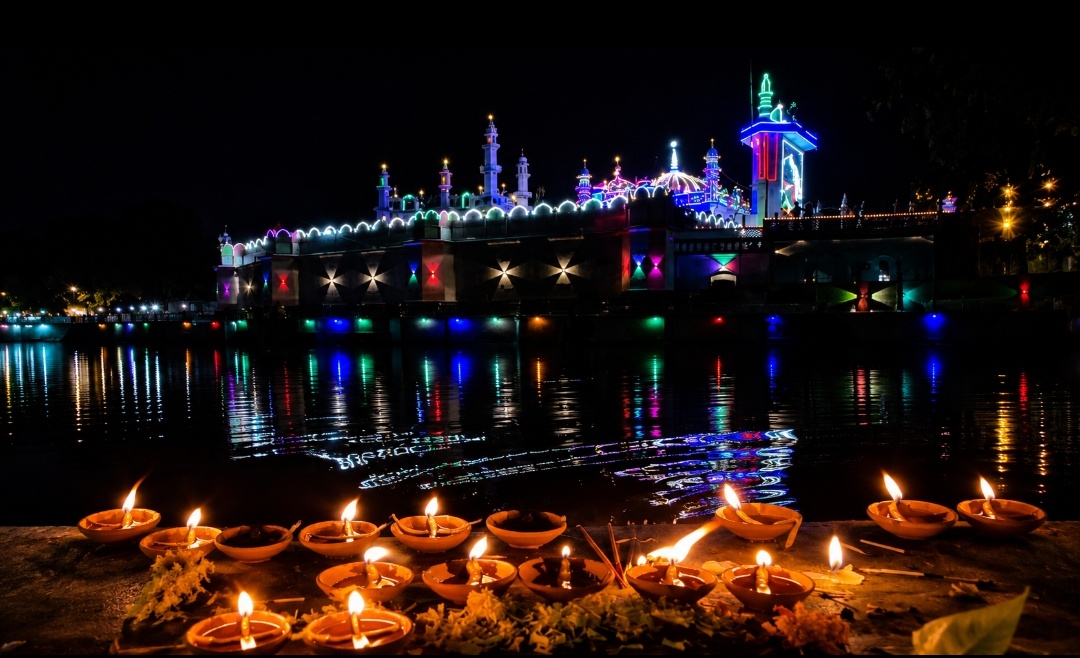
As the sun sets on Badi Diwali, non-Muslim zayireen (devotees) gather at the centuries-old Dargah of Hazrat Syed Makhdoom Ashraf Jahangir Semnani in Kichaucha Sharif, in Uttar Pradesh’s Ambedkar Nagar district. With diyas and agarbattis in hand, they come together around the tomb and the adjoining pond called Neer Sharif to light the first lamps of the evening in honour of the saint.
The sight may be hard to digest for many who spend more time on social media than in social spaces. Still, with rows of diyas, each carrying a dua, devotees mark their new year with Diwali at the dargah.
From the marigolds adorning the courtyard of Dargah Nizamuddin Auliya to the vivid kaleidoscope of colours at Deva Sharif, Sufi shrines have long been spaces where people from diverse communities come together to celebrate festivals and share in one another’s traditions. Today, such images of togetherness have frequently found their way into our social media feeds, invoked as reminders of India’s syncretic cultural fabric, sometimes as a form of resistance and often through a lens of nostalgia.
Few, however, pause to reflect on how the Sufis themselves made room for inclusivity in these spiritual spaces, where rigid religious mindsets could take a back seat and people of all castes, creeds and sects could connect through shared devotion.
For me, the story of a festival celebrated at a Sufi shrine is also a part of my childhood. I grew up watching Diwali celebrated at the saint’s tomb in my hometown. Visiting our village during the festival was among the most awaited times of the year, especially for the clay toys, or mitti ke khilone, that we would buy from the Diwali fair held at the dargah.
These little exchanges and rituals were also an expression of the age-old Ganga-Jamuni tehzeeb of Awadh. Perhaps, when misery knocks at the doors of our homes, religion dissolves into something else altogether, and then we call it a shared faith.
For generations, devotees have made a pilgrimage during the festival to a shrine with a history of more than six centuries. Just a few days before the Diwali mela begins, long queues of buses and cars can be seen around the premises. During my research, I also found that many devotees travel from places such as Bihar and Bengal.
The Persian-origin Sufi saint Syed Makhdoom Ashraf Jahangir Semnani hailed from Semnan in present-day Iran and is regarded as a prominent member of the Chishti order in India, alongside revered names such as Khwaja Gharib Nawaz (R.A.) in Ajmer and Nizamuddin Auliya (R.A.) in Delhi. According to The Life and Times of Makhdoom Syed Ashraf Jahangir (RAH) by Dr Syed Nurussyidyn Madani Ashraf, he renounced the throne of Semnan in his early teens to embark on a spiritual journey, dedicating himself to knowledge, meditation, preaching and helping those in need.
Set on a small hill in Kichaucha Sharif, the shrine has long been revered as a place of spiritual healing, particularly by those seeking relief from mental distress and from afflictions they associate with evil spirits or witchcraft. People from different parts of the country and beyond have come to the shrine whatever their faith, seeking solace, blessings and a deeper spiritual connection.
The Diwali celebrations have drawn a large number of zayireen every year, many of whom come in the hope of prosperity and to ward off poverty and misfortune. The festivities have traditionally lasted until Ekadashi, the eleventh day of the lunar fortnight, with devotees arriving for ziyarat throughout.
For many, lighting a diya at the dargah can be an act of devotion, rooted in the belief that it will bring blessings and protection from black magic. The light they carry back home, they believe, will also brighten their lives and bring prosperity to their families.
For some, the visit has been a tradition inherited from their forefathers, one that has continued through generations without needing an explanation. Sanjay Gupta, a devotee I met on Diwali last year, had travelled from Gorakhpur with his family to light diyas at the shrine.
“We have been coming here for a long time. Even our forefathers used to visit the dargah. For us, Diwali is incomplete without lighting a diya at Baba’s dargah,” he told me.
Syed Minhaj Ashraf, who traces his lineage to the saint’s family, recalls another tradition that speaks to the longstanding relationship between the shrine and the Hindu community.
“One ceremonial ritual that has continued since the time of Makhdoom Sahab is the lighting of the first chiragh (lamp) or diya on Badi Diwali. As the sun sets, around Maghrib (evening prayers), the first diya within the dargah’s premises is traditionally lit by a Hindu brother, often a shopkeeper from the Baniya community whose shops surround the shrine. Today, you might see the dargah illuminated with strings of fairy lights from the beginning of Makhdoom Sahab’s urs, which takes place in the month of Muharram. Yet, the tradition of lighting a diya at dusk on Diwali, known as the shaam ka chiragha, continues to hold special significance. Members of the non-Muslim community would also bring meethey khilone (sugar toys), a traditional Diwali offering, as chadhava to the dargah,” he says.
He adds, “There is also a special ceremony of ghusl, which refers to the washing or cleansing of a space and is traditionally performed after the urs of Makhdoom Sahab concludes. According to local folklore, the ritual also came to be associated with Diwali because the sugar toys offered by devotees during the festival would leave a sticky residue around the shrine. The premises would be cleaned after the celebrations, and over time, this practice evolved into a collective cultural tradition of ghusl, observed after both the urs and Diwali celebrations.”
And the stories of shared devotion have not ended within the premises of the dargah. While I was learning about the traditions that follow the Diwali celebrations at Kichaucha Sharif, a conversation with a local khadim (attendant) led me to another connection, one that links the Sufi shrine with the revered Guru Govind Sahab.
The khadim shared a piece of local folklore.
“About ten kilometres east of the dargah, near the border of Ambedkar Nagar and Azamgarh, lies the shrine of Guru Govind Sahab, where an annual fair has been held for around 400 years. Contrary to the communal beliefs we encounter today, religion was beautifully woven with love and tolerance back then. It is believed that Guru Govind Sahab would often visit the shrine of Makhdoom Sahab to offer prayers and seek his blessings. He was so taken by the grand mela there, where people from all walks of life came together, that he wished to have a shrine and a fair of his own. Through divine blessings, it is said that his wish was fulfilled. His shrine also has a pond, which he is believed to have dug, inspired by the pond at the Sufi saint’s shrine. The fair is still organised every year during Agrahayana Purnima, usually in November or December, after the Diwali mela at the dargah concludes. Lakhs of followers then move to his shrine,” he said.
Syed Abdullah Ashraf, another member of the same family, says Sufi traditions have historically made room for people of other communities and their celebrations, often finding varied ways to connect with them.
“Sufis have always opened their doors to everyone’s celebrations. They found different ways and means to include people. It is often quoted that when Khwaja Gharib Nawaz came to Rajasthan, for instance, he allowed old musical instruments to be incorporated into qawwalis to connect with the masses. That was one of the ways in which these spaces became more inclusive. Sufis have often sought to remain independent of political affiliations, so that their spiritual spaces would not be influenced by political biases. Such is the spirit of these places, which is why Diwali and Holi are still celebrated at these dargahs in harmony,” he says, adding that Diwali has also long been celebrated at the Khwaja Gharib Nawaz Dargah in Ajmer.
Sufism, known in Arabic as tasawwuf, has been understood as the mystical and inner dimension of Islam, one that emphasises the experience of the love and presence of God. It is a spiritual and ethical discipline within Islam, rooted in devotion, compassion, humility and the pursuit of divine love, and for centuries its teachings have found expression in shrines that welcome people of every faith.
As I close, a larger question looms, given the state of society today. Had it not been for the Sufis, where would we take our hatred to dissolve it in love? Had it not been for them, where would the political rhetoric come to an end, perhaps at the doorsteps of these dargahs?
These places have remained flickering lights of hope at a time when religion is increasingly invoked to despise and exclude. These stories speak of a time when faiths could coexist without rigid boundaries, against the communal narratives that often dominate conversations around religion today.
Perhaps that is why Sufi shrines in India remain significant even today. Their histories may be found in books and inscriptions, and in the melas that return every year, the offerings brought by devotees, the diyas lit at sunset and the memories that families carry through generations.
A couplet comes to mind while reflecting on these traditions.
Mil ke hoti thi kabhi Eid bhi Diwali bhi
Ab ye haalat hai ki darr darr ke gale milte hain
At a time when religious harmony can feel fragile, stories such as these may offer an abundance of hope. They remind us that there are still places where the spirit of brotherhood remains alive, religious differences need not stand in the way of shared devotion, and faith can become a common thread.
And perhaps, as long as a diya is lit at a dargah on Diwali, a little hope will remain that even hatred can find a place to dissolve.