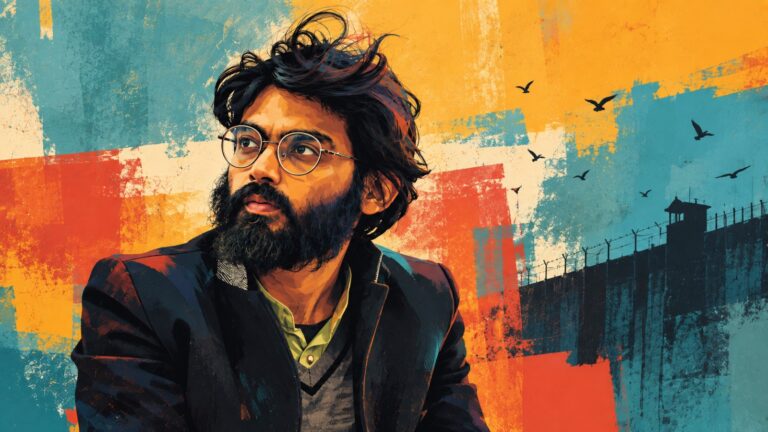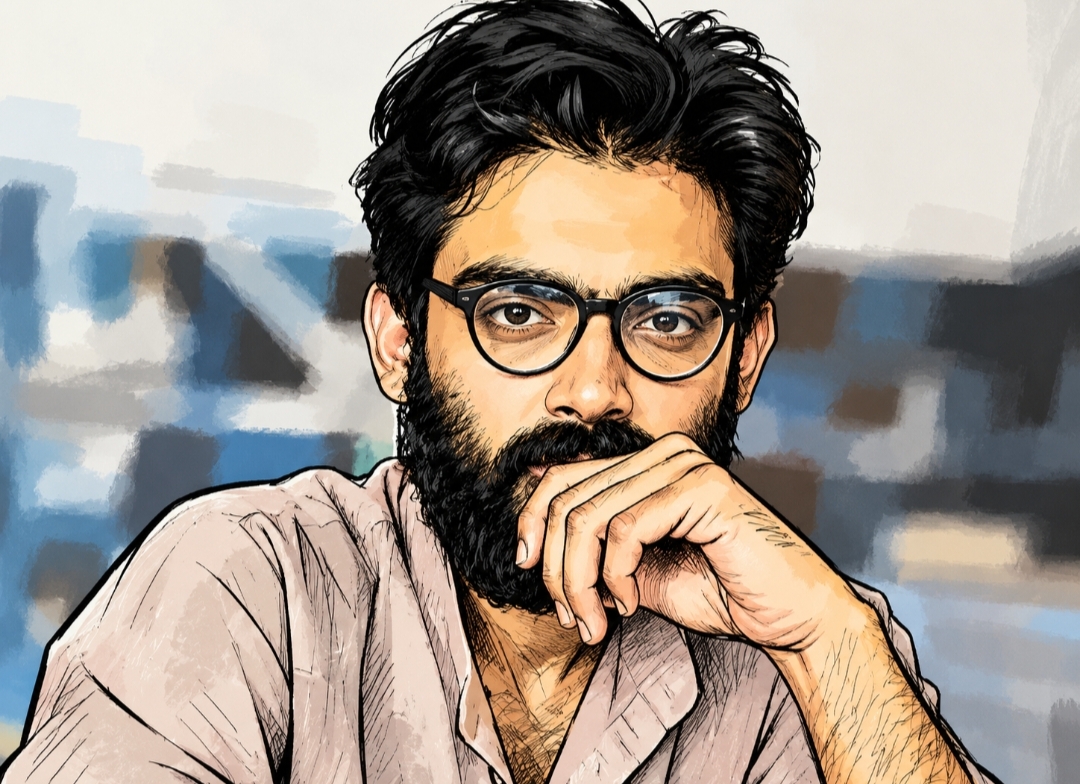
A strange, unwritten rule governs Muslim respectability in India today. If a Muslim decides to challenge the mainstream nationalist narrative, he is instantly cornered—forced to aggressively perform his loyalty or face real-world state incarceration. But if that same Muslim turns his analytical lens entirely inward, tearing apart his own community, the state machinery and corporate media eagerly grab him as a key witness for the prosecution. Ibn Khaldun Bharati’s piece in The Print, aggressively titled ‘Sharjeel Imam’s Islamist manifesto will be forgotten,’ plays right into this dangerous playbook. It reads exactly like old-school twentieth-century state propaganda, deliberately twisting a minority intellectual’s words to invent a massive, collective threat out of thin air.
Bharati builds his entire accusation on a simple hook. He claims Sharjeel openly rejects secularism, slaps the ‘fascist’ label on the Constitution and trashes democratic processes as rigged tools meant to keep Muslims politically weak. Leaping from this setup, Bharati spins Imam’s essays into prime state evidence for a separatist plot, practically accusing him of trying to map out a ‘rogue’ Muslim nation inside India.
But this interpretation bellicosely evens out a crucial distinction. Picking apart the constitutional framework as structurally exclusionary is a deeply rooted tradition in Indian political history. Sharjeel Imam is not the first person to call the text into question. To M.S. Golwalkar, the document was nothing more than an un-Indian ‘hotchpotch.’ Imagine the absolute uproar if a Muslim intellectual had used that exact word today. Even more striking, B.R. Ambedkar himself, the architect of the Constitution, famously stated he was ready to burn it and made a remark- “People always keep on saying to me, ‘Oh, you are the maker of the Constitution.’ My answer is I was a hack. What I was asked to do, I did much against my will.”
If neither Ambedkar nor Golwalkar are wiped out from history or locked behind bars for their incredulous moments, it forces a blunt question- why is identical rhetoric instantly criminalized the second it comes out of a Muslim’s mouth? The real conversation should be about whether or not, our constitutional system has failed to secure a truly dignified, safe existence for religious minorities over the decades. By ripping the text completely away from its historical context, Ibn Khaldun jumps straight to a clickbait headline, claiming Sharjeel wants a ‘Pakistan within India.’
From Deen Dayal’s Identitarian Supremacy to Deen (wretched) identity
Back in 1965, Deendayal Upadhyaya laid down a minimum threshold for Hindutva politics- Muslims had to be utterly broken on the political stage before they could ever be assimilated into the national fabric. Decades later, you only have to look at the current political climate to see that his vision has pretty much wrapped up its goals. Upadhyaya demanded total political submission as the price of admission to India. Bharati’s essay relies on the exact same structural mechanics, just updated for the modern media ecosystem.
Just look around. With Muslim presence in the judiciary and executive practically wiped out, institutional expurgation has turned daily cruelty into mere background noise. When a sitting MP can hurl explicit slurs on the floor of Parliament without facing any snub, street bigotry penetrating to the very Indian psyche, it becomes the default commonsense of the system. This is exactly where the whole myth of the ‘respectable Muslim’ falls apart. When a street bigot paints an entire community as ‘jihadi,’ you just become the same caricature. Pejoration is indiscriminate.
Ibn Khaldun has every right to call out Sharjeel Imam if he finds his positions regressive or supremacist. Who doesn’t do? But can you make a sweeping condemnation of an entire community’s political consciousness if you disagree with an individual’s rhetoric? Despite what ‘media-trial’ makes of him, Sharjeel’s core arguments are largely about decentralized power networks, proportional representation, autonomous minority boards and statutory protections. Whether you agree or not, this proposition is fundamentally about the friction between community safety and constitutional equality in a deeply fractured state.
Ibn Khaldun first dubs Sherjeel’s argument as an ‘Islamist manifesto’ and then he spins his critiques of the Constitution and democratic failures into absolute proof of a hidden agenda to forge a ‘Pakistan within India.’
But can demand for community autonomy be equated with the demand for territorial sovereignty? Ironically, the very idea of ‘nation’ behaves like a moving target across history. Nehru captures this beautifully in his famous 1952 address, ‘The Basic Unity of India.’ He recounts walking through rural fields and asking the local villagers who Bharat Mata actually was. When they stumbled over an answer, he stepped in to explain that India was never just a collection of soil, winding rivers, jagged mountains and open fields. Ultimately, he insisted, India was the very people who lived inside it. What Sharjeel meant was what Nehru had envisioned- a marginalized group claiming a cultural identity and a community pushing for strict constitutional safeguards.
One Muslim Speaking for All Muslims
The biggest flaw in Ibn Khaldun’s logic is its pure elasticity. Sharjeel drops a provocative comment and Khaldun chains Imam to Islamism and then using Islamism to speak for all Muslim political thought. He essentially drafts his own bizarre manifesto for a whole community: ‘Muslims of the world rot! You have nothing to lose but your homogeneity!!’
To validate this, he drags up the Muslim League’s 1946 election victory and ties it to the theological concept of Ijma (consensus), just to invent a uniform Muslim mind. The narcotising dysfunction of Hindutva-induced nationhood has completely clouded Ibn Khaldun’s vision. It drugs him into treating entirely separate pieces on a complex historical chessboard as one uniform mass. To him, everyone else is also blindly enslaved by the exact same tresses of a singular beloved in Mir Taqi Mir’s classic poetic imagery- Muslim League loyalists, defenders of composite nationalism, Congress-aligned leaders, left-wing socialists, constitutionalists and Islamists.
When Sharjeel makes a sweeping generalization about something, it is weaponized as proof of bigotry. When Ibn Khaldun paints an entire religious population with a single careless brush, it is praised as serious historical scholarship.
Ibn Khaldun and the Civilisational Nation-State
Let’s sequester the historical Ibn Khaldun from this columnist’s pen name ‘Bharati.’ The original 14th century scholar spent his life understanding how raw state power consolidates, rots from within and eventually vanishes into thin air. He never looked at a ruling dynasty as some permanent, sacred voice of an entire civilization. The columnist Ibn Khaldun Bharati, however, behaves like a flat simulacrum. He flattens a shifting civilisation into an unbroken, completely static Hindutva timeline. Doesn’t he know that a civilisation and a state are entirely different beasts?
India’s civilisational histories may encompass several millennia, but their ancient roots do not hand any single modern political faction a monopoly over their meaning. The actual Ibn Khaldun framework exposes the exact danger of confusing the long survival of a culture with the permanence of a passing political regime. Ruling a country and proving your moral right to rule it are two completely different questions. Snatching a historic electoral victory does not grant you permanent philosophical legitimacy. A dynasty might inherit a physical throne, but no political majority ever inherits a permanent, unchallengeable deed of ownership over the soul of the nation.
The Medieval Ruler Who Follows the Muslim Voter
Ibn Khaldun drags up Muhammad bin Qasim’s eighth-century conquest of Sindh to argue that Muslims harbour an unbroken entitlement to political rule. This is a massive category error. The historical existence of a Muslim dynasty does not prove that a modern citizen wants to resurrect a medieval sultanate. Besides, if we apply strict, aniconic theological standards, it remains highly debatable how ‘Islamic’ these dynastic rulers actually were.
Dynastic power, personal faith and democratic citizenship are entirely different realms. Historical monarchs never represented every single member of their religious group, let alone the political choices of people born centuries later. Look at Badayuni: he begrudgingly validated mut’ah marriages to legitimize Akbar’s domestic arrangements out of sheer imperial deference, even while fiercely detesting Akbar’s broader spiritual eclecticism. On the flip side, Maharana Pratap had multiple wives too, completely outside any Islamic legal framework.
When a modern Muslim demands political representation in Parliament or fights for basic cultural safeguards, they are not secretly plotting to restore a medieval kingdom. Protection against bigotry is not a disguised coup for a new empire.
Ibn Khaldun weaponizes Partition in the exact same way. The Muslim League’s 1946 electoral victory is a matter for historical debate, but it cannot prove a single, uniform Muslim mind then or now. The catastrophe of Partition was a messy collision of failed constitutional visions, tactical blunders by both Congress and the League, British panic, the collapse of the Cabinet Mission Plan and mass communal trauma. Reducing this historical tangle to a flat story of collective Muslim guilt is nothing but to make oneself comfortable in the political corridor.
Adam Gondvi beautifully sharpens the point- ‘Thi agar Babar ki ghalti, Jumman ka ghar phir kyon jale?’ (If Babar committed a historic wrong, why must a poor villager like Jumman watch his home burn today?). Ultimately, the primitive orthodoxy of Hammurabi’s code belongs to the bigot, not to a free, modern political consciousness.
Dalit Agency Is Not an Islamist Conspiracy
Ibn Khaldun’s panic over alliances between Muslims, Dalits and Adivasis exposes yet another massive crack in his logic as he frames them as calculated plots to recruit ‘foot soldiers’ against Hinduism. This conspiratorial vocabulary of ‘recruitment’ strips Dalits and Adivasis of any independent political agency. The moment their political choices happen to intersect with Muslim interests, their motivations are instantly painted as suspect and treasonous.
This is a deep insult to independent histories of resistance. Dalit political thought has its own rich, autonomous intellectual lineage, anchored heavily by the foundational work of B.R. Ambedkar. Its fierce critique of caste cannot be flattened into a mere tactical strategy drawn up by Muslim leaders. Similarly, Adivasi communities possess distinct, sovereign political histories and local concerns that belong entirely to them.
We must also confront the internal realities of these groups without falling into false equivalences. Social stratification among South Asian Muslims absolutely deserves serious scrutiny, but we have to investigate it honestly rather than assuming it functions exactly like the scriptural caste hierarchy found among Hindus.
Democratic alliances must be evaluated on the ground through their actual practices, demands, and outcomes. If a specific organization is using Dalits or Adivasis instrumentally, you have to get your hands dirty proving that claim with evidence. The simple fact that different marginalized communities choose to cooperate does not inherently prove a sinister conspiracy against Hinduism. Dalits are sovereign political actors, not brainless infantry waiting around for permission to choose their allies.
The Political Economy of the Acceptable Muslim
The deeper problem with Ibn Khaldun’s essay is the political role it risks assigning to the Muslim who dissents from other Muslims. Such a figure can be used to demonstrate that the dominant nationalist framework is not exclusionary. His identity becomes evidence that integration is possible; his distance from other Muslims becomes proof of his acceptability.
There is nothing inherently wrong with a Muslim criticising Islamism or religious conservatism within his community. The problem arises when the value of that criticism is measured by how effectively it validates the dominant political narrative.
The result is a hierarchy of Muslim respectability. The Muslim who confirms the majority’s suspicions is elevated as an exception, while the Muslim who challenges those suspicions is treated as confirmation of the rule. The community is divided into those who can be used as evidence of successful assimilation and those presented as evidence of its failure. The acceptable Muslim becomes a political alibi.
Therefore, the relationship between Sharjeel Imam and Ibn Khaldun Bharati reveals competing visions of political belonging. Sharjeel challenges secular nationalism and the constitutional order. Ibn Khaldun turns Sharjeel’s arguments into a general indictment of Muslim political consciousness.
A democracy worthy of the name does not require minorities to surrender political independence to prove their loyalty. When assimilation demands conformity to the majority’s interpretation of history, it becomes another word for submission. The challenge is not to make minorities politically invisible, but to distinguish equality from conformity.