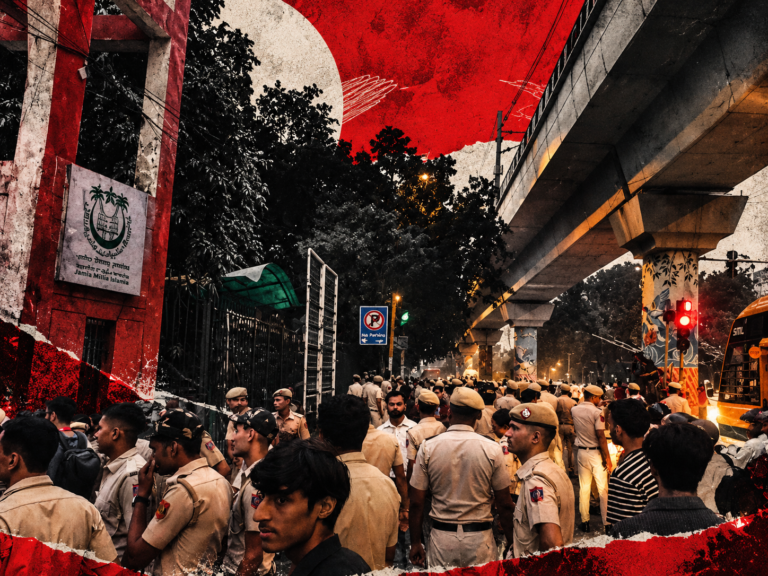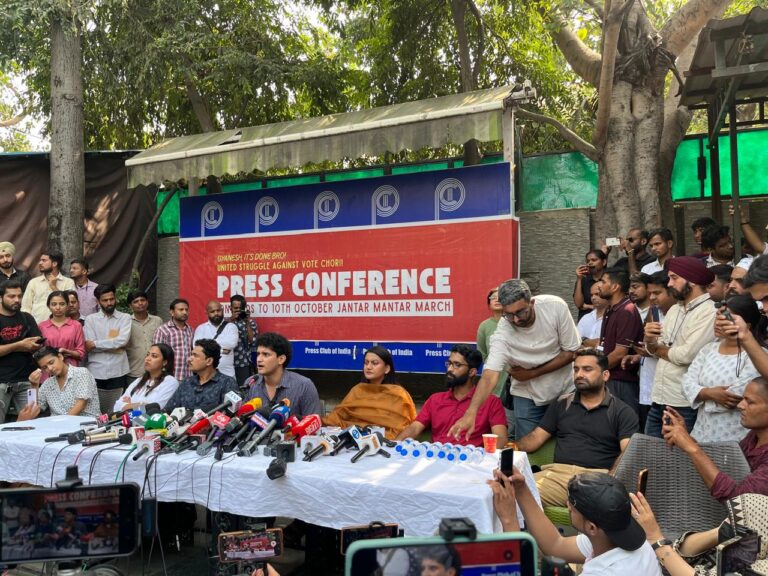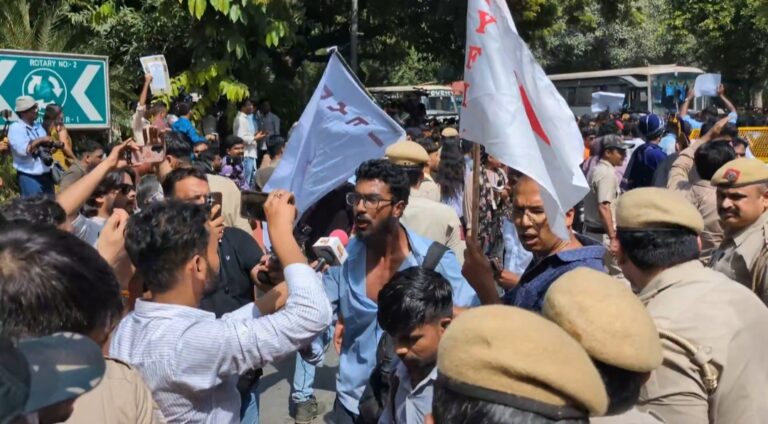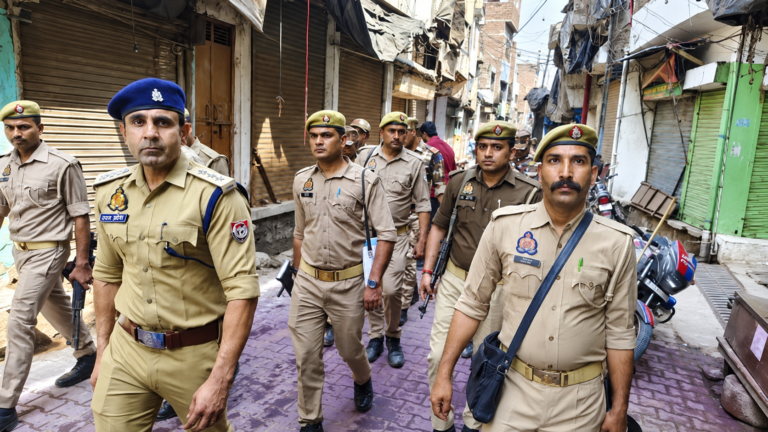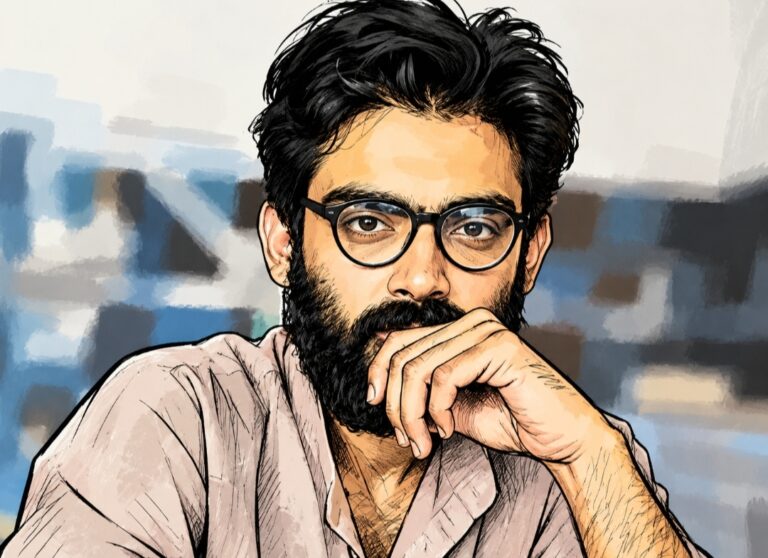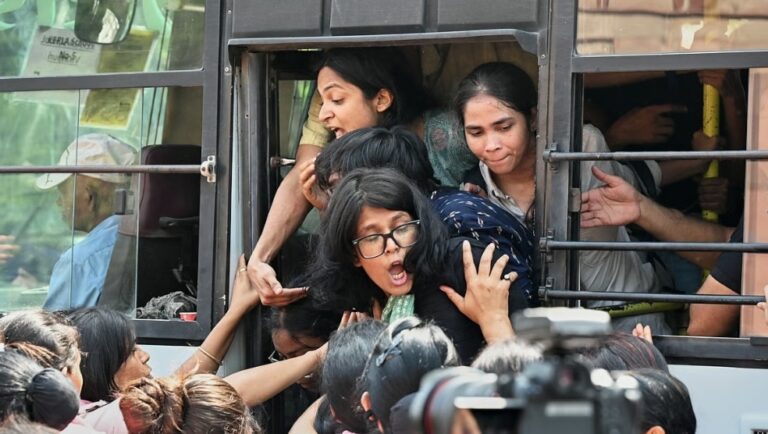
“Ghar mein ghuske marenge” (we will enter your homes and beat you). The phrase, often deployed as a threat against political opponents, appeared to take on a different meaning in Delhi on October 10, 2026, when right-wing supporters allegedly confronted and assaulted protesters as police personnel stood by. Among those present was Gaurav Hindu, a right-wing activist who has publicly claimed that he would beat people inside their homes.
For independent journalist Anushree Bisht, the incident was not simply another confrontation at a protest site. She told Karvaan India that she was heckled and subjected to sexually degrading remarks while covering protests and detentions near Jantar Mantar and Connaught Place. Her account, alongside videos circulating on social media, raises questions about the treatment of journalists, the safety of women reporting from the field, and the apparent disparity between how police personnel dealt with protesters and those confronting them.
What Anushree Bisht says happened
Bisht said she was recording a group of approximately 20 to 25 men gathered near Delhi Police personnel in the Connaught Place area when some of them noticed her filming and began confronting her.
“If Section 163 was imposed on us, why did it not apply to them?” she asked, questioning why the gathering was allowed to continue while protesters were being detained.
According to Bisht, one of the men, whom she identified as Rishikesh Shukla, approached her mockingly. Another allegedly called her “dimaagi Naxal” and “Naxali media” before asking, “Tu kitne mein biki hai? Kitne tujhe paise mile, kya hai tera rate?” The remarks insinuated that she had been paid to carry out her journalistic work.
Bisht further alleged that Gaurav Hindu confronted her in front of a Delhi Police officer and made sexually degrading remarks, including: “Tera rape kiya hai kya maine? Tera rape toh main karunga bhi nahi, teri jaisi…”
She said the police did not intervene during the confrontation. Bisht also recounted being told later that a Delhi Police officer had congratulated Gaurav Hindu by saying “well done” after the exchange. She clarified that she could not independently verify this claim.
The distinction matters. The alleged remarks and the reported absence of police intervention warrant scrutiny in their own right. If the account is substantiated, the incident would raise serious questions about the safety of journalists covering politically charged gatherings and the responsibility of police personnel to prevent intimidation and harassment.
From threats against a minor to the targeting of a journalist
The October 10 confrontation also brings renewed attention to Gaurav Hindu’s previous online conduct.
He first came to wider public attention in Delhi after a video circulated in which he threatened and abused Nishu Azad, a minor who had posted a video rejecting the idea of a Hindu Rashtra and expressing support for a secular India. During the NEET protests, Gaurav allegedly threatened sexual violence against her and made a sexually suggestive remark telling her to “give Hindu men a chance”.
The video prompted criticism from content creators, several of whom demanded action against him. On June 30, Nishu released a video appealing to the Delhi Police for protection.
The subsequent appearance of Gaurav Hindu alongside police personnel on October 10, including footage that appears to show him receiving their blessings, raises questions about whether the authorities took the earlier allegations seriously. Videos circulated online also appeared to show him assaulting protesters. The footage alone, however, does not establish the full circumstances of each confrontation or whether any action was taken outside public view.
What the law says
Threats of sexual violence against a minor can have serious legal consequences. Sections 11 and 12 of the Protection of Children from Sexual Offences (POCSO) Act address sexual harassment of a child and its punishment. Whether particular remarks meet the statutory requirements depends on the evidence and the circumstances of the case. Other criminal provisions may also be relevant, depending on the conduct established.
The broader concern is that women who express political dissent, report on protests or challenge majoritarian narratives can become targets of sexualised intimidation. When such conduct is accompanied by claims of impunity, the responsibility of law enforcement assumes even greater significance.
A journalist targeted online after the confrontation
The alleged harassment did not end with the October 10 incident.
On October 14, Gaurav Hindu posted a video on Instagram, from his new account, @hinduraj659, targeting Bisht. Referring to her as a “bhains” (buffalo), he claimed that she had escaped from Bihar and was now in Delhi. He asked viewers to identify her whereabouts and share the information in the comments, while offering Rs 1 to anyone who helped send her back to Bihar.
The video raises a separate concern: the potential consequences of directing an online audience to identify and locate a journalist who has already alleged harassment. Such appeals can expose individuals to further intimidation, particularly when their personal safety has become a subject of public confrontation.
The episode recalls the online targeting of journalist Ruchika Rathore, whose personal address was reportedly circulated by Hindutva supporters following the NEET protests. The circumstances of the two cases may differ, but both illustrate the risks journalists can face when online hostility moves towards identifying their whereabouts.
For women journalists, this form of targeting can blur the boundary between political abuse and threats to personal safety. Derogatory language, sexualised remarks and appeals to identify someone’s location can combine to create an environment in which reporting itself becomes a source of vulnerability.
What did the police do as protesters were allegedly assaulted?
The questions surrounding October 10 extend beyond the confrontation with Bisht.
In another video circulating online, investigative journalist Tanushree Pandey can be seen urging police personnel to intervene and stop violence. They appear not to respond to her appeals in the footage.
The video raises questions about whether officers took adequate steps to prevent assaults, whether they intervened at other points, and what instructions governed their response to the gathering.
If protesters were being detained under restrictions imposed on assemblies while another group was permitted to gather and confront them, the police should explain the basis for treating the two groups differently. The presence of restrictions on public gatherings does not, by itself, establish that every person present has committed an offence. Equally, any alleged assault or intimidation must be assessed on its own facts, irrespective of the political affiliation of those involved.
A credible account of the incident therefore requires more than competing claims on social media. It requires the police to clarify the applicable restrictions, the grounds for the detentions, the circumstances of the alleged assaults and whether complaints were received or action initiated against those involved.
A pattern of sexualised threats against women
Bisht is not the only woman Gaurav Hindu has allegedly targeted with sexually threatening remarks.
In an interview with the Instagram page ViralKhabarHindi1, he made threatening remarks about student activist Neha Bora, invoking Umar Khalid and suggesting that she was seeking “freedom” of another kind. He then made sexually explicit comments about her, threatened violence and referred to an incident in Jharkhand, claiming that she had been fortunate his group had not been present.
In the same interview, he reportedly boasted that even if 50 cases were filed against him in the Supreme Court, nobody could do anything to him. He also claimed that he continued to live openly in Connaught Place and threatened to beat people more severely than before.
These statements, if accurately represented in the circulating footage, warrant scrutiny from the relevant authorities. Publicly boasting about the consequences one expects to escape does not establish that a person enjoys political or institutional protection. It does, however, make the question of accountability difficult to avoid when further allegations of intimidation and violence emerge.
The legal response must ultimately depend on evidence, complaints, investigation and due process. But those processes cannot function meaningfully if threats are dismissed because they are delivered online, framed as political provocation or directed at people whose views are unpopular with those making them.
The question of equal protection
The events of October 10 bring these concerns together. A minor had previously appealed to the police for protection after allegedly receiving sexual threats. An independent journalist now says she was subjected to sexually degrading remarks while reporting from Delhi. Other footage appears to show a journalist urging police personnel to intervene as violence unfolded.
Taken together, these accounts demand answers. Did the police receive complaints concerning the alleged threats against Nishu Azad? Were any complaints filed in connection with the October 10 confrontation? What action, if any, followed the alleged assaults on protesters? And how do the authorities explain the apparent difference in treatment between those being detained and those confronting them?
These questions should be addressed through an independent examination of the available footage, witness accounts and police records. Allegations must be investigated fairly, and anyone found responsible must face the consequences prescribed by law.
The larger issue is the credibility of law enforcement itself. When people exercising their right to protest are detained while others are allegedly allowed to intimidate or assault them, the appearance of unequal enforcement can deepen public distrust. When a journalist attempting to document such an incident is allegedly subjected to sexualised abuse in front of a police officer, that concern becomes more immediate.
The law cannot be reduced to a question of whose politics are favoured or whose presence is tolerated. Its legitimacy rests on whether it protects people equally, including those who challenge the powerful, document state action or express dissenting views.
On October 10, the question was not merely who threatened whom. It was whether the authorities were prepared to protect those facing intimidation and hold the alleged perpetrators accountable. Until the police provide clear answers, the footage and the accounts of those present will continue to raise an uncomfortable question: who is protected when the law is supposed to protect everyone?