
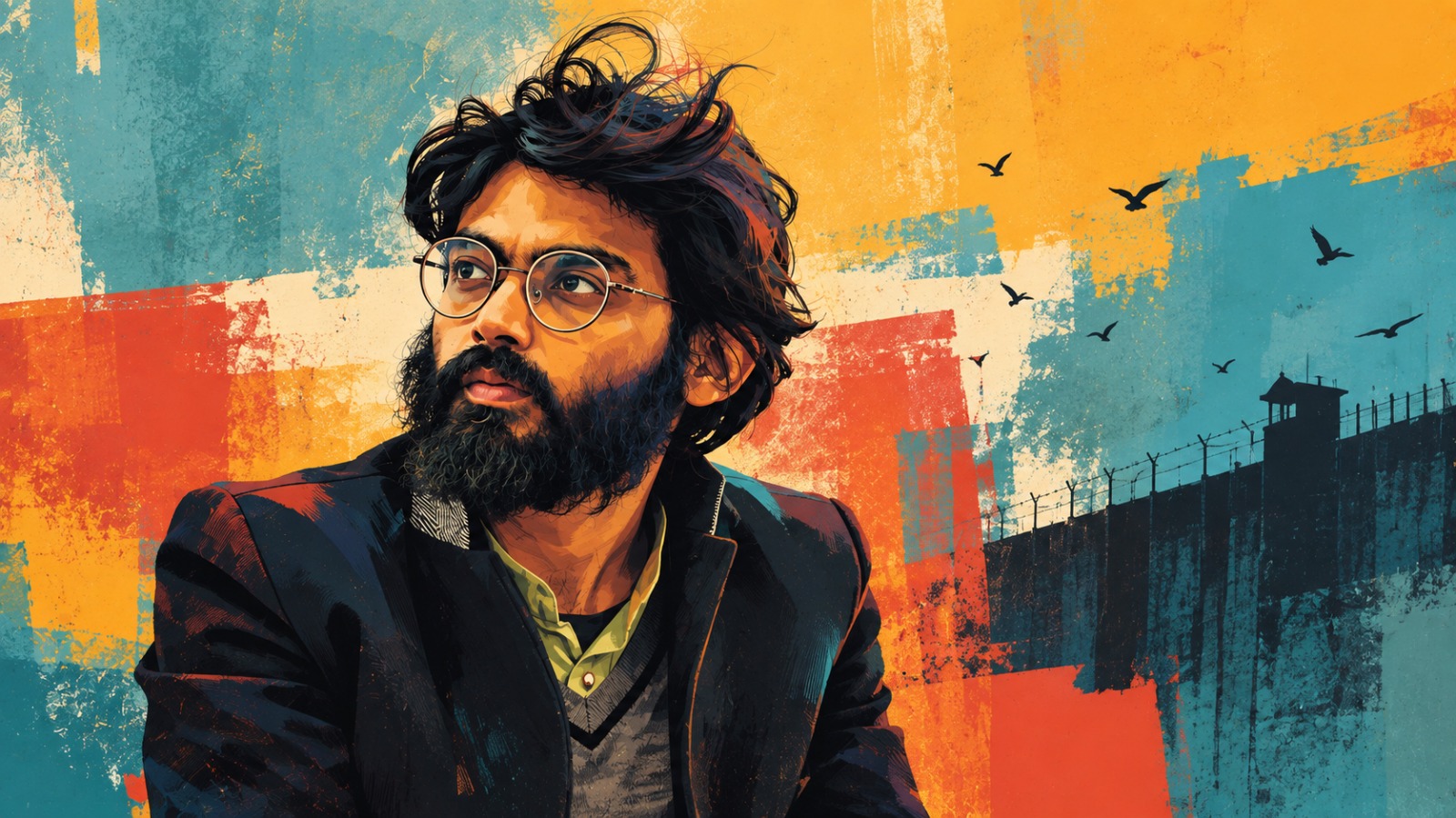
Sharjeel Imam wrote this letter from Tihar Jail in reply to Arka Deb, a journalist he holds in deep regard. It follows his life, his reading, his political convictions and his experience behind bars, and it takes in the legal and constitutional implications of his detention, his mother, his daily routine and his vision for Muslim political empowerment in India. The man who emerges has treated incarceration as a season of intense study, reflection and ideological honing, and has refused to treat it as a defeat.
Dear Arka Deb,
I apologise for answering so late, both the Bangla set of questions and the English set. I have read Bangla fluently for many years, although my articulation in the language remains less than satisfactory.
আমি বাংলা পড়তে ও বুঝতে পারি কিন্তু খুব ভালো ও অনর্গল বলতে ও লিখতে পারি না। “এই সময়” সংবাদপত্রে আপনার প্রবন্ধ পড়লাম, মুজাহিদদের আত্মাভিমান। দেরির জন্য ক্ষমা চাই।
I had thought of replying in English, but by then the hour had grown late. The English questions waited for another reason, since the Supreme Court hearing was under way and I wished the dust to settle before I answered.
Before the specific questions, I owe a few words on the Supreme Court order. The order equates chakka jaam with a terror act by bringing it under the phrase “any other means” in Section 15 of UAPA. This reading, if left standing, will deal a devastating blow to democracy in our republic, because any blockade or protest, even a non-violent one with no bearing on sovereignty, could be brought under the ambit of UAPA. Even within UAPA, the line between “unlawful activity”, a political offence, and “terrorism”, a crime against humanity, has been worn down until it hardly counts.
Bail was rejected for Umar and me, and we are being punished as the most articulate voices of the protest. I am singled out for having led the Shaheen Bagh movement in its initial and formative phase. The irony is that RSS-BJP have signalled clearly that we are being punished for our roles in the anti-CAA protest, and a section of the “secular” and “liberal” media still underplays my contribution by dismissing me and pointing to the “chicken neck” chakka jaam slogan, as if I sit in jail because I am a mad man or a “secessionist” with no significant role in the protests.
They wilfully ignore that the speech called for a peaceful chakka jaam, and that I have secured bail in all the speech cases, even supposing I were guilty. I have served more than enough years for most of these cases. I am in jail now for the Delhi riots case and not for my speeches, and I am there because I played a crucial role in leading the protests from early December. I sometimes feel thankful to the Delhi police for researching and recording my role in the protests and in Shaheen Bagh so meticulously for future generations. Without that record the “secular” media would have written me out of history. Why? Because I do not conform to their image of a good Muslim, because I am too much of a Muslim for them, because my ideas of social justice are bound up with my Islamic faith, and because I challenge their fabricated version of the history of partition and the Republic, since I wish for a re-reading of partition in relation to minority rights, decentralisation and so on.
What is at stake is the assertion of Muslim-ness, the narrative of minority rights and proportional representation, and these find expression through political actors like me and through the massive protests. The anti-CAA protests marked a watershed moment in the history of Muslim India and gave birth to new discourses. A few colleagues and I represent one important strand, which busts the myth of “secularism” and points towards the structural and systemic issues that made the emergence of naked fascism possible. Those issues brought Muslims to the helpless state we find ourselves in, and Congress itself planted the seeds in the 1940s.
Partition itself resulted from the denial of legitimate Muslim demands for decentralisation, religious autonomy and guaranteed representation. Congress rejected those demands and imposed a near-unitary Constitution with no safeguards for minorities and no guaranteed representation. We represent this new democratic voice, and in my opinion its emergence as a coherent discourse is one of the two most important consequences of the anti-CAA protests. The other consequence is that a disruptive chakka jaam proved effective and restored some agency to an otherwise beleaguered minority, one represented mostly by a self-serving leadership.
But more on this later.
I have one request. Please translate all of this, including the answers that follow, into Bangla. And before I forget, during the period when attempts were made to silence me or erase my name by a section of “secular” media and politicians, people like you, Aarko, upright, brave, hardworking and sensitive journalists, helped me keep my spirit up, and I will be forever grateful. May God reward you.
Dear Aarko, I know the piece runs long, and I ask you to publish it in full, in English and in Bangla, with a full translation.
Cheers,
Sharjeel
On structural reforms
My studies and research on partition have led me, again and again, to the conclusion that the Cabinet Mission Plan of 1946 was the last serious attempt at solving these issues, and that Congress rejected it, which led to partition. Any future solution that brings peace between the communities and nations of South Asia will have to follow the blueprint of the Cabinet Mission Plan, a loose confederation of decentralised nations.
In the short term we need to struggle and agitate for four systemic changes necessary for Muslims and other marginalised sections. The first is decentralisation, with power flowing from the bottom upwards and never the other way round. Urban and local bodies should be empowered against the state government, and state governments against the Union Government. This should become a fundamental and sacrosanct feature, so that nobody could convert an autonomous state like J&K into something else.
The second is proportional representation as the method of elections, with seats according to vote percentage. First Past the Post should be abolished, because it is the most undemocratic way of conducting elections and particularly unsuitable for a vast and diverse nation like India. Nations around the world have been moving from FPTP to PR or mixed systems, among them Germany, Indonesia, NZ, Türkiye, and even Nepal and Sri Lanka in South Asia. According to newspaper reports, Bangladesh is also discussing a switch to PR. Retired Election Commissioner SY Qureishi also spoke of his changed stand on FPTP and PR in his recent book.
The third is reservations for religious minorities in institutions, among them the judiciary, executive and universities, in all branches and departments, with internal quotas for backward and marginalised castes and sections within these religious groups. The fourth is a democratic mechanism for complete religious autonomy, for example Waqf, which should be handled by an elected Muslim body chosen by Muslims.
These fundamental changes are necessary for all marginalised classes. One only needs to check how many seats Mayawati’s BSP would have received in the 2014 or 2024 Lok Sabha (BSP had no MPs), or in the 2017 and 2022 UP assemblies, had their vote percentage been taken into account. In 2014 they were the third largest party in India with 4% of the vote and won zero seats. FPTP suppresses the voice of the marginalised in exactly this way. Bihar in 2025 offers a similar case, where RJD won 38% of the votes and fewer than 15% of the seats.
On global events
Yes, I follow international news through the newspapers we receive and some TV channels, and I have always followed it avidly, especially news from the Islamic World, the US and Europe.
We have all lived in a state of blissful ignorance, trying to make sense of the little information we possess. It would be difficult, indeed impossible, to say anything meaningful about “global politics” in any age, and the current period seems even more chaotic. But since you have asked, I will risk a few words. Two new and interrelated factors add to the complexity. The first is the internet, with live data from the whole globe, data democratisation, Gen Z and so on. The second is semiconductors, with AI, drones, supply chains, rare earths and the like. Both are moulding the contours of global politics and conflicts.
Behind the recent developments, tariffs among them, and the chaos that followed lie the contradictions within the finance capitalist model, which are being played out in its headquarters, the United States. To maximise profits, capitalists have looked for cheaper labour around the globe, accumulating profit in the US among the elites while deindustrialising the country in the process. The deindustrialised US, the Rust Belt and the rest, is now hitting back in the form of Donald Trump, who rocks the boat with tariffs and the like. A major consequence of this outsourcing was the rise of China as a manufacturing powerhouse, which has complicated things for the US as a global power. Self-sufficiency in areas like semiconductors has become key to the idea of sovereignty and national defence, even for the US.
On Gaza, my salaam goes to the brave and revolutionary people of Gaza, whose struggle against the settler colonial project of Israel continues into a new phase. Their sacrifices over the last seven decades, and the genocide perpetrated against them in the last two years, will not go in vain. They have gained supporters in every corner of the world, the world has been watching their genocide live, Israel has been delegitimised and the Zionist occupation has been laid bare. The illegal occupation of Palestine has been placed at the very forefront of international politics and global conscience. Among the Muslims of the world, the realisation has dawned that the Palestinians are the vanguard of the anti-imperial and anti-colonial movement.
The other big development is the revival of Russia from its lowest point twenty years ago, when Western powers had almost subordinated it. Three decades of absolute unipolarity have ended. The emerging bloc of Russia, China and Iran will become one of the most significant players on the Eurasian landmass, although China has to face a looming demographic crisis. As the US reverses supply chain linkages and Europe wanes into geopolitical irrelevance, blocs such as Russia, China, Iran, ASEAN or West Asian groupings will emerge as the prominent movers. The best path forward for us would be to make peace and integrate with our neighbours in South Asia, so that we can realise our full economic, cultural and geopolitical potential. We will first have to do away with anti-Muslim poison for that.
On systemic barriers and legal aid
One of the most conspicuous and prohibitive barriers is language itself. Most long-time inmates, undertrials and convicts alike, do not know English, although almost all business of the courts is carried out in it. Almost all legal literature in jails, jail manuals included, is also in English. Over the years I have translated orders, laws, witness statements and more for hundreds of inmates. I have observed that those with a keen interest in their case react quickly and meaningfully once they comprehend the larger legal landscape and the details of their cases. I believe language is the most important issue, even ahead of class, which comes next as a barrier. Poor inmates are regularly swindled by crooked lawyers who want the case, or even a bail hearing, dragged out as long as the inmate can be squeezed for whatever money he has, after which the lawyer disappears.
In this age of AI, the least the courts can do is arrange dynamic translations of all court proceedings and orders into the relevant regional languages. On class, the way lawyers are paid should come under stricter scrutiny, with at least some accountability, especially for poorer inmates. The legal aid offered by the state should also be made more attractive for sincere and hardworking lawyers.
Finally, I should point out that the little help I could give my co-accused and other poor inmates became possible only through the hard work and dedication of my lawyers, especially Ahmad Ibrahim, Talib Mustafa, Ayesha Zaidi and Jeet Chakrabarty. They treated these cases as seriously as they treat my own. I am extremely lucky to have found such lawyers and friends, who share a sense of duty towards the underprivileged. I would also like to point out that this long legal struggle could not have been waged without a few friends, especially from the IITs, who stood by me as fellow alumni, and given how few Muslims study at those institutes, almost all of them are non-Muslims.
On a jail memoir
I have already spent six years in jail and will probably spend at least one or one and a half more. I often joke about my education, five years at IIT Bombay, then JNU for six, and now Tihar for the same stretch. Jail is a unique place, and it has brought me innumerable lessons about human nature, state bureaucracy, legal affairs and animals, cats especially. I have a lot to say about life inside and will definitely write a memoir once I am out. For now the more important task is our political discourse, with a clear message that imprisonment is a small price to pay for our political rights.
On my daily routine
I go through many newspapers daily, then read books, play badminton, watch some news on TV and offer namaz in congregation at our ward mosque. A little FM radio before sleep ends the day. That is pretty much it. I also observe, and take part in, the lives of the cats in and around my ward, especially through Chhotu, a male cat who has lived with me round the clock, 24×7, since his birth around four years ago.
On my mother
When I surrendered to the Delhi police in Kako, she was present, and she said to me, “You are God’s gift to me, I am returning you to his custody.” She has always followed this line. She has told me to be patient, have faith in God, read the Qur’an and stay calm. She has also told me not to become too headstrong and to listen to others, especially my brother. She was the wife of a politician who worked tirelessly for people and kept a clean image, so she is a veteran of sacrifices and a reservoir of faith, patience and inspiration for me. She and my brother had to face financial hardships because of my incarceration, and she never complained. At this stage of her age, when she needed me most, I was unfortunately not there for her.
On the election
I have written earlier about my reasons for planning to take part in the Bihar elections of 2025 from Bahadurganj in the Seemanchal region, in earlier interviews, especially with Scroll and Outlook. I will summarise the points here.
Many youth and residents of Bahadurganj proposed the idea to us in the first place and suggested we contest from there. Bahadurganj lies in Seemanchal, the poorest and most neglected region of Bihar, which is already the poorest state.
Under FPTP, a political actor who argues for minority empowerment cannot enable the BJP by contesting seats the BJP might win through a split of Muslim votes. We need not fall in line behind the so-called “secular” parties that take our vote for granted, either. We can and should challenge the secular parties where the BJP does not contest, as on seats where JDU is contesting, or at the very least where Muslims and minorities dominate. It is our responsibility to defeat the BJP, and where it does not contest or cannot win, we will push our discourse for minority empowerment, the only space we have, which we have to use. We are and will remain at the forefront of anti-fascist struggles, carrying our own discourse of systemic and constitutional changes for empowering the marginalised. In a Muslim-majority constituency like Bahadurganj, we can discuss and propagate our discourse more freely, challenge the “secular” parties and force them to take note of our positive politics of systemic change, without fear of aiding the BJP or of polarisation.
Seemanchal also has the distinction of being the largest and foremost region, apart from some pockets in West Bengal, where various dialects and registers of Bangla and Urdu/Hindi are spoken and read. Bangla and Urdu/Hindi are the two largest languages of South Asia and also the two largest languages of its Muslims. More than 90% of South Asian Muslims can understand one of the two.
Unfortunately I could not secure interim bail, and the cost of custody parole would have been prohibitive. My presence was necessary to galvanise my supporters, to give them confidence, and to present and articulate the issues in the new way I attempt.
What lessons did we learn? The response was overwhelming, both on the ground and on social media throughout India, where thousands of people sent messages, reacted and offered support. In the constituency, which is highly rural and vast, we held multiple programmes, and the reception was much better than we expected, although the place lies hundreds of kilometres from my home in Jehanabad. Our team and friends had an important learning experience, and we plan to be there as soon as I am released.
The reach of our discourse on social media, and of our discussions of systemic changes, revealed to me the extent of disillusionment with the current state of affairs. A political vacuum has opened among Indian Muslims, and we have to fill it with reasoned, empirical, structured discourse about systemic and constitutional changes instead of emotive issues. That does not mean, and I repeat this, that we should split Muslim votes in constituencies where we lack a comfortable majority and the BJP wins because of our exercise. For now we should limit our exercise to seats where minorities form a large majority or where the BJP is not contesting at all, even if its allies are. We have to reject those “Muslim” parties that make no such distinction, since their reckless approach helps the BJP. This is the most important constraint on our politics until electoral reforms arrive and FPTP is abolished in favour of PR. Even within these constraints we can challenge the “secular” parties and help set the terms of political discourse.
On Iqbal and Ali Shariati
I began reading Iqbal in earnest in the eleventh class and continued through IIT Bombay. He was probably the most important and enlightened modern Islamic thinker of the twentieth century, and a political actor in late colonial British India as well. He was one of those rare thinkers who absorbed the twentieth-century revolutions in physics, like Relativity and Quantum, and in biology, evolution among them, grasped their significance and set out to “reconstruct” Islamic religious thought on the Qur’anic fundamentals of monotheism, personal accountability, justice and equality, shedding the accidental and sometimes plainly superstitious traditions that had latched on to these fundamentals over centuries.
He foregrounded the exceptional nature of the mission of Prophet Muhammad and of the Islamic ummah, and underscored the Qur’anic empathy and respect for other monotheistic communities and humans. Iqbal expressed all of these complicated themes in his sublime poetry in Urdu and Persian and in his English prose. He made me understand social justice as an integral part of Islam, and scientific enlightenment and empiricism too. He transformed me from a merely practising Muslim into a thinking Muslim, and from a sectarian boy into an empathetic Muslim.
His politics was also informed by his faith and religious thought, with a call to decentralisation, community-based representation and full religious and provincial autonomy that he propagated until his death. The Cabinet Mission Plan of 1946, eight years after his death, accommodated most of his proposals. His critiques of Congress and Gandhi remain relevant and have given me innumerable insights in my study of partition. Interestingly, although they stood in opposite political camps, Iqbal and Maulana Azad had more in common, especially in matters of faith and enlightenment. Azad was also the most vocal supporter of the Cabinet Mission Plan of 1946, a product of ideas Iqbal had propagated, although Congress ultimately rejected it. Iqbal was all of this and much more. For a discussion of Iqbal’s influence on my faith and work, please go through my essays “On Tawhid” and “Islamic Modernism” on the POLIS Project.
A friend in JNU introduced me to Shariati through a book in 2013. I could already read Persian, and what hooked me to listening to Persian was Ali Shariati, whose hundreds of audio lectures on YouTube were powerful, articulate and pleasing to hear, almost musical. That led me to a deep exploration of the Islamic revolution of 1979 in Iran, of which Ali Shariati, a young professor of history, was one of the major architects, although he died in 1977 after being imprisoned by the Shah.
He is in many ways a successor to Iqbal, and I hold him in great respect. His book “Iqbal and Us” is worth checking. Like Iqbal, he gave a beautiful articulation of the fundamentals of Islam, prophetic narrations and more. Besides these, his creative and for the most part non-sectarian exposition of the Shia school of thought and history attracted me. Brought up as a child in a Sunni household, I was ignorant of the nuances, which I learnt from him. Iqbal came from a Sunni family and Ali from a Shia family, and both were non-sectarian and enlightened Muslims and humanists. They taught me to respect every sect of Islam and, as mentioned earlier, all monotheistic traditions in the world.
Like Iqbal, Ali Shariati engaged with Marxist thought and wrote critiques of Marxism, capitalism and materialism. Iqbal’s leaned philosophical, invoking post-modern physics and ontology or evolutionary epistemology, while those of Ali Shariati leaned historical, rich in facts about human nature and the history of societies. That partly followed from their professions, since Iqbal was a philosopher and Ali tilted towards history and sociology, and partly from their ages. Iqbal died in the 1930s, around the time Ali was born. Ali lived through WWII and the totalitarian turn of the USSR, so his works account for these developments.
And Ali was an active revolutionary. He and his students formed the vanguard of the uprising against the Shah, and they paid with their lives. Ali Shariati died in his 40s. He is a true modern Muslim hero.
On books
I gave a long list in an article two years ago in Maktoobmedia and more recently in an interview on Quint. (Please add a link to the relevant paras here.) I will therefore take only a few important names here.
My reading can be sorted into five categories. The first is science and philosophy. Over the last few years I have read the scientists who led the way in twentieth-century physics and mathematics, among them Bohr, Schrödinger, Gödel and Heisenberg, along with related philosophical texts. A set of books by Max Jammer on developments in twentieth-century physics has been particularly helpful.
The second is history, meaning world history, South Asian history and Islamic history, with Hobsbawm, Bayly, Hodgson, Dalrymple, Partha Sarathi Gupta and others, and most recently Joya Chatterjee’s Shadow at Noon.
The third is Islamic literature, with significant names like Shah Waliullah, Iqbal, Ali Shariati, Maulana Azad and Abdullah Yusuf Ali. Around six or seven books by Rashid Ghaz have recently proved extremely thought-provoking. In poetry I have read Hafiz Shirazi, Akbar Ilahabadi and others.
The fourth is fiction in general, with P.G. Wodehouse, Amitav Ghosh, Tolstoy, Dostoyevsky, Shamsur Rahman Faruqi and others. I would especially mention Tagore’s Ghare Baire (ঘরে বাইরে), which I read after watching Satyajit Ray’s adaptation in jail. The way this novel complicates the “Swadeshi” movement is fascinating, and the protagonist Nikhilesh’s refusal to chant Vande Mataram, with his reasons for it, remains relevant today.
The fifth is German literature, mostly Kafka, Nietzsche and Thomas Mann. I recently finished “Deutsche Hörer”, a set of radio messages sent by the exiled Thomas Mann from the US to his homeland and to compatriots living under Nazi rule. These messages, smuggled in, constitute a critique of fascism and ultra-nationalism that remains extremely relevant for us today. I am trying to read Goethe’s “Faust” now, although I find German verse too heavy, and even in English I cannot appreciate poetry. I can enjoy poetry only in Urdu and Persian.
Besides, I am reading Tafsir-al-Manar by Md. Abduh and Rashid Rida in Arabic, one of the first modern and reformist exegeses of the Holy Qur’an.
This is an incomplete list of the books I have gone through in the last five or six years, and it is difficult to cover everything, so a larger list can be found in the article mentioned above. In short, I have been able to read hundreds of books with renewed interest and concentration, and in that respect these years have been the most productive of my life.
On release
I will try to finish my thesis as soon as possible, since a couple of months of archival work remain pending, and after that I will keep researching and writing. As a software engineer and coder I am better equipped than most historians to harness the digital revolution of AI in the service of history writing. My academic life will be accompanied by activism and politics, whose contours emerged during our discussions about the Bihar elections, although we have not arrived at their final form at this moment. After getting out, I will hold discussions with friends, comrades, sympathetic intellectuals, civil society representatives and people at large to chart a future course of action. My experiences, academic and practical alike, will serve our struggle for change, for improving the conditions of Muslims and all other marginalised peoples.
Message to Muslim intellectuals
I have two suggestions. The first concerns religious discourse. We have to foreground and articulate the Qur’anic message of a universal, non-sectarian, anti-caste and monotheistic faith, while maintaining and exploring the unique historical mission of the Prophet and of the Islamic Ummat in all its specificities. Many scholars emphasised these ideas in the nineteenth and twentieth centuries, among them Iqbal, Maulana Azad and Abdullah Yusuf Ali. Enlightened monotheists who advocate equality and rationalism among other religious communities are, and have always been, allies of enlightened Muslims. These ideas are not new, and they sit at the core of the Qur’an, with a clear articulation in early scholars as well, for example Imam Ghazzali. Beyond monotheists, we have the Qur’anic motto of peaceful co-existence with all, “lakum deenukum wa lee-a-deen” (chapter 109, verse 6), which means “To you be your Way/Faith; And to me Mine”, and “la ikraha fid-deen” (chapter 2, verse 256), “let there be no compulsion in religion”.
Muslim scholars bear the responsibility of making these ideas commonplace, in order to undo the damage done by narrow-minded bigots among Muslims and non-Muslims alike. A related task is to undo the harm done by literalists, especially in the readings and exegesis of the Holy Qur’an. As human knowledge and comprehension grow, concepts once considered simple reveal their underlying complexity, and words such as Sun, moon, Earth, life and creation gain layers of meaning. In that context a dynamic reading of the Holy Qur’an becomes the duty of every generation. A scholar of the tenth century had his own set of tools, we have ours and future generations will have theirs.
An old tafsir or exegesis can guide us and serve as a reference point, but it cannot bind future generations literally. The performative and ritualistic core has remained the same and will stay so, in salaat, fasting, Hajj and zakaat, while each succeeding generation will face new issues and find new solutions and new grounds of consensus in the Holy Qur’an. Evolution offers a simple example. The data on evolutionary development has widened our comprehension of the process of creation, and of how this process might have unfolded over a long period of time. The Qur’anic terms “created”, “developed” and the like can be understood better in this light, and scholars like Iqbal and Maulana Azad did precisely that. It is our responsibility to keep this process alive and strengthen it. (I have discussed evolution in my article on the POLIS project as well.)
The second suggestion concerns historical scholarship and political discourse. We have to re-evaluate the history of partition and free ourselves from pro-Congress and pro-centralisation bias in understanding it. This will require meticulous research, and the focus should fall on majoritarianism versus minority rights, the results of the 1937 and 1946 elections, centralisation versus decentralisation, caste discrimination, uniformity versus religious and cultural autonomy and similar questions. We have to stop viewing our history through the prism of “nationalism” and start seeing it as a collection of humans and communities, a patchwork of autonomous entities over thousands of years.
We have to understand what led the educated and middle classes of Indian Muslims to oppose Congress and support the Cabinet Mission Plan of 1946, and why Congress and the Hindutva forces rejected it in favour of a partitioned but centralised India. Detailed answers to these questions will help us understand our history and escape the “secular” trap that holds us responsible for partition.
Even a die-hard Congressman like Maulana Azad wrote clearly in India Wins Freedom that history would hold his party responsible for partition if it rejected the Cabinet Mission Plan. We, the scholars of India, have to write that history. Ram Jethmalani, a famous lawyer and a partition refugee from Sindh, provides another example, since he wrote to Indira Gandhi that her party had partitioned India. Only a firm grasp of our recent history will let us understand the processes unfolding today and develop a clear democratic vision for the future.
A related task is chronicling the oppression meted out to Muslims, Dalits and other backward and marginalised sections in post-partition India. It will serve two purposes. It will show clearly that systemic issues have plagued our Republic from the start and not only since 2014, and by distancing ourselves from Congress we will disprove the fabricated theory now in currency that Muslims had it easy under Congress rule, when in truth the scale of atrocities has defied proper documentation. It also means that we do not have to carry the burden of defending Congress and its misdeeds, which are for the most part indefensible. We have to build an anti-fascist discourse that is fresh, democratic and empowering and that creates space for regional and democratic forces.
As for the Muslim youth, I will invoke Dr Ambedkar’s slogan “Educate, Organise and Agitate”. They should fight casteism, superstition and communalism and build alliances with other marginalised classes to agitate for systemic changes, so that we become a just and equal society, and so that their campaign against fascism and against RSS-BJP results in permanent structural changes.
Extra, on bail denial
In addition to the introduction, I wish to add some words on bail denial. The introduction took up the aspect of the Supreme Court order that deals with the definition of terrorism, and here I add a few words on the other aspect, that of Article 21. When is my fundamental right violated? What is the Constitutional threshold? After six years, or seven? The court asked us to come back after a year, which makes it around seven years, so is that the threshold? What about people who died in prison because of the abuse of UAPA, Father Stan Swamy, Altaf Fantoosh, and Prof. Sai Baba, who died soon after being acquitted and released? What of those political undertrials who have already spent more than seven years inside, like many Kashmiri detainees, Shabbir Shah among them, and Engineer Rashid, the elected MP from Baramulla, who won his election from behind bars?
UAPA has been weaponised to target political dissenters, especially but not only Muslims, and to keep them in jail without conviction. DY Chandrachud, the former Chief Justice of India, has according to media reports recently commented on our bail rejection, saying we ought to have received it. I was glad to hear it. He should have shown the same attitude when he held that office, however, and I had approached the Supreme Court under Article 32 in October 2024 to expedite the hearing of my bail application in the High Court. I still welcome the comment.
But there is still hope. People like Kapil Sibal, Siddhartha Dave and Fauzia Shakil have argued our case tirelessly, lawyers like Kaleeswaram Raj and Sanjay Hegde have written about us, politicians like Manoj Jha have openly expressed solidarity, Hon’ble Judges like Justice Madan Lokur and Justice Dhulia have spoken up, and veteran activists like Apoorvanand and Harsh Mander have done the same, with countless more besides. I am thankful to all of them, although I know only a few names through the newspapers.
(The Wire previously published part of this letter. Sharjeel Imam wrote it before the Bengal elections and asked Karvaan India to publish the full, unabridged version )
About The Author

Support Karvaan India
We believe independent journalism can remain truly independent and fierce only when it has its own sustainable revenue streams, alongside public contributions. Help us build those revenue streams.
Support Now →